
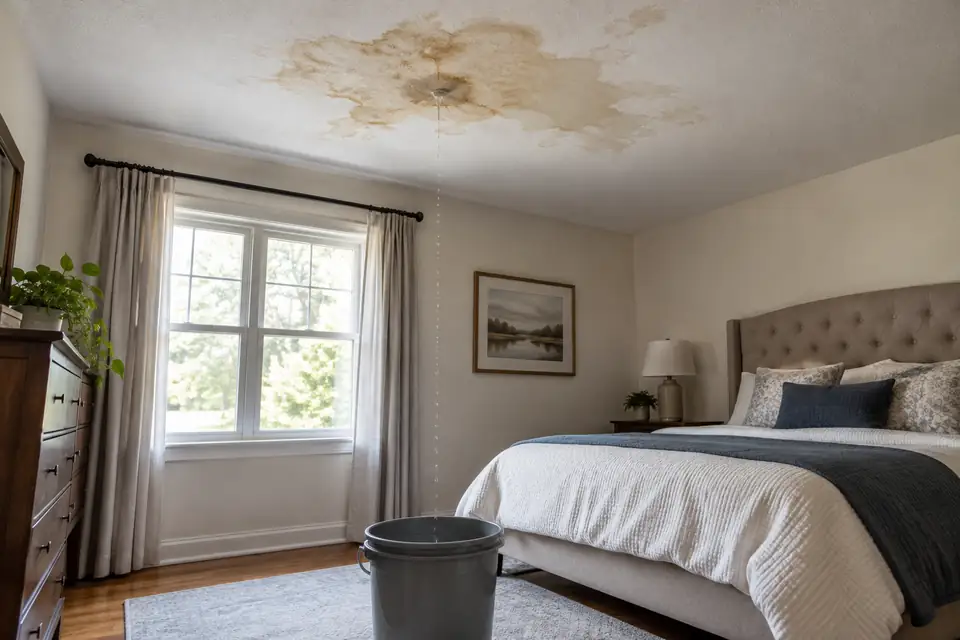
Most roof leak repairs cost $350 to $1,500, about $800 on average, according to Fixr; HomeAdvisor puts a leaking roof at $360 to $1,550. The fix itself is often small, such as new flashing, a vent boot or a few shingles. The hard part is finding where the water gets in, because it rarely drips straight down from the hole. Start in the attic, protect the house from further damage, and have a roofer confirm the source before you pay for a repair.
Where roof leaks usually start
Water gets through a roof where something interrupts the shingles, or where the shingles themselves have failed. IKO, a shingle manufacturer, and InterNACHI, the home inspectors' association, name these common sources:
- Flashing around chimneys, in valleys and where the roof meets a wall. InterNACHI notes that metal flashing corrodes if it is left long enough, and that flashing installed wrongly can leak from the start.
- Roof penetrations such as plumbing vents, exhaust fans and skylights. InterNACHI calls these common leak sources.
- Missing or damaged shingles.
- Exposed or misdriven nails.
- Things mounted on the roof, such as solar panels or cameras, and earlier repairs that were not done well.
- Sealant that has dried and cracked. InterNACHI says sealant around a chimney eventually dries, shrinks and cracks, and should be checked every year.
- The edge where a roof ends against a wall. InterNACHI explains that without a kickout flashing there, runoff can get inside the wall and damage the sheathing, framing and insulation.
Why the stain is not under the hole
Water that gets through the roof deck follows the wood. It can run along a rafter or pool on the attic floor before it finds a way out. IKO says water usually escapes where it can, such as at a light fixture or soffit vent, and not necessarily below the spot where it came through the roof. A stain on the ceiling tells you roughly where to start looking, not where to repair.
Check the attic first
If you can get into the attic safely, it is the best place to trace a leak. IKO advises checking the type of insulation first, wearing protective gear and making sure that whatever you step on will hold your weight.
- Take a good flashlight and note where the ceiling stain is below you.
- Look at the underside of the roof deck above the stain and uphill of it. InterNACHI says water stains on the underside of the decking record past and present leaks, even before a ceiling shows anything.
- Follow the trail uphill. Look for dark wood, wet or matted insulation and discolored rafters, and trace them to the highest wet point.
- Check around every penetration: vent pipes, fans, the chimney and skylight wells.
- Look for rusty nails coming through the deck. InterNACHI says they point to moisture that has been a problem for a while.
- Turn off the flashlight and look for daylight. IKO notes that where light gets in, water can too.
- Measure from a fixed point, such as the gable wall or a vent pipe, so a roofer can find the same spot from outside.
Not every wet attic has a roof leak. The Department of Energy's Building America guidance lists condensation as another source: humid indoor air leaking into the attic, or a bath fan or dryer vented into it instead of outdoors. If you find wet spots with no rain to explain them, tell the roofer.
If your house has no attic or a vaulted ceiling, IKO advises calling a roofer to inspect from outside. Do not climb onto the roof yourself: NRCA, the roofing contractors' association, advises homeowners to inspect a damaged roof only from the ground.
Leaks that only happen in winter
A leak that appears when there is snow on the roof, and stops when it melts, may be an ice dam. The Department of Energy explains how it forms: warm air leaking into the attic heats the roof, snow melts and runs down to the colder eaves, and it freezes there. The ice then holds back water, which backs up under the shingles and leaks into the house. The same guidance notes that large icicles and ice dams can point to air leaks into the attic even when nothing drips. Because the guidance ties ice dams to air leaks and poor insulation in the attic, ask a roofer or an energy auditor to look at those as well as the shingles.
Leaks around a vent pipe
Plumbing vent pipes are a common place for a roof to leak. Each pipe comes through the roof inside a flashing with a rubber collar, usually called a pipe boot or vent boot, that grips the pipe. Fixr explains that when the boot cracks or wears out, the seal breaks and water runs down the pipe into the house.
Why boots fail. This Old House lists sun, swings in temperature, storm debris and poor installation, including a sharp pipe edge that damages the seal from the start. The rubber usually gives out long before the shingles: a home inspection company that writes about the problem says the boots it sees last about 10 to 15 years.
The signs. This Old House names damp attic insulation, dripping during rain, a musty smell, visible cracks in the boot and stains near the pipe. The home inspection company notes that the water shows up as ceiling damage below the pipe, often in a bathroom. In the attic, look at the wood and insulation around the pipe where it comes through the deck.
The fix and the cost.
| Job | Price | Source |
|---|---|---|
| Repair or replace a vent boot | $75 to $250 | Fixr, roof repair |
| Roof vent repair | $75 to $250 | This Old House |
| Roof leak traced to a damaged vent boot | $100 to $600 | Fixr, roof leak repair |
The usual repair is a new boot or vent flashing. The home inspection company also describes slip-on rubber collars that fit over a split boot, sold for under $10. This Old House puts the parts for a do-it-yourself boot replacement at $10 to $20, but the work is on the roof, and NRCA advises homeowners to leave that to a professional. If several pipes have boots the same age, ask the roofer to check them all on the same visit. Our guide to roof flashing covers the other flashing on a roof.
Water coming through the ceiling
A drip or a spreading stain on the ceiling tells you water is getting in, but not always from the roof.
Work out when it happens. A leak that shows up during or just after rain points to the roof. One that appears with no rain may be something else. InterNACHI notes that water pipes and plumbing fixtures can release large amounts of water, and that most plumbing is hidden, so problems can start unnoticed. If there is a bathroom or other plumbing above the stain, have that checked too. The Department of Energy guidance above adds condensation in the attic as a third cause.
Look above and uphill of the stain. If the roof is the cause, the entry point is usually above the stain or uphill of it, where water has run along the wood. InterNACHI names chimneys, plumbing vents and skylight wells as common places where water gets through a roof, so start with any of those near the wet spot. A stain on a bathroom ceiling close to a vent pipe is a hint to check the pipe boot first.
Don't ignore a bulge. A ceiling that sags or bulges is holding water. IKO warns against poking a hole in it yourself, because you cannot tell how much water is above or whether the ceiling will come down. Keep people out from under it and get professional help.
What the inside repair costs. HomeAdvisor puts ceiling water damage repair at $450 to $1,600 and drywall repair at $300 to $850, with a typical water damage restoration job at $1,383 to $6,369, about $3,868 on average. HomeAdvisor also says to fix a leaking roof quickly, because the damage spreads.
What to do right away
- Keep water off the electrics. If water is coming through a light fixture or near wiring, the CDC advises turning off power at the main breaker or fuse, never while standing in water, and not turning it back on until a qualified electrician has inspected it.
- Catch the water with buckets and move furniture, rugs and electronics out of the way.
- Do not poke a hole in a bulging ceiling without professional advice. IKO warns that you cannot tell how much water is above it or whether the ceiling will come down.
- Photograph everything before you clean up: the ceiling, the attic, damaged belongings and the outside of the roof from the ground.
- Protect the house with reasonable temporary steps, such as having a roofer tarp the damaged area, and keep every receipt. Triple-I says you may be able to submit them for reimbursement if the damage is covered.
- Dry what got wet. The EPA advises cleaning and drying damp building materials and furnishings within 24 to 48 hours to prevent mold, and fixing the source of the water.
What each fix costs
Once the source is found, the repair is priced by what failed. Fixr gives these ranges for roof leaks by source:
| Leak source | Typical cost |
|---|---|
| Clogged gutters | $100 to $250 |
| Damaged vent boot | $100 to $600 |
| Missing or damaged shingles | $150 to $450 |
| Nail pops | $200 to $500 |
| Damaged flashing | $200 to $600 |
| Skylight leak | $300 to $800 |
| Valley leak | $300 to $1,500 |
| Ice dam | $400 to $1,500 |
| Chimney leak | $200 to $3,500 |
The national cost guides roughly agree on the whole job:
| Source | Roof leak repair |
|---|---|
| Fixr, updated January 27, 2026 | $350 to $1,500; $800 average; $100 to $8,000 or more from the smallest to the largest |
| HomeAdvisor, updated June 19, 2026 | $360 to $1,550 |
| This Old House, updated March 5, 2026 | $100 to $1,500 for holes and leaks |
Fixr says labor is about 60% of the cost of a leak repair, which is why a small part can still produce a bill of several hundred dollars. Ask whether an estimate covers only the roof or also damage inside, such as wet drywall or insulation. For repair prices beyond leaks, and what a roofer's minimum charge looks like, see our guide to roof repair cost.
Will insurance pay for the leak?
It depends on why the roof leaked. Triple-I says homeowners policies typically cover roof damage from a covered peril, such as wind, hail or a falling tree. It treats water seepage as a maintenance issue, not a claim. So a leak that starts when a storm tears off shingles may be covered, while a leak from worn-out flashing or old shingles is usually yours to pay for. Triple-I also notes that even a small leak can lead to widespread water damage, mold and mildew, which is one more reason to act quickly.
If a storm caused the leak, call your insurer before you sign with a roofer, and keep your photos and receipts. Our guide to a roof insurance claim covers deductibles, the adjuster's visit and contractors to avoid after a storm.
When a leak means a new roof
One leak from one failed part is a repair. Leaks that come back after a repair, leaks in several places at once, or a soft deck around the leak point toward a bigger problem. Fixr compares its average leak repair with an average replacement of about $10,000. Our guides on whether to repair or replace your roof and the signs you need a new roof help you decide.
Frequently asked questions
Can I fix a roof leak myself?
Finding it from the attic is something many homeowners can do safely. Working on the roof is different: NRCA advises homeowners to inspect a damaged roof only from the ground and to hire a professional roofing contractor to inspect it.
Why does my ceiling leak far from where the roof is damaged?
Water follows rafters and pools on the attic floor until it finds a way out, often at a light fixture or vent. IKO says it rarely comes out directly below where it came through the roof.
How much does it cost to find a roof leak?
The national cost guides do not price leak detection on its own; it is usually part of the repair. Fixr puts an average roof inspection at $430. Ask whether the repair price includes finding the leak and a return visit if it continues.
Is a roof leak an emergency?
Treat it as urgent. Turn off power to any wet electrics, catch the water and protect your belongings, then get the roof covered. The EPA advises drying wet materials within 24 to 48 hours to prevent mold. Fixr puts the extra charge for emergency roofing service at $100 to $300.
How we got these numbers
HomeAnvil does not yet publish price data of its own. Every figure and fact on this page comes from a published source, read on September 26, 2026:
- Fixr, roof leak repair cost, updated January 27, 2026: the typical, average and full range of leak repair costs, the prices by leak source, the labor share, the average inspection and the average replacement.
- Fixr, roof repair cost, updated January 21, 2026: the extra charge for emergency service and the cost to repair or replace a vent boot.
- HomeAdvisor, roof repair cost, updated June 19, 2026: the cost of repairing a leaking roof. HomeAdvisor says its figures come from a survey of its customers and other published research.
- This Old House, cost of roof repair, updated March 5, 2026: the cost of repairing holes and leaks.
- This Old House, how to fix a leaking rooftop vent pipe, updated May 27, 2026, read on September 26, 2026: why vent boots fail, the signs, and the cost of parts for a replacement.
- Structure Tech Home Inspections, a common cause of roof leaks: failed plumbing vent flashings, by Reuben Saltzman, July 11, 2023, read on September 26, 2026: how long rubber vent boots last in the inspector's experience, where the leak shows inside, and slip-on repair collars.
- HomeAdvisor, water damage restoration cost, updated June 17, 2026, read on September 26, 2026: the cost of water damage restoration, ceiling water damage and drywall repair, and its advice to fix a leaking roof quickly.
- InterNACHI, moisture intrusion, by Nick Gromicko and Kenton Shepard, read on September 26, 2026: plumbing leaks as a source of water. The page carries no date.
- IKO, how to find a roof leak, July 20, 2023: common leak sources, how to search the attic safely, how water travels and the warning about bulging ceilings.
- InterNACHI, what your attic reveals about your roof: stains on the decking, rusty nails and penetrations as leak sources. The page carries no date.
- InterNACHI, roof penetrations, part 1: corroded flashing and sealant around chimneys. The page carries no date.
- InterNACHI, inspecting step and kickout flashing: what happens where a roof edge meets a wall without a kickout flashing.
- U.S. Department of Energy, Building America, measure guideline: air sealing attics, June 2012: how ice dams form and cause leaks, and condensation from air leaks and misvented fans.
- NRCA, urging caution when repairing roof systems, July 27, 2022: inspecting only from the ground and hiring a professional.
- CDC, protecting yourself from electrical hazards, last reviewed August 26, 2026: turning off power when wiring is wet.
- EPA, ten things you should know about mold, September 8, 2026: drying within 24 to 48 hours and fixing the source of the water.
- Triple-I (Insurance Information Institute), how to file a homeowners claim, how your roof influences your home insurance and am I covered?: temporary repairs and receipts, covered perils, water seepage and the damage a small leak can cause.
We will update this page when these sources publish new figures, and the date above will say when.
Related guides
 How much does a roof repair cost?Most roof repairs cost $395 to $1,967, about $1,173 on average. Prices by problem: shingles, flashing, leaks, decking, vents, fascia and sagging.
 Should you repair or replace your roof?Most roof repairs cost $395 to $1,967; a replacement typically costs $5,900 to $13,400. How age, damage, layers and repair history decide which one you need.
 How does a roof insurance claim work after a storm?Insurance usually pays for sudden wind or hail damage, not wear. Wind/hail deductibles often run 1% to 5% of your home's insured value. How a claim works.
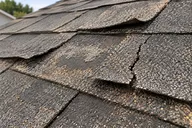 What are the signs you need a new roof?The signs a roof needs replacing, outside and in: age past 20 to 30 years for shingles, bald or curling shingles, repeat leaks, a sagging line. What each means.
 How much does a roof replacement cost?A roof replacement typically costs $5,900 to $13,400, or $400 to $1,100 per square installed. How to measure your roof, what moves the price and how to compare estimates.
 How long does a roof last?Architectural shingles last about 30 years, 3-tab about 20, metal 40 to 80, slate 60 to 150. What shortens a roof's life, and why a warranty isn't a lifespan.