
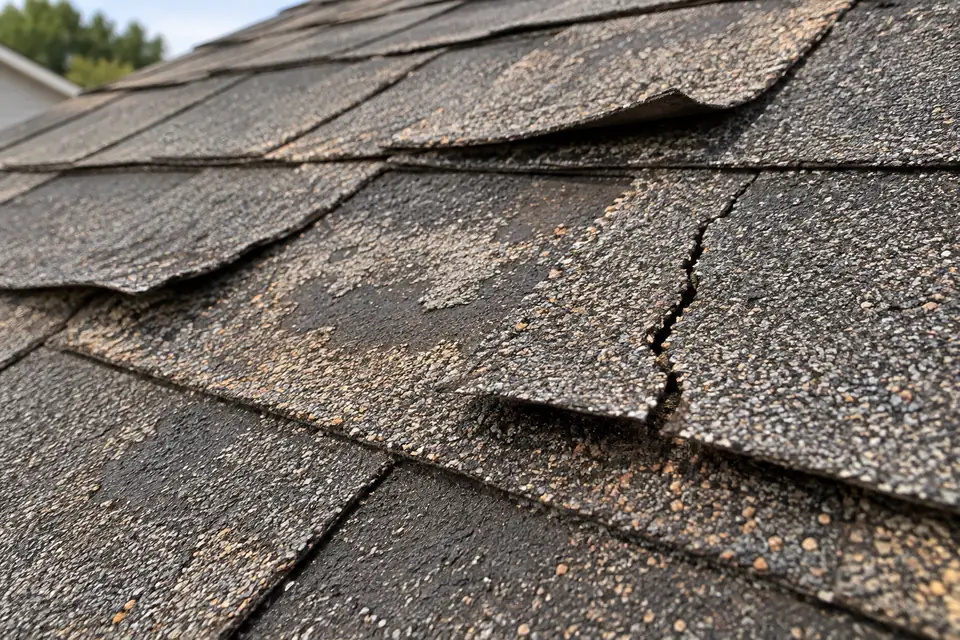
A roof usually needs replacing when the signs of wear show up across the whole roof rather than in one spot: shingles that are bald, brittle or curling on every slope, leaks that return after repairs, a roofline that sags, and an age near the end of the roof's expected life, which InterNACHI puts at 20 years for 3-tab asphalt shingles and 30 for architectural shingles. One missing shingle or one stain on a ceiling is usually a repair. The signs below tell you which you are looking at.
Start with the age of the roof
Age does not prove a roof has failed, but it tells you how seriously to take everything else you find. InterNACHI, the home inspectors' association, gives these typical life expectancies:
| Roof covering | Typical life expectancy |
|---|---|
| Asphalt shingles, 3-tab | 20 years |
| Asphalt shingles, architectural | 30 years |
| Wood | 25 years |
| Metal | 40 to 80 years |
| Slate | 60 to 150 years |
| Clay or concrete tile | 100 years or more |
These are guidelines for a roof with normal wear and upkeep. InterNACHI notes that weather, design, material quality and maintenance all change them, and that hot climates cut the life of asphalt shingles sharply. If you don't know how old your roof is, the permit record for the last reroof, the home inspection from your purchase or the previous owner may tell you.
The signs at a glance
| Sign | Where to look | What it usually means | What to do next |
|---|---|---|---|
| Bald patches on shingles | From the ground, with binoculars | Worn-out shingles if it is widespread | Have the roof inspected; plan a replacement if it covers large areas |
| Curling, cupping or clawing shingles | Shingle edges and corners | Advanced aging of the shingles | Have the roof inspected and a replacement priced |
| Missing or cracked shingles | After wind, on every slope | Storm damage, or brittle shingles | Repair if it is a few; inspect if it keeps happening |
| Sagging roofline | From the street, along the ridge | A structural problem under the roof | Call a professional soon |
| Moss | Shaded slopes | Moisture held against the shingles | Remove it; ask whether the shingles underneath are damaged |
| Dents or bruises after hail | Shingles, vents, gutters | Impact damage | Photograph it and call your insurer |
| Water stains on ceilings | Upper-floor ceilings, top of walls | Water getting in from the roof, plumbing or condensation | Find the source before you repaint |
| Damp insulation or dark wood | The attic, after rain | A slow leak | Have the roof and ventilation checked |
| Leaks that come back | Anywhere inside | A roof failing in more than one place | Price a replacement alongside the repair |
Outside: what the shingles tell you
Bald patches and granules. The granules on an asphalt shingle shield it from the sun. As they wear away, the asphalt underneath is exposed and the shingle turns brittle. IKO, a shingle manufacturer, advises planning a replacement when large bare patches appear across many shingles. Some granules in the gutters are normal, especially on a new roof: InterNACHI explains that loose granules come off during shipping and installation and wash off in the first storms. Worry when the loss is heavy on an older roof or leaves dark, bare spots you can see from the ground.
Curling, cupping and clawing. These are the shapes an aging shingle takes as its edges dry out and soak up water at a different rate from the middle: corners that lift, centers that dip, edges that bend down. InterNACHI describes them as part of the normal aging of shingles, and a shingle that has distorted will not flatten again. When most of a slope looks this way, the shingles are near the end of their life. InterNACHI notes that slopes facing south and west, which get the most sun, usually age first.
Missing or cracked shingles. A few shingles lost in a windstorm are a repair. Shingles that crack when a roofer lifts them, or that keep blowing off in ordinary wind, point to a covering that has gone brittle with age.
Moss. Moss holds water against the roof and can damage shingles and open a path for leaks, according to IKO. Have it removed, and ask the roofer whether the shingles underneath are still sound.
Outside: the roofline, flashing and gutters
A sagging roofline. Stand across the street and look along the ridge and the eaves. A line that dips, or a roof that looks wavy, can mean the deck or the framing under the shingles has weakened. IKO lists sagging, along with cracks in walls and uneven floors, as a sign of structural trouble that has to be understood before any new roof goes on. This one needs a professional soon, whatever the age of the roof.
Flashing. Flashing is the metal that seals the joints around chimneys, vents, skylights and walls. Loose, rusted or missing flashing is a common cause of leaks, and it is usually a repair on its own. It becomes part of a replacement decision only when the shingles around it are worn out too.
Hail. Hail leaves dents in gutters and vents and dark bruises or cracks in shingles where the granules have been knocked off. IKO notes that how much damage a storm does depends on the size of the stones, the temperature and the angle they hit at. Hail damage can be bad enough to justify a new roof, so photograph it and call your insurer before you sign with a contractor.
Inside: the attic
The attic shows a leak long before a ceiling does. Go up on a dry day after a rain, with a flashlight, and look for:
- Dark or stained wood on the underside of the roof deck or on rafters.
- Damp or matted insulation.
- A musty smell.
- Nails with dark rings around them, where water has run down the nail.
- Heavy condensation on the underside of the deck.
IKO lists each of these as an early sign of a leak that homeowners often miss. Condensation and dampness can also come from poor attic ventilation rather than the roof covering, so ask the roofer to check both. Water can run a long way along a rafter before it drips, so a stain in one place does not mean the hole is directly above it.
Inside: ceilings and walls
Water stains. A white, yellow, orange or brown ring on a ceiling means water has got in. IKO points out that the cause may be the roof, a plumbing line or condensation, so find the source before you paint over it.
Peeling or bubbling paint. Paint that blisters or peels near the top of a wall, or in the corners of a ceiling, is often moisture from above.
Mold. Mold on ceilings or the tops of walls can come from a roof leak, condensation or plumbing. Check that the insulation is dry and the attic is ventilated, and have the roof inspected.
Leaks that come back. One leak is usually one failure. A leak that returns after a repair, or new leaks in different rooms, is a sign that the roof is failing in more than one place.
What to do when you see these signs
- Note what you found and where. Take photos from the ground, in the attic and inside, with dates.
- Stop the damage. Put a bucket under a drip and move belongings. Don't climb onto a wet or steep roof yourself.
- Call your insurer first if a storm caused it. Homeowners policies generally cover sudden damage such as wind and hail, not the wear of age. InterNACHI notes that insurers treat even, long-term granule loss as normal aging rather than damage.
- Get the whole roof inspected. HomeGuide puts a roof inspection at $100 to $400 on average, and suggests one each year and after severe weather. Ask for photos of everything the inspector finds.
- Ask for a repair price and a replacement price. Our guide to whether to repair or replace your roof walks through the decision, and our guide to roof replacement cost explains how to compare estimates.
- Check the contractor. Our guide to what to check before you hire a home improvement contractor covers licenses, insurance and references.
Why it pays to act early
The roof is the part of a house that storms damage most. The Insurance Institute for Business and Home Safety, a research group funded by insurers, says roof damage makes up 70 to 90 percent of insured residential losses from catastrophes in most years, and it recommends fixing and replacing roofs on a sunny day rather than after a storm. A worn roof is more likely to let water in when bad weather comes, and water that gets into the deck, insulation and ceilings turns a roof job into a larger repair.
Frequently asked questions
Are granules in the gutters a sign I need a new roof?
Not on their own. A new roof sheds loose granules for a while, and every roof loses some as it ages. It becomes a warning sign when the loss is heavy, the roof is old, and you can see bare, dark patches on the shingles.
Does one leak mean I need a new roof?
Usually not. One leak often comes from one flashing, vent or damaged shingle, and a repair fixes it. Replacement comes into question when the roof is near the end of its life or the leaks return.
My roof is 20 years old but looks fine. Should I replace it?
Not because of age alone. Have it inspected, especially if it is 3-tab asphalt, which InterNACHI expects to last about 20 years. If the inspection finds the shingles still flat and holding their granules, keep it and check it again after the next severe storm.
Can I check my roof without going up on it?
Yes. Binoculars from the ground show bald patches, curling, missing shingles and a sagging line, and the attic shows leaks from underneath. Leave walking on the roof to a professional.
How often should a roof be inspected?
HomeGuide suggests an inspection once a year and after any severe storm. You can do your own check from the ground and the attic more often, and call a professional when something on this page turns up.
How we got these numbers
HomeAnvil does not yet publish price data of its own. Every figure on this page comes from a published source, read on September 26, 2026:
- InterNACHI, standard estimated life expectancy chart for homes: the life expectancy of each roof covering and its notes on what changes them. The page carries no date.
- InterNACHI, Mastering Roof Inspections: curling, cupping and clawing and granule loss, written for home inspectors: what distorted shingles mean, which slopes age first, the granules a new roof sheds, and how insurers treat even, long-term granule loss.
- IKO, how to know if you need a new roof, May 13, 2026: the signs of leaks, stains, paint damage, mold, moss, granule loss, structural trouble and hail, and the early attic signs.
- HomeGuide, roof repair cost, February 9, 2026: the cost of a roof inspection and its advice on how often to have one.
- Insurance Institute for Business and Home Safety, lead with the roof: the share of insured residential catastrophe losses that come from roof damage.
We will update this page when these sources publish new figures, and the date above will say when.
Related guides
 How much does a roof replacement cost?A roof replacement typically costs $5,900 to $13,400, or $400 to $1,100 per square installed. How to measure your roof, what moves the price and how to compare estimates.
 Should you repair or replace your roof?Most roof repairs cost $395 to $1,967; a replacement typically costs $5,900 to $13,400. How age, damage, layers and repair history decide which one you need.
 How does a roof insurance claim work after a storm?Insurance usually pays for sudden wind or hail damage, not wear. Wind/hail deductibles often run 1% to 5% of your home's insured value. How a claim works.
 Are architectural shingles worth it over 3-tab shingles?Architectural shingles start near $3.50 a square foot against $1.50 for 3-tab, last about 30 years instead of 20, and carry longer warranties.
 What to check before you hire a contractorFive things to ask for before you sign with a roofing, siding, window, bath or HVAC contractor, wherever you live in the United States.