
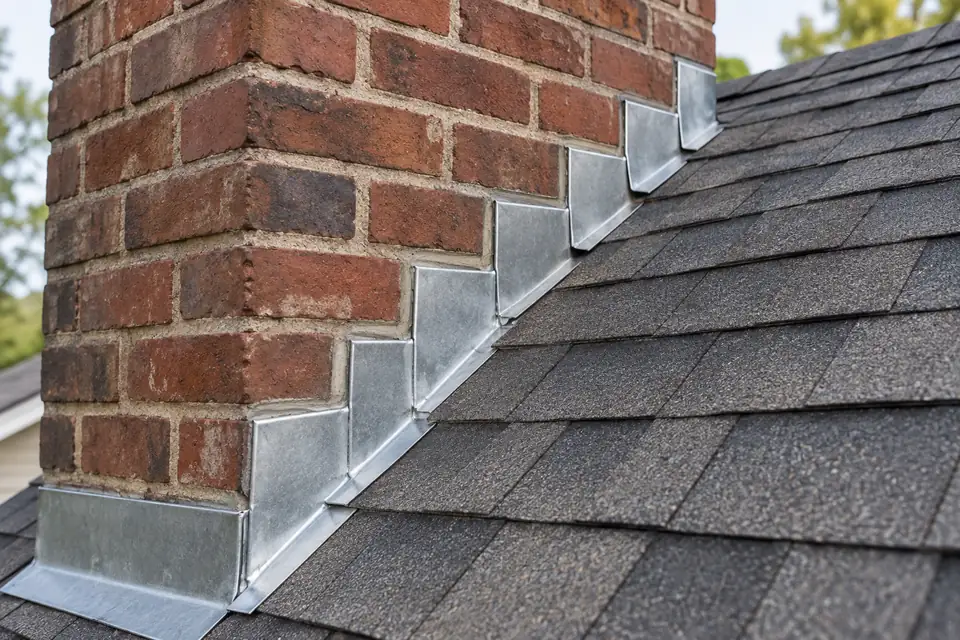
Replacing the flashing on a roof costs $150 to $1,000, according to HomeAdvisor, and reflashing a skylight $300 to $500. For chimneys, Fixr puts a flashing repair at $200 to $300 and a full replacement at $300 to $800. Flashing is the metal that seals the joint where the roof meets a chimney, skylight or wall, and it can fail while the shingles around it are still sound.
What flashing is, and why it matters
The joints in a roof are where water can get in: wherever something passes through the roof or the roof runs into a wall. InterNACHI describes flashing as sheet metal shaped to stop water getting into the roof at those joints. Galvanized steel is the most common material, and InterNACHI notes that copper flashing can last about 70 years.
Because the flashing can fail while the shingles beside it are fine, a leak next to a chimney or skylight is often a flashing repair rather than a sign that the whole roof needs replacing. Our guide to repairing or replacing a roof covers that bigger decision.
The parts of chimney and skylight flashing
| Part | Where it goes | What it does |
|---|---|---|
| Step flashing | Along each side of a chimney or skylight, one piece per course of shingles | Each bent piece is woven in with a course of shingles and overlaps the piece below it |
| Counterflashing (cap flashing) | Set into the chimney's brickwork, lapping down over the step flashing | Covers the top edge of the step flashing, so water running down the chimney cannot get behind it |
| Apron flashing | Across the lower, downhill face of the chimney or skylight | One wide piece that lies over the shingles below and turns up the face |
| Cricket or saddle | Behind the chimney or skylight, on the uphill side | A small peaked roof that splits the water and sends it around the sides instead of letting it pool |
ASHI, the American Society of Home Inspectors, explains why chimney flashing comes in two layers. The base flashings, meaning the steps and the apron, are fastened to the roof. The counterflashing is fastened to the masonry. The chimney and the roof move separately, and the overlap between the two layers lets them move without opening a gap. ASHI describes counterflashing bent into a mortar joint by 1 to 1½ inches and sealed with mortar, with each side piece overlapping the next by at least 3 inches.
InterNACHI gives a minimum size for step flashing at a wall: at least 4 inches up the wall and 4 inches out onto the roof deck. Shingle makers publish their own sizes in their installation instructions, and our guide to the roof replacement process covers one of them.
Skylights use the same parts, made to fit. VELUX, a skylight maker, says its flashing kit for deck-mounted skylights on shingle roofs includes step flashing that is woven in with the shingles, a head or saddle flashing at the top, a sill flashing at the bottom, and a roll of adhesive underlayment. VELUX says its flashing is designed to shed water without relying on sealants that break down over time.
When a chimney needs a cricket
A wide chimney blocks water running down the slope, and InterNACHI describes the cricket as a way to stop it pooling on the uphill side. InterNACHI and ASHI both put the line at 30 inches: a chimney wider than that should have a cricket on its uphill side, and ASHI notes that many authorities require one at that width. InterNACHI notes that a cricket creates two small valleys of its own, which need flashing, and that debris caught in them holds moisture against the metal and speeds up rust.
This Old House lists chimney cricket work at $700 to $1,300 among its chimney repair costs. If your chimney is wide and has no cricket, a roof replacement is the natural time to add one; ask each roofer to price it as a separate line.
Signs your flashing is failing
- Rust or corrosion on the metal. InterNACHI treats corroded flashing as a replacement item, sooner or later depending on how far it has gone.
- Caulk or roofing cement doing the work. ASHI calls a caulked joint at the top of the counterflashing, or one sealed with asphalt cement, a temporary fix that needs ongoing maintenance. InterNACHI says counterflashing held on with sealant alone is a reason to look for water damage nearby.
- Counterflashing pulled out of the mortar, or missing altogether. InterNACHI notes that step and counterflashing are sometimes simply left out.
- Stains or rot around the opening. InterNACHI tells inspectors to look for stains or decay in the roof sheathing around a chimney, and to check suspect areas with a moisture meter.
- Streaks down the chimney or wall below a roof edge, which InterNACHI links to missing kickout flashing where a roof ends against a wall.
- Leaves and debris packed behind the chimney, which hold water against the flashing.
- Water or condensation around a skylight. VELUX lists leaks and condensation around the panes among the signs that a skylight needs replacing.
What flashing repairs cost
| Job | Price | Source |
|---|---|---|
| Replace flashing, any location | $150 to $1,000 | HomeAdvisor |
| Stop a roof leak, depending on the source | $150 to $2,000 | HomeAdvisor |
| Chimney flashing repair | $200 to $300 | Fixr; This Old House |
| Chimney flashing replacement | $300 to $800 | Fixr; This Old House |
| Chimney cricket work | $700 to $1,300 | This Old House |
| Skylight flashing, install or replace | $300 to $500 | HomeAdvisor; Fixr |
| Skylight flashing repair | $50 to $150 | Fixr |
| Skylight leak repair | $50 to $700 | HomeAdvisor ($50 to $600 in Fixr) |
| Skylight repair, all kinds | $454 to $1,514, average $961 | HomeAdvisor |
| Skylight repair, all kinds | $350 to $800, average $500 | Fixr |
| Full skylight replacement, removal included | $800 to $2,200 | Fixr |
The chimney figures from This Old House say they are based on Fixr and HomeAdvisor pricing, so they are not an independent check. A repair, such as resealing or refastening a piece, is at the low end; replacing every piece of flashing around a chimney means lifting the shingles around it and cutting fresh grooves in the mortar, and costs more.
Repair or replace the flashing
A small, recent failure, such as one loose piece of counterflashing or a sealant joint that has cracked, can be a repair. Replacement makes more sense when the metal is rusted through, when the flashing was put in wrong (no step flashing, no counterflashing, or everything held on with cement), or when the same spot has been patched before and leaks again.
Flashing and shingles are woven together, so replacing step flashing means lifting and relaying the shingles beside it. That makes a roof replacement the natural time to renew the flashing too. If your roof is close to the end of its life, ask for the flashing repair and a full roof replacement to be priced separately; see signs you need a new roof.
Flashing elsewhere on the roof
Chimneys and skylights are not the only joints. The same job, keeping water out where the shingles stop, is done by other flashing around the roof, and each kind fails in its own way.
| Flashing | Where it is | What goes wrong |
|---|---|---|
| Step and wall flashing | Where a sloped roof runs along a wall (a sidewall), or where the top of a roof meets a wall (a headwall) | Pieces missing or held on with sealant, no counterflashing over the top on brick or stone, or no kickout at the bottom |
| Vent pipe flashing (pipe boot) | Around each plumbing vent pipe | The rubber collar dries out and splits, letting water run down the pipe |
| Valley flashing | Along the inside crease where two slopes meet | Damaged metal, or debris that holds water in the valley |
| Drip edge | Along the eaves and the sloped gable edges (rakes) | Missing or bent, letting water wick back under the shingles and into the wood at the edge |
Wall flashing. InterNACHI explains that step flashing is short pieces, each lapping the shingle in the course below, and that it is the method for asphalt shingles, wood and slate. Owens Corning's installation instructions ask for corrosion-resistant step flashing at least 4 by 4 by 8 inches, and 2 inches wider than the shingle's exposure, wherever the roof meets a sidewall or chimney. At a headwall, InterNACHI says the flashing is usually one bent piece, commonly with 4-inch and 5-inch flanges. On brick or stone, a counterflashing should lap over the top of the wall flashing, set into the mortar joints or a groove cut in the masonry. InterNACHI says many installers skip it and use sealant alone, which eventually fails. Where a wall runs past the bottom edge of a roof, a kickout flashing turns the water into the gutter; InterNACHI names water getting into the wall as the sign it is missing. It also calls for a gap of at least 1½ inches between the wall covering and the roofing, so the siding does not wick up water.
Vent pipe flashing. A plumbing vent pipe comes through the roof inside a flashing with a flat base and a rubber collar, often called a pipe boot. Fixr explains that when the boot cracks or wears out, the seal breaks and water gets in. This Old House lists UV exposure, temperature swings, storm debris and poor installation as causes, and names cracks in the boot, damp attic insulation and ceiling stains near the pipe as signs. A home inspection company that writes about the problem says the rubber boots it sees last about 10 to 15 years, well short of a shingle roof. Our guide to finding and fixing a roof leak explains how to trace one from the attic.
Valley flashing. InterNACHI describes two kinds of valley. In an open valley, metal lines the crease and the shingles stop 2 to 6 inches either side of the center, so you can see the metal. In a closed valley the shingles run across or are cut along the crease, over a lining underneath; Owens Corning's instructions call for a 36-inch-wide valley liner for its closed-cut valley. Fixr says valleys leak from damaged flashing or from debris that holds moisture against the roof, so keeping them clear matters.
Drip edge. Drip edge is the bent metal at the roof's edges. InterNACHI's inspection gallery describes it at the eaves and rakes of shingle roofs, reaching at least ¼ inch below the roof sheathing and at least 2 inches back onto the deck, fastened at intervals of no more than 12 inches. At the eaves the underlayment goes over the drip edge; at the rakes it goes under, as Owens Corning's instructions and IKO, another shingle maker, both describe. IKO says that without it water can get under the shingles and rot the deck and fascia, and Fixr says the same about the fascia. Fixr cites the International Residential Code as requiring drip edge at the eaves and rakes of shingle roofs, while one of InterNACHI's inspection articles says the model code does not require it. Codes are adopted locally and by edition, so ask your roofer what applies to your house.
What other flashing repairs cost
| Job | Price | Source |
|---|---|---|
| Replace flashing, any location | $150 to $1,000 | HomeAdvisor |
| Flashing repair | $200 to $600 | Fixr |
| Chimney or roof flashing | $200 to $500 | This Old House |
| Vent pipe boot, repair or replace | $75 to $250 | Fixr; This Old House (for roof vents) |
| Leak at a vent boot | $100 to $600 | Fixr |
| Valley repair | $300 to $1,000 | This Old House |
| Valley leak | $300 to $1,500 | Fixr |
None of the cost pages we read gives a price for drip edge on its own; it is usually part of a new roof or an edge repair. A pipe boot is often one of the cheapest roof repairs, but a roofer's minimum charge still applies; see our guide to roof repair cost.
Should you replace a skylight when you replace the roof?
Often, if the skylight is old. HomeAdvisor suggests installing new skylights when you redo the roof because it reduces labor, and Fixr says replacing a skylight during roofing work can be cheaper, since a separate replacement later means cutting into the new roof. VELUX, which sells skylights, says a reroof is the best time to replace them and that doing both together lines up the skylight's warranty with the roof's.
How old is too old? The sources disagree widely:
| Source | Skylight lifespan |
|---|---|
| HomeAdvisor | 8 to 15 years |
| InterNACHI life expectancy chart | 10 to 20 years |
| VELUX, for its own skylights | 20 to 30 years |
| Fixr | 20 to 40 years |
A skylight that is newer, still clear, and dry around its frame can usually stay, with new flashing fitted to the new roof. One that is fogged between the panes, has leaked before, or is near the low end of these ranges is a good candidate to replace while the roof is open. If you keep your old skylight, ask whether the new flashing will come from its maker: VELUX says its flashing must be used to qualify for its installation warranty.
Frequently asked questions
Can a roofer just seal the flashing with caulk?
It can stop a leak for a while, but ASHI treats caulk or asphalt cement at the top of the counterflashing as a temporary fix that needs ongoing maintenance. Properly installed flashing sheds water by how the metal laps, not by sealant.
Who fixes chimney flashing, a roofer or a mason?
The step and apron flashing are part of the roof, and the counterflashing is set into the masonry, so the job touches both. Ask whoever you hire whether their estimate includes cutting and repointing the mortar joints, and if the brickwork itself is crumbling, get it looked at too.
Does a narrow chimney need a cricket?
InterNACHI and ASHI put the threshold at 30 inches wide. Below that, ASHI describes a back flashing that runs up the chimney by at least one-sixth of its width, and never less than 6 inches.
Is a leak at a skylight always the flashing?
No. The skylight itself can fail too: HomeAdvisor names a failing frame, mold between the panes and persistent leaks as reasons to replace a skylight rather than keep repairing it, and VELUX lists condensation around the panes as a sign of an aging unit. Ask the roofer to tell you which part has failed before pricing the fix.
Will insurance pay for failed flashing?
Insurance generally covers sudden damage, such as a storm, not wear and rust. See our guide to roof insurance claims.
How we got these numbers
HomeAnvil does not yet publish price data of its own. Every figure on this page comes from a published source, read on September 26, 2026:
- HomeAdvisor, roof repair cost, updated June 19, 2026: the cost to replace flashing and to stop a roof leak. HomeAdvisor says its figures come from a survey of its customers paired with other published research.
- HomeAdvisor, skylight repair cost, updated June 19, 2026: skylight repair, leak repair and flashing costs, its skylight lifespan and its advice on replacing skylights with a roof.
- Fixr, chimney repair cost, updated January 31, 2025: chimney flashing repair and replacement.
- Fixr, skylight repair cost, updated January 31, 2025: skylight repair, flashing, leak repair and replacement costs, its skylight lifespan and its advice on timing.
- This Old House, chimney repair cost, updated March 12, 2026: chimney flashing and cricket costs, which it says are based on Fixr and HomeAdvisor pricing.
- ASHI, chimney flashings, by Carson Dunlop, September 1, 2012: the two layers of chimney flashing, counterflashing in the mortar joint, the 30-inch cricket threshold, the back flashing on narrower chimneys, and caulked joints as a temporary fix.
- InterNACHI, roof penetrations, part 1 and part 2: counterflashing set in mortar, sealant-only counterflashing, signs of leakage, missing flashing, crickets and debris.
- InterNACHI, flashing, part 1: what flashing is, the common materials and corrosion.
- InterNACHI, step and kickout flashing at roof-wall intersections: step flashing dimensions and signs of missing kickout flashing.
- InterNACHI, standard estimated life expectancy chart for homes: skylight lifespan.
- InterNACHI, flashing, part 2 (headwall, sidewall and step flashing, and the gap above the roof), part 3 (counterflashing on brick and stone), part 4 (kickout flashing), part 5 (open and closed valleys) and part 6 (drip edge, and its statement that the model code does not require it), read on September 26, 2026.
- InterNACHI, drip edge flashing along rake and eave edges, inspection gallery, read on September 26, 2026: where drip edge goes, its dimensions and fastening.
- Owens Corning, Duration series shingles installation instructions, January 2026, read on September 26, 2026: step flashing size, the closed-cut valley liner, and underlayment over the drip edge at the eaves and under it at the rakes.
- IKO, guide to drip edges for shingle roofs, August 15, 2023, read on September 26, 2026: what drip edge does and how it laps the underlayment.
- Fixr, roof leak repair cost, updated January 27, 2026, and roof repair cost, updated January 21, 2026, both read on September 26, 2026: flashing, vent boot and valley costs, how vent boots fail and why valleys leak.
- Fixr, roof drip edge, February 29, 2024, read on September 26, 2026: drip edge and fascia rot, and the code requirement it cites.
- This Old House, cost of roof repair, updated March 5, 2026, and how to fix a leaking rooftop vent pipe, updated May 27, 2026, both read on September 26, 2026: flashing, roof vent and valley costs, and the causes and signs of vent pipe leaks.
- Structure Tech Home Inspections, a common cause of roof leaks: failed plumbing vent flashings, by Reuben Saltzman, July 11, 2023, read on September 26, 2026: how long rubber vent boots last in the inspector's experience.
- VELUX, flashing systems, mounting and flashing and skylight FAQs: the parts of a skylight flashing kit, sealant-free design, VELUX skylight lifespan, replacing skylights with a roof and the flashing warranty requirement.
We will update this page when these sources publish new figures, and the date above will say when.
Related guides
 Should you repair or replace your roof?Most roof repairs cost $395 to $1,967; a replacement typically costs $5,900 to $13,400. How age, damage, layers and repair history decide which one you need.
 What are the signs you need a new roof?The signs a roof needs replacing, outside and in: age past 20 to 30 years for shingles, bald or curling shingles, repeat leaks, a sagging line. What each means.
 What happens during a roof replacement, step by step?An asphalt shingle roof usually goes on in one to three days. What happens before, during and after, from tear-off and deck repair to flashing and cleanup.
 How much does a roof replacement cost?A roof replacement typically costs $5,900 to $13,400, or $400 to $1,100 per square installed. How to measure your roof, what moves the price and how to compare estimates.
 How much does a flat roof replacement cost?A flat roof replacement typically costs $3,331 to $11,558, or $4 to $35 a square foot. Membranes, lifespans, drainage, and why shingles can't go on it.
 How does a roof insurance claim work after a storm?Insurance usually pays for sudden wind or hail damage, not wear. Wind/hail deductibles often run 1% to 5% of your home's insured value. How a claim works.