
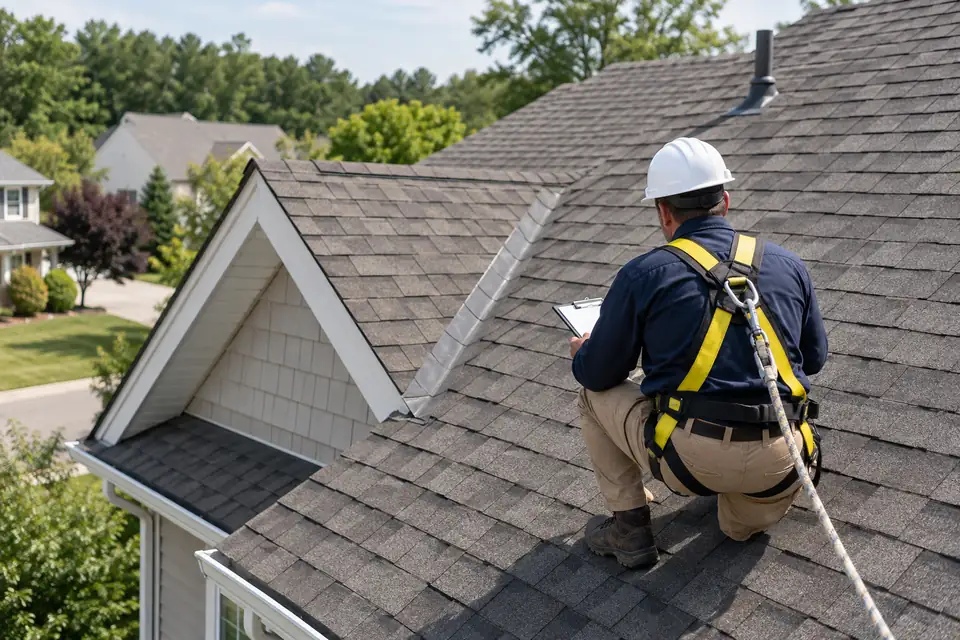
A homeowners policy generally pays to repair a roof that a storm damaged suddenly, such as shingles torn off by wind or bruised by hail. It does not pay for a roof that has simply worn out. You report the damage, an adjuster from your insurer inspects it, and the insurer pays for the covered damage less your deductible. Whether you are paid for a new roof or for an old roof's depreciated value depends on your policy. Every policy is different, so read yours, and treat this page as general information, not legal or insurance advice.
What a claim usually covers, and what it does not
Standard policies list the perils they cover. Triple-I, the insurance industry's information group, names wind, hail and falling trees among the usual causes of covered roof damage. What they leave out is gradual decline. One large insurer puts it plainly in its customer guide: shingles wearing down over time are not covered, and a roof that leaks because it was not maintained is the owner's repair to pay for.
| Usually a claim | Usually not a claim |
|---|---|
| Shingles blown off in a windstorm | Shingles curling or cracking with age |
| Hail that breaks or bruises shingles | Shingles worn thin by years of weather |
| A tree limb that falls through the roof | A slow leak nobody fixed |
| Hail or wind damage you can document | Damage from skipped maintenance |
Your policy's wording decides where the line falls. Some policies also limit what they pay on an older roof, so find the roof section of your policy before a storm, not after.
Your roof's age matters
Age affects both whether you can insure a roof and how a claim is paid. Triple-I says that when a roof is more than 20 years old, most insurers require it to pass an inspection before they will write a policy. Some decline older roofs outright, and others cover them only at actual cash value, which subtracts depreciation from the payment.
Age also changes how a roof stands up to the next storm. Research from IBHS, the Insurance Institute for Business & Home Safety, found that most asphalt shingles hold up well against hail for roughly five years, and that conventional shingles between five and ten years old lose much of that resilience, even in moderate storms.
Deductibles, including percentage deductibles
Your deductible is the part of each claim you pay yourself. Triple-I says most insurers offer a minimum deductible of $500 or $1,000, and that it applies each time you file a claim.
Many policies in hail-prone and wind-prone areas carry a separate wind/hail deductible, and it is often a percentage rather than a flat amount. Triple-I puts these percentage deductibles at typically 1% to 5% of your home's insured value. That is the dwelling coverage on your policy, not the size of the claim.
| Home insured for | 1% deductible | 2% deductible | 5% deductible |
|---|---|---|---|
| $200,000 | $2,000 | $4,000 | $10,000 |
| $300,000 | $3,000 | $6,000 | $15,000 |
| $500,000 | $5,000 | $10,000 | $25,000 |
The table is plain arithmetic on the 1% to 5% range. A 5% deductible on a home insured for $300,000 means you pay the first $15,000 of a storm claim yourself. Check your declarations page for the dollar or percentage figure that applies to wind and hail, and whether a separate hurricane deductible applies.
Actual cash value or replacement cost
Your policy pays a roof claim in one of two ways, and the difference can be large.
- Replacement cost pays to repair or replace the damaged roof with materials of like kind and quality, without subtracting depreciation.
- Actual cash value pays the depreciated value. Triple-I defines depreciation as the loss in value from age, wear and tear and other factors.
The NAIC, the association of state insurance regulators, gives a worked example. Two households each have $15,000 of roof damage and a $1,000 deductible. The one with replacement cost coverage receives $14,000. The one with actual cash value coverage has $10,000 taken off for depreciation and receives $4,000.
Even with replacement cost coverage, the money may arrive in two parts. Triple-I says the first check is often based on the depreciated value, and the insurer pays the difference once you have actually replaced the damaged property. It says you generally have several months from that first payment to do so; ask your agent for the exact deadline in your policy.
Document the damage before anything is moved
- Photograph and video the roof from the ground, the yard, the gutters and every room with a stain or drip. Include the date.
- Keep what fell. Triple-I advises against throwing damaged items away until the adjuster has seen them.
- Protect the house from further damage with reasonable temporary steps, such as a tarp over an opening, and keep the receipts. Triple-I says you may be reimbursed for them.
- Stay off the roof. The roofing contractors' association NRCA advises homeowners to inspect a storm-damaged roof only from the ground.
- Write down the date and time of the storm and when you reported the claim.
The adjuster's inspection
After you report damage, your insurer sends an adjuster, either its own employee or an independent one it hires, to inspect the roof and estimate the covered damage. The NAIC says it may help to have your contractor meet you and the adjuster at the inspection. Triple-I says the adjuster will also interview you.
If you and the adjuster cannot agree on the amount, Triple-I suggests starting with your agent or the insurer's claims manager. Triple-I says a policy allows for an independent appraisal of the loss, in which you and the insurer each hire an appraiser and the two appraisers choose a mediator. Check how your policy describes it. You may hire a public adjuster to handle the claim for you; Triple-I notes their fee can be as much as 15% of the settlement.
Discontinued shingles and matching
A common sticking point comes after the adjuster agrees there is damage. Replacing only the damaged shingles makes the roof keep out water again, but the new ones may not match: the old shingles have weathered, or the line or color on your roof is no longer made. Our guide to repairing or replacing a roof explains why new and old shingles rarely look the same. The claim question is who pays for the difference, and the answer depends on your policy and your state's rules.
What policies say. A 2016 report prepared for United Policyholders, a consumer group for insurance holders, by researchers at Rutgers Law School, reprints the wording that decides these disputes. The standard replacement cost form pays to repair or replace the damaged part of the building with material of like kind and quality. Some insurers go further and write matching out: one policy it reprints says the insurer will not pay to replace undamaged property because of a mismatch in texture, color, fading, weathering, or obsolescence or discontinuation of the material. Other endorsements it reprints exclude cosmetic wind or hail damage, such as marring or pitting, to roof surfacing that still keeps the weather out, or pay for wind and hail damage to the roof on a schedule that shrinks with the roof's age. A United Policyholders volunteer expert, answering a homeowner who could not match their shingles, put the usual position this way: most policies promise like kind and quality, and insurers try to match closely, but an exact match is not guaranteed.
The NAIC model rule. The NAIC's Unfair Property/Casualty Claims Settlement Practices Model Regulation, from 1997, sets out a matching standard for policies that pay replacement cost. When replaced items do not match in quality, color or size, it says the insurer should replace all items in the area so the result has a reasonably uniform appearance, inside or outside the house, with the policyholder paying nothing beyond the deductible. A model regulation is a template for state regulators, not law in itself. The United Policyholders report found that it has been the basis for statutes or regulations in a number of states, usually with small changes, and the volunteer expert noted that some states have no matching rule at all. Check your state's rules through its insurance department.
The same model regulation also says an insurer that denies a claim because of a specific policy provision should name that provision, and should give the denial in writing. It also says insurers should not fail to disclose the benefits and provisions of a policy that apply to a claim. Whether your state has adopted those standards is again a question for its insurance department.
What to ask the adjuster. None of this is insurance or legal advice, but these questions help you see where your claim stands:
- Does my policy pay replacement cost or actual cash value on the roof, and does it have a matching exclusion, a cosmetic damage exclusion or a roof payment schedule?
- If you are paying for only part of a slope or the roof, how will the new shingles be matched, and what happens if the shingle on my roof is discontinued?
- What does my state's rule say about matching, if it has one?
- If you decline to pay for matching, which policy provision is that based on, and will you put it in writing?
It helps to arrive with evidence. The volunteer expert suggests taking a sample shingle to a reputable contractor to look for a match; if you have leftover bundles from the original job, keep one for the adjuster and the roofer to see. Ask your roofer to put in writing whether a matching shingle is still made. If the answer does not satisfy you, another United Policyholders volunteer expert advises asking for the insurer's position and the basis for it in writing, taking it to a manager, and then contacting your state's department of insurance.
Storm chasers and other contractor red flags
After a storm, contractors you have never heard of arrive at the door. Some are honest. The FTC, the NAIC and the Better Business Bureau all warn about the ones who are not. Be wary when a contractor:
- Knocks on your door uninvited saying they noticed damage from the street.
- Pressures you to sign today for a discount or a place in line.
- Asks you to pay everything up front, or to pay by cash, wire transfer, gift card, payment app or cryptocurrency.
- Asks you to sign over your insurance check. The FTC says never to do this.
- Hands you a contract with blank spaces.
- Offers to waive or absorb your deductible. An insurer's consumer guide warns that a contractor who offers this may be hiding the amount elsewhere in the estimate, and that it may be insurance fraud. Your deductible is yours to pay.
- Asks you to sign an assignment of benefits. The NAIC explains that this lets a contractor act on your behalf with your insurer, file the claim and collect the payments without you. Read the fine print before you sign anything like it.
- Says they are FEMA certified. The NAIC says FEMA does not certify contractors.
The FTC advises paying by credit card or check, holding back the final payment until you are satisfied with the work, and getting a written contract with the contractor's name, address, phone and license number, start and finish dates, the payment schedule and every promise made. Check a contractor's license and insurance before you hire; our guide to what to check before you hire a home improvement contractor walks through it.
A typical claim, step by step
There is no standard number of days for any of this. Your policy and your insurer set the deadlines, so ask for them when you call.
- The storm passes. Check from the ground, photograph everything and make temporary repairs if water is getting in.
- Report the claim right away. The NAIC says the time you have to report varies, and Triple-I says most policies require a claim within one year of the loss. Ask your insurer for your deadline, your deductible and whether they want repair estimates.
- Get written estimates. Triple-I suggests line-by-line bids from licensed contractors. The NAIC says your adjuster may want to see estimates before repairs begin.
- The adjuster inspects and the insurer sends a settlement.
- The first payment arrives. If you have a mortgage, Triple-I says the check will generally be made out to both you and your lender, which must endorse it.
- The roof is replaced or repaired, and you send the insurer the invoice.
- The rest is paid. On a replacement cost policy, this is where withheld depreciation is released, within the time your policy allows.
Storm records and insurance rules differ from state to state. Our roof cost pages by state list each state's billion-dollar storm history, building code and contractor licensing rules.
Frequently asked questions
Will my insurance pay for a new roof because mine is old?
No. Insurance pays for sudden damage from a covered peril such as wind or hail. A roof that has worn out with age is a maintenance cost, not a claim.
How is a percentage deductible calculated?
It is a percentage of your home's insured value, not of the damage. At 2% on a home insured for $300,000, you pay the first $6,000 of a covered wind or hail claim.
Can a roofer pay my deductible for me?
Be wary of any roofer who offers to. The amount may be hidden elsewhere in the estimate sent to your insurer, which may be insurance fraud. You are responsible for paying your deductible.
Should I call the insurer or a roofer first?
Call your insurer first. The NAIC advises filing the claim before you hire a contractor. You can still ask a roofer to inspect and give you a written estimate, and to meet the adjuster.
What if I disagree with the adjuster?
Start with your agent or the insurer's claims manager, and bring your photos and written estimates. Your policy may allow an independent appraisal. Your state insurance department can explain the rules that apply to your policy.
Where this information comes from
HomeAnvil does not publish claim data of its own. Each fact on this page comes from the source named beside it, read on September 26, 2026 unless another date is given:
- Triple-I (Insurance Information Institute), Understanding your insurance deductibles: minimum deductibles, per-claim deductibles and 1% to 5% wind/hail deductibles.
- Triple-I, Background on: Hurricane and windstorm deductibles: how a percentage deductible is calculated, including the $300,000 home at 5%.
- Triple-I, How your roof influences your home and business insurance: covered perils and insuring roofs over 20 years old.
- Triple-I, How is the settlement amount determined?: replacement cost, actual cash value and depreciation.
- Triple-I, Understanding the insurance claims payment process: the first check, depreciation paid after replacement, the lender on the check and the one-year filing requirement in most policies.
- Triple-I, How to file a homeowners claim: documenting damage, temporary repairs and the adjuster's visit.
- Triple-I, Settling insurance claims after a disaster: disputes, appraisal, line-by-line bids and public adjuster fees.
- NAIC, Rebuilding after a storm: replacement cost and actual cash value for your roof, July 22, 2021: the $15,000 worked example.
- NAIC, What you need to know when filing a homeowners claim, April 20, 2022: reporting promptly and meeting the adjuster with your contractor.
- NAIC, Assignment of benefits: consumer beware, September 13, 2023: assignment of benefits and having the adjuster review estimates.
- NAIC, How can I avoid getting scammed by a contractor?, September 30, 2024: filing before hiring, door-to-door contractors and FEMA certification.
- FTC Consumer Advice, How to avoid scams after weather emergencies and natural disasters: contractor red flags, payment methods and what a contract should include.
- Better Business Bureau, Protect yourself from storm chasers: door-to-door contractors, up-front payment and insurance checks.
- Co-operative Insurance Companies, Contractor fraud after storm damage: offers to waive or absorb a deductible. This is an insurer's consumer guide.
- Progressive, Does homeowners insurance cover roof damage?, updated January 23, 2025: wear and tear and lack of maintenance. This is an insurer's consumer guide.
- NRCA, NRCA urges homeowners affected by severe weather to use caution, July 27, 2022: inspecting from the ground.
- IBHS, 2025 Year in Review: how shingle age affects hail performance.
- NAIC, Unfair Property/Casualty Claims Settlement Practices Model Regulation, MDL-902, July 1997, read on September 27, 2026: section 9A(2) on replaced items that do not match, section 7 on written denials naming the policy provision, and section 5 on disclosing pertinent policy benefits.
- United Policyholders, "Matching" in replacement cost homeowners insurance policies, prepared by Jay Feinman and others at Rutgers Law School, April 2016, read on September 27, 2026: the matching problem on roofs, like kind and quality wording, matching and cosmetic damage exclusions, the roof payment schedule and the spread of the NAIC model into state rules.
- United Policyholders, volunteer expert answer, unable to match roofing shingles, read on September 27, 2026: like kind and quality, no guaranteed exact match, taking a sample shingle to a contractor and states without a matching rule. The page gives no calendar date.
- United Policyholders, volunteer expert answer, reasonable match, read on September 27, 2026: asking for the insurer's position in writing, escalating to management and contacting the state insurance department. The page gives no calendar date.
- The deductible table is arithmetic on Triple-I's 1% to 5% range.
Insurance rules and policy terms vary. When this page and your policy differ, your policy decides. We will update this page when these sources change, and the date above will say when.
Related guides
 How much does a roof replacement cost?A roof replacement typically costs $5,900 to $13,400, or $400 to $1,100 per square installed. How to measure your roof, what moves the price and how to compare estimates.
 Is a metal roof worth it over asphalt shingles?A standing-seam metal roof costs about 1.6 times as much as asphalt shingles ($51,865 against $31,871) but is rated to last 40 to 80 years instead of 20 to 30.
 Are architectural shingles worth it over 3-tab shingles?Architectural shingles start near $3.50 a square foot against $1.50 for 3-tab, last about 30 years instead of 20, and carry longer warranties.
 Should you repair or replace your roof?Most roof repairs cost $395 to $1,967; a replacement typically costs $5,900 to $13,400. How age, damage, layers and repair history decide which one you need.
 What are the signs you need a new roof?The signs a roof needs replacing, outside and in: age past 20 to 30 years for shingles, bald or curling shingles, repeat leaks, a sagging line. What each means.
 How long does a roof last?Architectural shingles last about 30 years, 3-tab about 20, metal 40 to 80, slate 60 to 150. What shortens a roof's life, and why a warranty isn't a lifespan.
 What happens during a roof replacement, step by step?An asphalt shingle roof usually goes on in one to three days. What happens before, during and after, from tear-off and deck repair to flashing and cleanup.
 Should you replace gutters with a new roof?Often, if they are old or sagging. New gutters cost about $3 to $45 a linear foot by material, and guards $6 to $45. Sizing, fascia, and when to keep yours.