
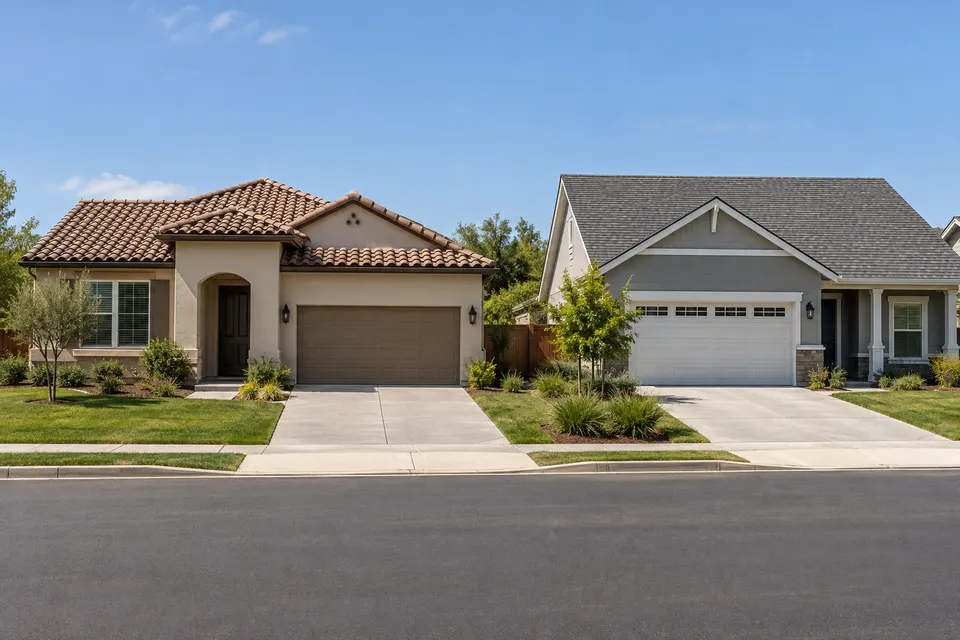
Tile is worth the extra cost if you will stay in the house long enough to skip at least one shingle replacement, your roof frame can carry the weight, and your winters suit the tile you pick. HomeAdvisor's customers report paying $8,476 to $26,223 for a tile roof, an average of $17,349, against $6,137 to $13,992 for asphalt shingles, an average of $10,065. InterNACHI, the home inspectors' association, rates clay and concrete tile at more than 100 years, against 20 to 30 years for asphalt shingles. But tile weighs about three times as much, and the underlayment beneath it wears out long before the tile does.
Tile and shingles side by side, and what each costs
| Asphalt shingles | Clay or concrete tile | |
|---|---|---|
| Typical total (HomeAdvisor) | $6,137 to $13,992; average $10,065 | $8,476 to $26,223; average $17,349 |
| Installed, per square foot (HomeAdvisor) | $4 to $12 | $7 to $25; concrete $9 to $18, clay $8 to $25 |
| Expected life (InterNACHI) | 20 years (3-tab), 30 years (architectural) | more than 100 years |
| Expected life (HomeAdvisor) | 15 to 20 years | concrete 30 to 50 years; clay more than 100 |
| Weight | the baseline | about three times asphalt (Building America Solution Center) |
| Average repair (HomeAdvisor) | $975 | $1,000 |
| Fire rating | Class A for the shingles in our architectural shingle guide | Class A (InterNACHI) |
HomeAdvisor's totals are averages of real jobs of every size, so the two averages do not describe the same house. HomeAdvisor itself says tile installation costs nearly double what asphalt does. Fixr, another cost site, puts a tile roof higher, at $19,000 to $35,000, and about $27,000 for a 1,500-square-foot roof.
A shingle roof is mostly labor: HomeAdvisor says labor is about 60% of its cost. Tile costs more in both parts. HomeAdvisor splits a tile roof's installed price into $2 to $10 a square foot for material and $5 to $18 for labor. A tile estimate may also carry lines a shingle estimate does not:
- Strengthening the roof frame, if an engineer finds it needed: $1,000 to $10,000, according to Fixr.
- Coloring or painting the tile: $0.50 to $5 a square foot, according to HomeAdvisor.
- Tear-off and disposal of the old roof: $1 to $5 a square foot on a tile job, according to HomeAdvisor.
Our tile roof cost guide sets out clay and concrete prices in full, and our roof replacement cost guide shows how to measure your roof in squares so you can compare estimates for either material. The roof cost calculator does that arithmetic for you.
Cost over the life of the roof
A roof that costs more but lasts longer can come out cheaper over the years you own it. The table below is our own arithmetic, not a published figure. It prices one 2,000-square-foot roof (20 squares) at the midpoint of HomeAdvisor's installed ranges: $8 a square foot for shingles, $13.50 for concrete tile and $16.50 for clay tile. It adds HomeAdvisor's underlayment replacement price of $2 to $3 a square foot, $4,000 to $6,000 on this roof, each time the tile's underlayment is replaced. It covers 60 years, in today's prices, with no inflation, interest, repairs or structural work.
| Roof | Installed cost, 2,000 sq ft | Lifespan used | Installs in 60 years | Underlayment jobs | Total over 60 years |
|---|---|---|---|---|---|
| Architectural shingles | $16,000 | 30 years (InterNACHI) | 2 | 0 | $32,000 |
| Asphalt shingles | $16,000 | 15 to 20 years (HomeAdvisor) | 3 to 4 | 0 | $48,000 to $64,000 |
| Concrete tile | $27,000 | 30 to 50 years (HomeAdvisor) | 2 | 0 | $54,000 |
| Concrete tile | $27,000 | more than 100 years (InterNACHI) | 1 | 1 to 2 | $31,000 to $39,000 |
| Clay tile | $33,000 | more than 100 years (InterNACHI and HomeAdvisor) | 1 | 1 to 2 | $37,000 to $45,000 |
How to read it:
- The first roof decides a short stay. On this roof, concrete tile costs $11,000 more than shingles on day one and clay $17,000 more. If you sell before the shingles would have needed replacing, most of tile's extra life goes to the next owner.
- Over a long stay, tile can come out level or ahead. Against 30-year architectural shingles, long-lived concrete tile costs about the same over 60 years and clay somewhat more. Against shingles that last 15 to 20 years, both cost less.
- The lifespan you believe changes the answer. If concrete tile lasts 30 to 50 years, as HomeAdvisor says, it costs more than shingles over 60 years in this arithmetic.
- Underlayment jobs are a guess at a count, not a forecast. We found no neutral published figure for how long underlayment lasts under tile, so the table shows one and two replacements. HomeAdvisor's $2 to $3 may not include lifting and relaying the tile; ask what a lift-and-relay estimate covers.
- Structural work is left out. If your frame needs strengthening, add Fixr's $1,000 to $10,000 to the tile rows.
How long each roof lasts, and the underlayment underneath
InterNACHI rates asphalt shingles at 20 years for 3-tab and 30 for architectural, and clay or concrete tile at more than 100. HomeAdvisor is more cautious: 15 to 20 years for asphalt, 30 to 50 for concrete tile and more than 100 for clay. InterNACHI says its figures are a general guideline only, and that weather, installation, maintenance and material quality all move a roof's life. Our guide to how long a roof lasts covers the rest.
The tile is not the part that fails first. InterNACHI says the International Residential Code requires at least 30-pound felt under clay and concrete tile, and that roofs from 2 in 12 to 4 in 12 need a double layer. It also says felt underlayment is not permanent: it breaks down as it loses its volatile oils, so under a roof covering that lasts far longer, such as slate, the underlayment is likely to go first. The same holds for tile. Replacing it means lifting the tile, laying new underlayment and relaying the tile, with new pieces for any that break.
With shingles, the underlayment and the covering are replaced together at every re-roof, so the question does not come up.
Weight and structural checks
Tile is heavy. The Building America Solution Center, the U.S. Department of Energy's building guidance site, says tile is about three times heavier than asphalt roofing, so the framing and sheathing must be strong enough to carry it. InterNACHI puts concrete tile at 900 to 2,000 pounds per square, depending on type and maker. For comparison, CertainTeed's Landmark architectural shingle weighs 211 to 225 pounds per square.
Before you switch from shingles to tile:
- Have the frame assessed. The Solution Center says to consult an engineer about reinforcement when tile replaces asphalt shingles, and InterNACHI tells inspectors to call for a structural engineer where the framing may not be adequate.
- Check the deck. The Solution Center calls for sheathing at least 15/32 inch thick under tile.
- Check the slope. InterNACHI says tile needs a slope of at least 2 in 12.
- Get the answer before you sign. Ask for any strengthening to be priced in the estimate, not found later.
Going the other way, from tile to shingles, raises no weight question: the frame was built for more.
Which suits your climate
Climate matters more for tile than for shingles, and it matters differently for clay and concrete. This holds anywhere in the country; what counts is the weather at your house.
- Heat. InterNACHI says hot climates shorten asphalt shingle life sharply. The Solution Center says tile's thermal mass can help regulate indoor temperatures in hot climates, and HomeAdvisor says terracotta suits warmer areas.
- Freeze-thaw. Fixr says clay tile tends to crack in freeze-thaw cycles and concrete copes better with temperature extremes. The Solution Center says clay tile is not common in very cold climates and advises against it where snow might need removing, and calls for an ice barrier 24 to 36 inches up from the eaves where ice dams form. The National Park Service says poor-quality porous clay tile is the kind most likely to break or spall when it freezes. The Tile Roofing Industry Alliance, the tile trade group, says Grade 1 tile, under ASTM C1167 for clay and ASTM C1492 for concrete, is made to withstand harsh winters. Where winters freeze hard, get the tile's grade in writing. Shingles have their own cold-weather risk; see our guide to ice dams.
- Hail. InterNACHI says tile typically achieves Class 3 or Class 4 hail ratings, and the trade group says tested products resist 2-inch hail under the FM 4473 standard. The Solution Center recommends Class 4 tile where hail is common. Progressive, an insurer, says tile cracks more easily, and the Park Service lists heavy hail among the causes of broken clay tile. Shingles are sold in Class 4 versions too; our guide to impact-resistant shingles explains what the rating means.
- Wind. InterNACHI says properly installed tile can resist winds over 125 mph, and the trade group says tile roofs can be designed for up to 200 mph. For shingles, the wind speed a manufacturer's warranty covers is often lower than the lab rating; see our architectural shingle guide. With either roof, ask for the rating of the exact product and the installation it requires.
Repairs
A typical repair costs about the same for either roof: HomeAdvisor's averages are $975 for asphalt shingles and $1,000 for tile. The difference is in the work:
- Tile breaks underfoot. InterNACHI says concrete tile may break if you step on the wrong part, and the Park Service lists careless roofers among the causes of broken clay tile. Keep satellite installers, painters and anyone else off a tile roof unless they know how to cross it.
- Matching can be hard. A tile roof can outlast its product line. Our tile roof cost guide covers salvaged tile, custom runs and where to put new tiles so they show least.
- Shingles are easier to reach and replace, though a patch on an older shingle roof may not match in color.
Our roof repair cost guide compares repairs across materials.
Insurance and resale
This section is general information, not insurance or financial advice.
Insurance. Triple-I, the insurance industry's information group, says a roof's material and shape, as well as its age and condition, affect how an insurer judges your risk, and that the type of roof and its materials are among the factors in what it would cost to rebuild your house. Progressive says more durable materials, including tile, generally get better rates than asphalt, but that tile is expensive to replace. Triple-I also says most insurers require a roof over 20 years old to pass an inspection, and some cover older roofs only at actual cash value; our guide to roof age and insurance explains what that means. Before you choose, ask your agent how each material would change your premium, your deductible and how a claim is paid, and tell your insurer when the work is done. Each state regulates insurers, so check your state's rules.
Resale. We found no national figure for how much of a tile roof's cost comes back when a house sells. Fixr says a properly installed tile roof, in the right conditions, increases a home's value, without giving a figure. Our guide to whether a new roof adds value sets out the national figures for asphalt and metal. What a buyer sees is a roof's remaining life: a tile roof with sound tile but aging underlayment still faces a lift-and-relay job.
What to ask before you choose
- Can my roof frame and deck carry tile, and who will assess it? What would strengthening cost?
- Is the estimate for clay or concrete, which product, and what is its freeze-thaw grade, hail class and wind rating?
- What underlayment goes under the tile, how many layers, and what does its maker say about its life?
- What would a future lift-and-relay cost, and how many broken tiles does that price allow for?
- How many extra tiles will you leave me for future repairs?
- For shingles: which product line, what wind and algae warranty, and is a Class 4 version available?
- Who pulls the permit, and what does the labor warranty cover?
Put the same questions to anyone pricing either roof, and check the contractor too: our guide to what to check before you hire a home improvement contractor covers licenses, insurance and references.
Frequently asked questions
Is a tile roof worth it over asphalt shingles?
It can be, if you stay long enough. In our own arithmetic for a 2,000-square-foot roof, tile costs $11,000 to $17,000 more up front. Over 60 years, concrete tile comes out about level with 30-year shingles and clay somewhat above them, and both come out below shingles that last 15 to 20 years, but only if the tile lasts as long as InterNACHI expects.
How much more does tile cost than shingles?
HomeAdvisor's customer averages are $17,349 for tile and $10,065 for shingles, and HomeAdvisor says tile costs nearly double. Per square foot installed, it gives $7 to $25 for tile and $4 to $12 for shingles.
Can I replace shingles with tile?
Often, but not always. Tile weighs about three times as much as asphalt, so have an engineer check the frame and deck first, and get any strengthening priced in the estimate. Tile also needs a slope of at least 2 in 12.
Does a tile roof really last 100 years?
The tile can: InterNACHI rates clay and concrete at more than 100 years, though HomeAdvisor gives concrete 30 to 50. The underlayment beneath wears out sooner and has to be replaced by lifting and relaying the tile.
Is tile a good choice where winters are cold?
Clay tile is the riskier choice where it freezes hard; Fixr and the Building America Solution Center both caution against it in cold climates. Concrete copes better. Either way, ask for tile graded for freeze-thaw under ASTM C1167 or C1492.
How we got these numbers
HomeAnvil does not yet publish price data of its own. Every figure on this page comes from a published source, read on September 27, 2026, except the lifetime cost table, which is our own arithmetic from those figures:
- HomeAdvisor, tile roof cost, updated June 19, 2026: the tile totals and average, price per square foot by tile type, material and labor split, underlayment replacement, tear-off, coloring, lifespans, the "nearly double" comparison and the note on terracotta in warm areas. HomeAdvisor says its figures come from surveys of its customers and other published research.
- HomeAdvisor, shingle roof replacement cost, updated June 17, 2026: the shingle totals and average, price per square foot, labor share and lifespan. That page lists clay tile at $12 to $25 a square foot, which differs from HomeAdvisor's own tile page; we use the tile page for tile.
- HomeAdvisor, roof repair cost, updated June 19, 2026: the average repair by material.
- Fixr, tile roof installation cost, updated January 31, 2025: its tile totals, reinforcement cost, freeze-thaw comment and statement on home value.
- InterNACHI, standard estimated life expectancy chart: lifespans and the effect of hot climates on shingles.
- InterNACHI, Mastering Roof Inspections: Tile Roofs, part 1, part 2, part 3 and part 4: fire, hail and wind ratings, underlayment and slope rules, concrete tile weight, walking on tile and structural review.
- InterNACHI, slate roofs, part 5: felt underlayment deteriorating as it loses its oils.
- Building America Solution Center, run by a national laboratory for the U.S. Department of Energy, clay or concrete tile roofs, last updated December 6, 2022: weight relative to asphalt, engineer review, sheathing, climate guidance and ice barriers.
- National Park Service, Preservation Brief 30, The Preservation and Repair of Historic Clay Tile Roofs, by Anne E. Grimmer and Paul K. Williams: porous tile and freezing, and causes of broken tile.
- Tile Roofing Industry Alliance, durability and longevity: wind, hail and freeze-thaw standards. This is the tile industry's trade group.
- CertainTeed, Landmark shingle data sheet: the architectural shingle weight used for comparison. We cite it as one maker's figure, not as a recommendation.
- Triple-I, how your roof influences your home and business insurance and insurance for your house and personal possessions.
- Progressive, how roof types affect homeowners insurance, updated July 3, 2025. This is an insurer's own statement.
We will update this page when these sources publish new figures, and the date above will say when.
Related guides
 How much does a tile roof cost? Clay vs concreteA tile roof typically costs $8,476 to $26,223, or $7 to $25 a square foot installed. Clay vs concrete, weight, underlayment and repair costs compared.
 How much does a roof replacement cost?A roof replacement typically costs $5,900 to $13,400, or $400 to $1,100 per square installed. How to measure your roof, what moves the price and how to compare estimates.
 Are architectural shingles worth it over 3-tab shingles?Architectural shingles start near $3.50 a square foot against $1.50 for 3-tab, last about 30 years instead of 20, and carry longer warranties.
 How long does a roof last?Architectural shingles last about 30 years, 3-tab about 20, metal 40 to 80, slate 60 to 150. What shortens a roof's life, and why a warranty isn't a lifespan.
 Are Class 4 impact-resistant shingles worth it?Class 4 shingles pass a 2-inch impact test under UL 2218 or FM 4473. IBHS found top-rated ones cost about 9% more per square. What the rating does not promise.
 How does your roof's age affect your homeowners insurance?Many insurers inspect or decline roofs over 20 years old, and older roofs are often paid at depreciated value. What to check in your policy and at renewal.