
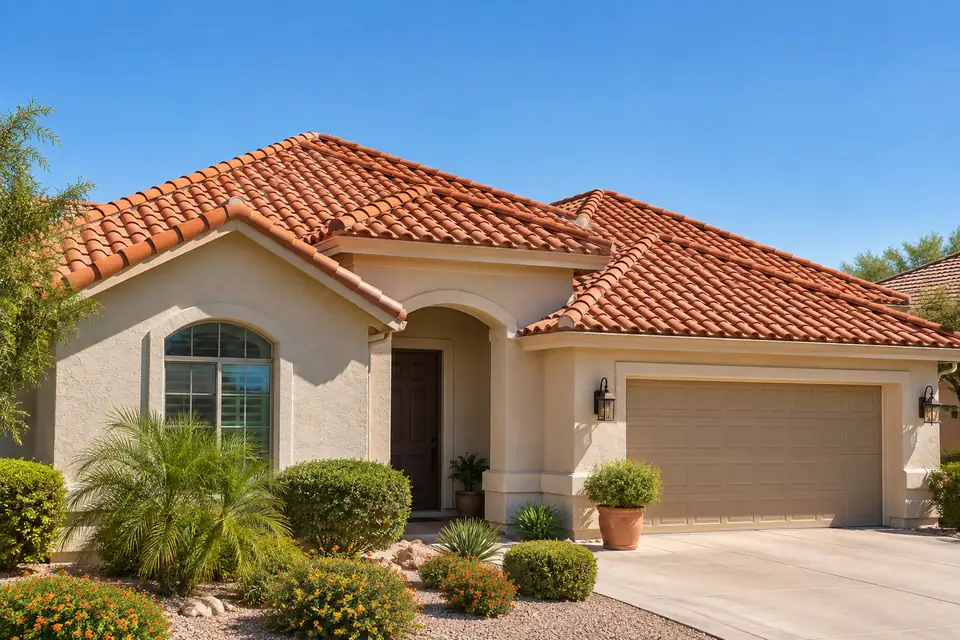
Most tile roofs cost $8,476 to $26,223, with a reported average of $17,349, according to HomeAdvisor's survey of its customers. That works out to $7 to $25 a square foot installed. Fixr, another cost site, reports a higher range of $19,000 to $35,000. Concrete tile usually costs less than clay; clay tends to last longer. Both are heavy, both need a sound roof frame, and on both the underlayment beneath the tile wears out long before the tile does.
Clay and concrete tile side by side
| Concrete tile | Clay tile | |
|---|---|---|
| Installed cost per square foot (HomeAdvisor) | $9 to $18 | $8 to $25 |
| Material only, per square foot (HomeAdvisor) | $2 to $4 | $3 to $7 |
| Material only, per square foot (Fixr) | $4 to $20 | $5 to $15 |
| Expected life (HomeAdvisor) | 30 to 50 years | more than 100 years |
| Expected life (Fixr) | about 50 years | about 100 years |
| Expected life (InterNACHI chart) | more than 100 years | more than 100 years |
| Weight | 900 to 2,000 pounds per square (InterNACHI) | varies by profile; see below |
| Fire rating (InterNACHI) | Class A | Class A |
A square is 100 square feet of roof. HomeAdvisor also lists terracotta separately at $10 to $25 a square foot installed. The cost sites and the home inspectors' association disagree on how long concrete lasts; read any single figure as the middle of a range.
For color, frost grades, weight and breakage in more depth, see clay vs concrete roof tiles.
What a tile roof costs
| Source | Typical total | Per square foot, installed |
|---|---|---|
| HomeAdvisor, updated June 19, 2026 | $8,476 to $26,223; average $17,349; high-end jobs to about $46,000 | $7 to $25 |
| Fixr, updated January 31, 2025 | $19,000 to $35,000; about $27,000 for a 1,500-square-foot roof | $7 to $41 |
HomeAdvisor's figures come from what its customers reported paying; Fixr prices a set roof size. HomeAdvisor splits its per-square-foot price into $2 to $10 for material and $5 to $18 for labor. It also lists the extras that often appear on a tile estimate:
- Tearing off and disposing of the old roof: $1 to $5 a square foot.
- Replacing the underlayment: $2 to $3 a square foot.
- Coloring or painting tile: $0.50 to $5 a square foot.
- Strengthening the roof frame, if needed: $1,000 to $10,000, according to Fixr.
To compare estimates fairly, divide each total by the squares it covers. Our roof replacement cost guide shows how to measure your roof in squares.
Weight and your roof frame
Tile is far heavier than asphalt shingles. InterNACHI, the home inspectors' association, says concrete tile weighs 900 to 2,000 pounds per square, depending on the type and the maker. For comparison, one major maker's architectural asphalt shingle weighs 211 to 225 pounds per square. Clay tile weight depends heavily on its shape; one clay tile maker says two of its flatter profiles weigh under 600 pounds per square. We did not find a published weight for curved or barrel clay tile.
What that means for your house:
- A house built for shingles may not be built for tile. The National Park Service's guidance on clay tile roofs says the tiles are heavy and the roof structure must be sound. InterNACHI suggests a structural engineer's review where the framing may not be adequate.
- Not every house needs work. A concrete tile maker says most well-built modern homes need little or no extra bracing. The only way to know for yours is an assessment before you sign.
- An old tile roof comes off. Codes based on the International Residential Code do not allow a new covering over existing clay or cement tile. Our guide to putting new shingles over old ones explains the rule.
The underlayment wears out first
Tile sheds most water, but it is not a waterproof layer. InterNACHI describes a tile roof as a water-resistant system in which the underlayment below is the second line of defense. InterNACHI says the International Residential Code calls for at least 30-pound felt under both clay and concrete tile. It adds that modern codes allow tile on slopes of 2 in 12 and steeper, with a double layer of underlayment on slopes from 2 in 12 up to 4 in 12.
Felt loses its oils and breaks down with age. InterNACHI makes the point about slate, and it applies to any roof covering that lasts much longer than felt: the underlayment is likely to deteriorate before the roof covering does. Replacing it means lifting the tile, laying new underlayment and relaying the same tile, often with new tile for any that break. HomeAdvisor puts underlayment replacement at $2 to $3 a square foot; Fixr puts the underlayment itself at $0.50 to $2 a square foot. Ask any roofer who prices this work:
- how many tiles they expect to break, and whether replacements are included;
- whether the price covers new battens, flashing and fasteners, or only the underlayment;
- what underlayment they will use and how it laps on your roof's slope.
Repairs and walking on tile
HomeAdvisor gives an average tile roof repair cost of $1,000. Fixr reports $900 to $2,300, from a slipped tile put back in place to a leak that needs tiles lifted. Our roof repair cost guide compares repairs across materials.
Tiles break underfoot, and a careless visit can cost more than the repair it was for. InterNACHI warns that walking on concrete or clay tile risks breaking it. The Park Service describes roofers spreading their weight on plywood, planks or sand-filled bags, or on a ladder hooked over the ridge. One concrete tile maker tells roofers to step on the bottom 3 inches of each tile, where the tile beneath supports it; a clay tile maker points to the 2- to 3-inch overlap. Keep satellite installers, painters and anyone else off a tile roof unless they know how to cross it.
A broken tile is cut free and the new one is held with a copper strap or a hook where nails can no longer reach, the Park Service explains.
Clay tile and freezing weather
The sources disagree on how clay handles hard freezes. Fixr says clay tile tends to crack in freeze-thaw cycles and is not fit for every climate, while concrete handles extreme temperatures more easily. The Tile Roofing Industry Alliance, the trade group, points to freeze-thaw grades in the product standards, ASTM C1167 for clay and ASTM C1492 for concrete. The Park Service notes that poorly fired, porous clay tile is the kind most likely to break or spall when it freezes. Where winters freeze hard, ask for the freeze-thaw grade of the exact tile in writing.
The same trade group says tile roofs can be designed for winds up to 200 mph and that tested products resist hail up to 2 inches across under the FM 4473 standard. Those are ratings for specific products and installations, so ask for the rating of yours. Our guide to hail damage explains the impact classes.
Matching and sourcing tiles
A tile roof can outlast the product line it was made from. When you need replacements:
- Salvaged tile. The Park Service notes that some companies stock and sell salvaged clay tile, and that pan tiles often survive even when many cover tiles are broken.
- Custom runs. If a tile is no longer made, the original molds may still exist and can be used for a custom order large enough to justify it.
- Placement. New tile weathers differently, so the Park Service suggests moving original tiles to the most visible spots and putting new ones where they show least. It advises against patching handmade tile with machine-made or concrete tile.
- When to stop repairing. On historic roofs, the Park Service says that if more than about 30% of the tiles are lost or broken and no match can be found, replacing all of them may be necessary.
- Extra tile. Order extra for breakage in shipping and on site, and keep some for future repairs.
Frequently asked questions
Is clay or concrete tile cheaper?
Concrete usually is. HomeAdvisor puts concrete at $9 to $18 a square foot installed and clay at $8 to $25, with clay material costing more per square foot.
How long does a tile roof last?
The tile can last a very long time: InterNACHI's chart gives more than 100 years for clay or concrete, while HomeAdvisor gives 30 to 50 years for concrete. The underlayment beneath it usually needs replacing sooner, which means lifting and relaying the tile.
Can my house hold a tile roof?
Maybe. Concrete tile weighs 900 to 2,000 pounds per square according to InterNACHI, several times the weight of asphalt shingles. Have the framing assessed before you choose tile, and ask what any strengthening would cost; Fixr puts it at $1,000 to $10,000.
Can I walk on my tile roof?
Avoid it. Tiles break underfoot. Roofers spread their weight with boards or ladders and step only where the tile below supports it.
Can a tile roof be repaired instead of replaced?
Usually, if the damage is limited. Broken tiles can be swapped one at a time, and failed underlayment can be replaced under the same tile. HomeAdvisor's average tile repair is $1,000.
How we got these numbers
HomeAnvil does not yet publish price data of its own. Every figure on this page comes from a published source, read on September 26, 2026:
- HomeAdvisor, tile roof cost, updated June 19, 2026: the typical, average and high-end totals, the price per square foot by tile type, labor, underlayment, disposal and coloring, and its lifespans. HomeAdvisor says its figures come from a survey of its customers and other published research.
- HomeAdvisor, roof repair cost, updated June 19, 2026: the average tile repair.
- Fixr, tile roof installation cost, updated January 31, 2025: its totals, price per square foot, material prices, reinforcement, underlayment, repair range, lifespans and freeze-thaw comment. Fixr also gives a tile weight of about 225 pounds per square, which is below the weight of ordinary asphalt shingles and conflicts with InterNACHI's figure, so we have not used it.
- InterNACHI, Mastering Roof Inspections: Tile Roofs, part 1, part 2, part 3 and part 4: fire rating, slope and underlayment rules, concrete tile weight, walking on tile and structural review.
- InterNACHI, slate roofs, part 5: felt underlayment deteriorating as it loses its oils.
- InterNACHI, standard estimated life expectancy chart: tile life.
- National Park Service, Preservation Brief 30, The Preservation and Repair of Historic Clay Tile Roofs, by Anne E. Grimmer and Paul K. Williams, spring 1993: weight and structure, causes of failure, repair methods, walking on tile, salvage and custom tile, and the 30% guideline.
- Tile Roofing Industry Alliance, durability and longevity: wind, hail, fire and freeze-thaw standards. This is the tile industry's trade group.
- Eagle Roofing, frequently asked questions, and Ludowici, frequently asked questions: a concrete tile maker's and a clay tile maker's guidance on bracing, walking on tile and the weight of two flat clay profiles. We cite them as manufacturers' statements, not as recommendations.
- CertainTeed, Landmark shingle data sheet: the architectural shingle weight used for comparison.
We will update this page when these sources publish new figures, and the date above will say when.
Related guides
 Types of roofing materials, and how they compareRoofing materials compared: asphalt costs $3 to $7 a square foot installed and lasts 20 to 30 years; slate $15 to $30 and 60 to 150 years.
 How much does a slate roof cost?A slate roof typically costs $4,389 to $22,377, and natural slate $20 to $30 a square foot installed. Lifespan by grade, weight, and repair vs replace.
 How much does a roof replacement cost?A roof replacement typically costs $5,900 to $13,400, or $400 to $1,100 per square installed. How to measure your roof, what moves the price and how to compare estimates.
 How long does a roof last?Architectural shingles last about 30 years, 3-tab about 20, metal 40 to 80, slate 60 to 150. What shortens a roof's life, and why a warranty isn't a lifespan.
 How much does a roof repair cost?Most roof repairs cost $395 to $1,967, about $1,173 on average. Prices by problem: shingles, flashing, leaks, decking, vents, fascia and sagging.
 Can you put new shingles over old ones?Often yes, once: the building code bars a layover on a roof with two or more layers. What a roof-over saves, what it adds in weight, and what it hides.