
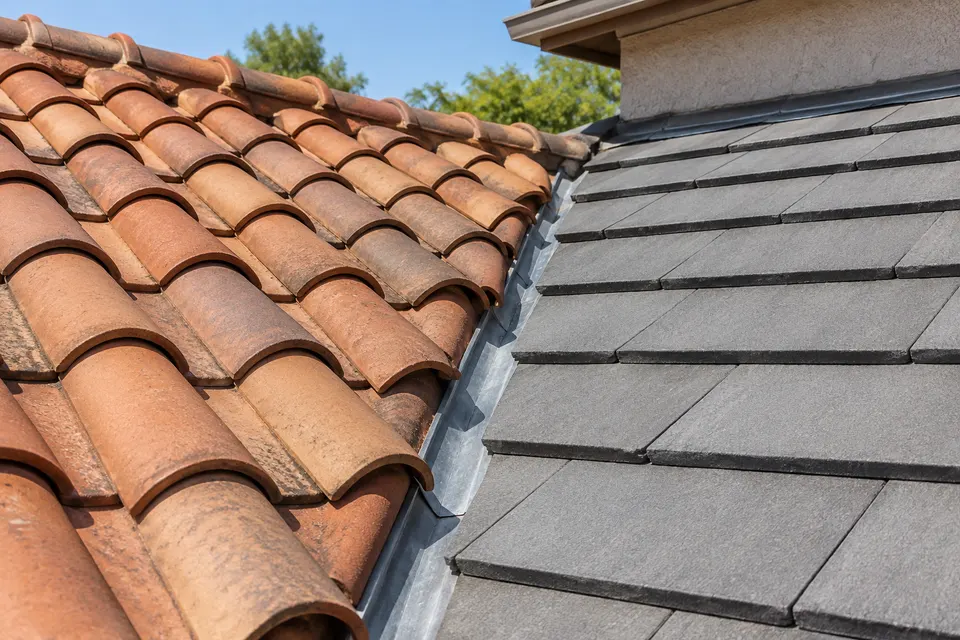
Clay is the better tile if you want color that lasts and a roof that can outlive the house, and you can pay for it. Concrete is the better tile if the budget is tight and you accept that its surface color will change and may need recoating. HomeAdvisor puts concrete at $9 to $18 a square foot installed and clay at $8 to $25. Clay's color is fired into the tile; concrete's is pigment in the mix or a coat on the surface, and it fades. Clay tile made to the top grade of its standard absorbs very little water, but poorly fired clay is the tile most likely to crack in a hard freeze. The two weigh about the same per square at common profiles, so the house's frame rarely decides between them; it decides whether you can have tile at all.
The short answer, point by point
| Clay tile | Concrete tile | |
|---|---|---|
| Installed cost per square foot (HomeAdvisor) | $8 to $25 | $9 to $18 |
| Material only, per square foot (HomeAdvisor) | $3 to $7 | $2 to $4 |
| Expected life (cost sites) | about 100 years (Fixr); may outlast the house (HomeAdvisor) | about 50 years (Fixr); 30 to 50 (HomeAdvisor) |
| Expected life (InterNACHI chart) | more than 100 years | more than 100 years |
| Where the color is | fired into the clay or a fired-on glaze | pigment through the tile, or a surface coat |
| Color over time | holds; one clay maker warrants it for 75 years | surface wears in the first decade and lightens; one concrete maker does not warrant color |
| Product standard | ASTM C1167, in three grades of frost resistance | ASTM C1492 |
| Weight per square | under 600 pounds (flat profiles) to 900 (one barrel profile), one maker | 550 to 970 pounds across one maker's line; 900 to 2,000 (InterNACHI) |
| Fire rating (InterNACHI) | Class A | Class A |
A square is 100 square feet of roof. Our tile roof cost guide sets out the whole-roof totals, underlayment and repair prices for tile in general; this page goes further into how the two materials differ.
What each one costs
HomeAdvisor gives the clearest split by material. Its per-square-foot prices, the same ones our tile cost guide uses:
| Tile | Material only | Installed |
|---|---|---|
| Concrete | $2 to $4 | $9 to $18 |
| Clay | $3 to $7 | $8 to $25 |
| Terracotta, a fired clay HomeAdvisor lists on its own | $5 to $10 | $10 to $25 |
Fixr, another cost site, gives material-only prices of $4 to $20 for concrete and $5 to $15 for clay, and in its clay-versus-concrete section gives a second pair of ranges, $3 to $20 for concrete and $9 to $20 for clay, without saying whether they include labor. HomeAdvisor's own shingle cost page lists clay at $12 to $25 installed, higher than its tile page; we use the tile page here, as our other tile guides do.
An example, our own arithmetic. A 20-square roof (2,000 square feet) at HomeAdvisor's installed ranges comes to $18,000 to $36,000 in concrete and $16,000 to $50,000 in clay. At the middle of each range that is about $27,000 against $33,000. Clay's range is wide because it runs from plain machine-made tile to glazed and specialty shapes; concrete's top end is lower.
HomeAdvisor says clay costs more because it is heavier and more water-resistant. The extras on an estimate are the same for both materials: tear-off, underlayment, any frame strengthening, and HomeAdvisor's $0.50 to $5 a square foot for coloring or painting tile, a line that matters more for concrete, as the color section explains. The roof cost calculator prices your roof's squares in several materials.
How long each one lasts
The cost sites agree that clay lasts longer. Fixr gives clay about 100 years and concrete about 50, and HomeAdvisor gives concrete 30 to 50 years and says clay may last longer than your house. InterNACHI, the home inspectors' association, puts both at more than 100 years in its life expectancy chart, and a concrete tile maker says its tile will last the life of the structure. The Building America Solution Center, the U.S. Department of Energy's building guidance site, says tile, and clay in particular, can exceed 100 years.
Read those as the life of the tile, not the roof. HomeAdvisor says the underlayment beneath tile typically lasts only about 10 years, and replacing it means lifting and relaying the tile, whichever material it is. The National Park Service's guidance on clay tile roofs adds that a clay roof's life depends as much on its nails, flashing and other parts as on the tiles. Our guide to how long a roof lasts compares every material.
Two things move the gap between clay and concrete on a real roof: the grade of the tile, covered below, and the surface of a concrete tile, which wears even when the body of the tile is sound.
Color: fired in or on the surface
This is the clearest difference you will see from the street.
Clay. The color of natural clay tile comes from the clay itself. The Park Service explains that the familiar terracotta red comes from clay rich in iron oxide, with natural variations from deep reddish brown to pale orange and pink, and buff, beige and black tile made from other clays. Colored glazes are fired onto the tile. HomeAdvisor says the color of terracotta is baked in during firing, so it is less likely to fade. One clay tile maker calls its color fired-in and warrants it against fading for 75 years. Tile from one kiln run still varies in shade, which that maker says is part of the look, not a defect.
Concrete. Concrete tile is portland cement, sand and aggregate with pigment added, the Park Service says, and it tends to lack the color permanence and subtle variation of clay. There are two ways to color it:
- Color-through. The pigment is mixed through the whole tile. One concrete tile maker says the color of the mix lasts, but the cement-rich surface layer wears away within about the first ten years and exposes the sand beneath, so the roof looks lighter. That maker does not warrant color.
- Surface coat. A colored cement slurry is bonded to the top of the tile. The same maker says these slurry-coated tiles are the exception to the freeze-thaw requirements its other tiles meet.
The same maker says the clear factory sealer burns off in the sun in about a year to a year and a half, and suggests a clear acrylic sealer or an acrylic paint recoat after cleaning if you want the original look back. New concrete tile can also show efflorescence, a white chalky bloom that the maker says is harmless and washes off with rain over time. The Park Service photographs concrete tile and notes that it tends to fade and lose its color.
What that means for you: with clay, the color you pick is broadly the color you keep. With concrete, pick a color you will still like when it is lighter, ask whether it is color-through or surface-coated, and allow for a recoat. Our guide to roof colors covers how color affects heat.
Water absorption and freeze-thaw: the grades that matter
A tile that soaks up water can crack when that water freezes and expands. Both standards test for it, and this is where you should ask for paperwork.
Clay: ASTM C1167. The standard sorts clay tile into three grades by resistance to weathering: Grade 1 resists severe frost, Grade 2 moderate frost, and Grade 3 has negligible frost resistance. It also sets three types by shape and checks durability, freeze-thaw resistance, breaking strength, efflorescence and permeability. Tile passes on water absorption and a figure called the saturation coefficient; a lab freeze-thaw test is the alternative for tile that does not meet those limits.
Grade 1, for severe frost, is the most demanding grade. We could not read the standard's full tables, so we do not print its limits. One clay maker's barrel tile data sheet lists it as Grade 1 with water absorption under 2%.
Concrete: ASTM C1492. The concrete tile standard tests for water absorption, freeze-thaw, transverse strength, permeability and dimensions, and covers tile made with normal-weight or lightweight aggregate. The Tile Roofing Industry Alliance, the tile trade group, says Grade 1 tile under C1492 or C1167 is made to withstand harsh winters and freeze-thaw cycles.
Where the sources disagree. Fixr says clay tends to crack in freeze-thaw and that concrete handles temperature extremes more easily. HomeAdvisor and Fixr both say concrete absorbs more water than clay, which makes it prone to mold and harder to maintain. The trade group says clay and concrete tile both average less than 1% moisture absorption. The Park Service explains the likely reason for the split: poorly fired, porous clay tile is the kind that breaks and spalls in freezing weather, and it warns that tile made for a hot, dry climate may not survive freeze-thaw cycles. A dense, Grade 1 clay tile is a different product from a porous one.
If your winters freeze, ask for the tile's ASTM grade in writing, and for concrete, whether it is a slurry-coated tile. The Building America Solution Center adds that clay tile is uncommon in very cold climates and advises against it where snow might have to be cleared from the roof.
Weight per square
Both are heavy, and neither is always heavier.
| Tile | Pounds per square | Source |
|---|---|---|
| Clay, two flat profiles | under 600 | Ludowici |
| Concrete, one maker's lightweight line | 550 to 720 | Eagle Roofing specifications |
| Clay, one barrel profile | 900 | Ludowici data sheet |
| Concrete, one maker's standard line | 900 to 970 | Eagle Roofing specifications |
| Concrete, any type or maker | 900 to 2,000 | InterNACHI |
| Architectural asphalt shingle, for comparison | 211 to 225 | CertainTeed data sheet |
The sources point in opposite directions. HomeAdvisor says clay is heavier than concrete. The Park Service says concrete tile reproduced the look of clay at a somewhat lower weight, yet is generally thicker than clay. The Expanded Shale, Clay and Slate Institute, a trade group for lightweight aggregate, says standard concrete tile weighs about 9 pounds a square foot, or about 900 pounds a square, and that lightweight concrete tile under 6 pounds a square foot is made. In the published figures above, a standard concrete tile and a clay barrel tile land close together, and flat clay or lightweight concrete come in lighter.
So ask for the weight per square of the exact tile, not the material. The same institute says moving to standard-weight concrete tile normally needs a structural engineer's report. Our tile vs shingles guide covers the frame and deck checks when tile replaces a lighter roof.
Strength and breakage
Both are brittle. The Building America Solution Center says tile can break from a heavy impact such as a falling branch. What differs is where each tends to break.
- Concrete. InterNACHI says concrete tile's resistance to breaking underfoot depends on its profile, quality and fastening, and that the thin interlocking edges are the most fragile part, because they are cast thinner than the rest of the tile. It says to step only on the lower 3 inches of a flat tile.
- Clay. The Park Service says flat clay tiles can usually be crossed by a careful roofer, but high-profile curved tiles break easily. It also warns that nails driven too deep press on the tile and can crack it in a freeze or when someone walks on it.
- Hail. InterNACHI says both typically reach Class 3 or Class 4 hail ratings, and that clay varies more widely than concrete. Ask for the rating of the exact product. Our guide to hail damage explains the classes.
Both reach Class A for fire, and InterNACHI says both, properly installed, can resist winds over 125 mph.
Maintenance
Neither needs much, but concrete needs more.
- Concrete. Plan for the surface to wear and lighten, efflorescence on a new roof, and a possible clean and recoat to restore color; HomeAdvisor prices coloring or painting tile at $0.50 to $5 a square foot. HomeAdvisor and Fixr both say concrete's higher water absorption makes it more prone to mold and harder to maintain.
- Clay. One clay maker says moss and algae can grow on textured or matte tile without harming it, and that a professional soft wash removes it. Our guide to roof moss and algae covers cleaning methods that do not damage a roof.
- Both. Keep gutters clear: the Park Service says water backing up under tile rots battens and sheathing, and ice building up under tile breaks it. Keep people off the roof unless they know how to cross tile. Expect the underlayment to need replacing long before the tile.
- Repairs. Keep spare tiles from the job. The Park Service says concrete tile is not a compatible substitute for clay: it is too thick and lacks clay's range of color. Patch clay with clay.
Looks and profiles
Both come in similar shapes. The Park Service groups clay tile into two basic shapes, rounded pantiles, including Spanish or S tiles, mission or barrel tiles and Roman tiles, and flat tiles that overlap like slate or interlock. ASTM C1167 sorts clay tile into three types by the features that shape its appearance. The Building America Solution Center says tile comes in round, curved, flat and interlocking profiles in many colors.
Concrete is made to resemble clay, and the Park Service says it reproduces the general look, if not always the exact profile or proportions. Up close, concrete tile is usually thicker, with more even color; clay shows the shade variation of the kiln. On an older or historic house with clay tile, the Park Service is clear that concrete, metal or plastic tiles are generally not appropriate replacements. If you are comparing tile against other heavy materials, see slate vs tile and metal vs tile.
What to ask before you choose
- Is this clay or concrete, which profile, and what does it weigh per square?
- For clay: what is its ASTM C1167 grade, and can I see the water absorption figure on the data sheet?
- For concrete: does it meet ASTM C1492 freeze-thaw requirements, and is it color-through or slurry-coated?
- Does the maker warrant the color, for how long, and what counts as fading?
- What hail class and wind rating does this tile carry, and does that depend on how it is fastened?
- Can my frame carry it, and who will check? What would strengthening cost?
- What underlayment goes underneath, and what would a future lift-and-relay cost?
- How many spare tiles will you leave me?
Check the roofer as well as the tile: our guide to what to check before you hire a contractor covers licenses and insurance, and questions to ask a roofer has more.
Frequently asked questions
Is clay or concrete tile cheaper?
Concrete usually is. HomeAdvisor puts concrete at $9 to $18 a square foot installed and clay at $8 to $25, and clay material at $3 to $7 against $2 to $4 for concrete. Plain clay can overlap concrete at the low end; glazed and specialty clay costs the most.
Does concrete roof tile fade?
Yes, more than clay. One concrete maker says the surface layer wears off in about the first ten years and the roof looks lighter, and it does not warrant color. Clay's color is fired in; one clay maker warrants it against fading for 75 years.
Is clay tile a bad choice where winters freeze?
Porous clay is. Fixr says clay tends to crack in freeze-thaw, and the Park Service says poorly fired, porous clay is the tile that spalls. Clay made to ASTM C1167 Grade 1 is rated for severe frost. Ask for the grade in writing.
Which is heavier, clay or concrete tile?
It depends on the profile. One maker's standard concrete tile weighs 900 to 970 pounds a square and one clay barrel tile 900; flat clay and lightweight concrete come in under 600 to 720. InterNACHI gives concrete 900 to 2,000.
Can I repair a clay roof with concrete tiles?
It is not recommended. The Park Service says concrete tile is too thick and lacks clay's range of color, so it will not match. Keep spare clay tiles, or look for salvaged tile of the same profile.
How we got these numbers
HomeAnvil does not yet publish price data of its own. Every figure on this page comes from a published source, read on September 27, 2026. The 20-square example and the comparisons between sources are our own arithmetic.
- HomeAdvisor, tile roof cost, updated June 19, 2026: material and installed prices for concrete, clay and terracotta, lifespans, weight and water resistance, fired-in terracotta color, coloring cost and underlayment life. HomeAdvisor says its figures come from a survey of its customers and other published research.
- Fixr, tile roof installation cost, updated January 31, 2025: material prices, its clay-versus-concrete ranges, lifespans, freeze-thaw and maintenance comments.
- InterNACHI, standard estimated life expectancy chart, and Mastering Roof Inspections: Tile Roofs, part 1 (fire, hail and wind) and part 4 (concrete tile weight, breakage and walking on tile).
- Building America Solution Center, run by a national laboratory for the U.S. Department of Energy, clay or concrete tile roofs: the ASTM standards each material must meet, profiles, breakage, lifespan and cold-climate guidance.
- National Park Service, Preservation Brief 30, The Preservation and Repair of Historic Clay Tile Roofs, by Anne E. Grimmer and Paul K. Williams: clay color, concrete tile's make-up, color and thickness, porous tile and freeze-thaw, tile shapes, breakage, drainage and repairs.
- ASTM International, summaries of C1167 for clay roof tiles and C1492 for concrete roof tile: what each standard covers. The frost resistance of each C1167 grade is from the standard's published summary as reported in search results; we could not read the full standards.
- Tile Roofing Industry Alliance, durability and longevity: Grade 1 tile and freeze-thaw, and its moisture absorption figure. It is the tile trade group.
- Expanded Shale, Clay and Slate Institute, lightweight concrete roof tile: standard and lightweight concrete tile weight and structural reports. It is a trade group for lightweight aggregate.
- Ludowici, frequently asked questions and Spanish 13 1/4" barrel tile data sheet: clay color and its warranty, weights, grade and water absorption, and cleaning. Eagle Roofing, frequently asked questions and technical specifications: concrete tile color, sealer, efflorescence, freeze-thaw, lifespan and weights.
- CertainTeed, Landmark shingle data sheet: the asphalt shingle weight used for comparison.
Manufacturers are named only because their data is published; naming them is not a recommendation. We will update this page when these sources publish new figures, and the date above will say when.
Related guides
 How much does a tile roof cost? Clay vs concreteA tile roof typically costs $8,476 to $26,223, or $7 to $25 a square foot installed. Clay vs concrete, weight, underlayment and repair costs compared.
 Slate vs tile roof: cost, weight and lifespan comparedNatural slate costs $20 to $30 a square foot installed and tile $7 to $25. Both weigh several times as much as shingles. Lifespan, repairs and ratings compared.
 Tile roof vs asphalt shingles: is tile worth it?A tile roof typically costs $8,476 to $26,223 against $6,137 to $13,992 for shingles. It can outlast two shingle roofs but weighs about three times as much.
 Metal roof vs tile roof: which is better for your home?Metal averages $11,765 installed and tile $17,349 (HomeAdvisor). Tile weighs several times more and can last 100 years; metal is light and needs no bracing.
 Types of roofing materials, and how they compareRoofing materials compared: asphalt costs $3 to $7 a square foot installed and lasts 20 to 30 years; slate $15 to $30 and 60 to 150 years.
 How do you choose a roof color?A light or cool-pigment roof stays much cooler in sun and can cut cooling costs 7% to 15%. How to weigh heat, siding and trim, neighborhood rules and metal finishes.