
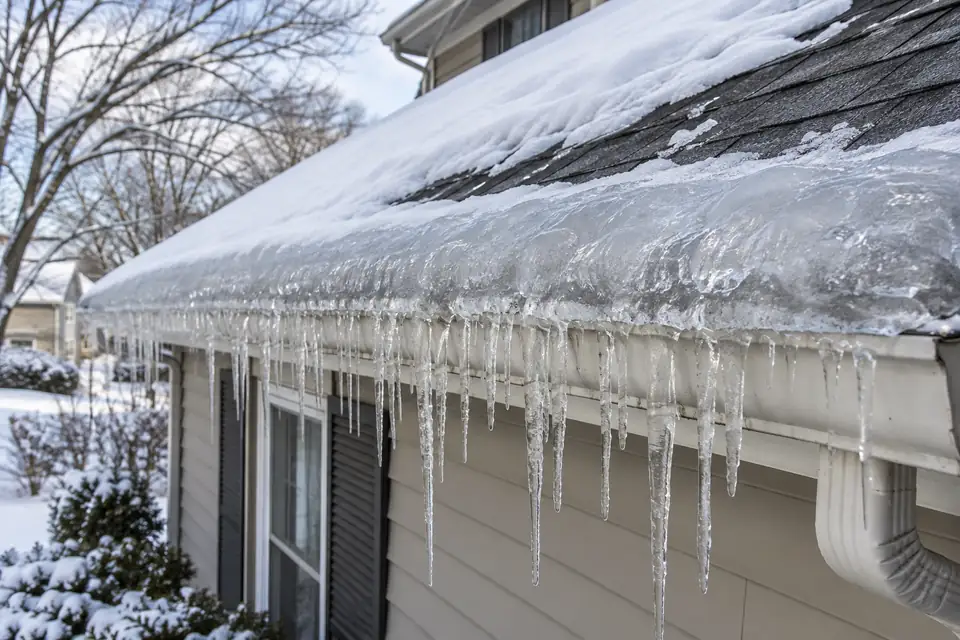
An ice dam is a ridge of ice along the lower edge of a roof that stops melting snow from draining off. It forms when heat escaping from the house warms the upper roof above freezing while the eaves stay below freezing: snow melts on the warm part, runs down and refreezes at the cold edge, and the water that backs up behind the ice can leak into your ceilings and walls. The lasting fix is in the attic, not on the roof: seal the air leaks from the house, add insulation, and keep the roof deck cold with ventilation. For a dam that is already there, HomeAdvisor's customers report paying $650 to $2,000 for professional removal, with an average of $1,200.
How an ice dam forms
Three things have to happen at once, according to a university extension guide to ice dams: there is snow on the roof, the higher parts of the roof surface are above 32°F, and the lower parts, along with the outside air, are below 32°F. The snow over the warm part melts, the water runs down the slope, and it freezes again when it reaches the cold edge. Each thaw adds to the ridge of ice, and the pool of water behind it grows.
It does not take a big storm. The Building America Solution Center, run for the U.S. Department of Energy, says ice dams can form with as little as 2 inches of snow on the roof. Building Science Corporation's digest on the subject says they are a common problem wherever there is snowfall and at least a month of below-freezing temperatures.
Where the heat comes from
The eaves stay cold because they hang past the walls, over no heated space. The rest of the roof warms because heat reaches it from the house. The common routes are:
- Air leaks into the attic. Warm air rises through gaps around wiring, plumbing stacks, recessed lights, furnace flues and chimneys, and attic hatches and stairs. ENERGY STAR adds kneewalls, dropped soffits that are open to the attic, and duct chases to the list.
- Too little insulation. Heat conducts through a thin layer of insulation to the roof deck. Building Science Corporation's Joseph Lstiburek recommends R-60 of roof insulation where ice dams are common.
- Ducts and equipment in the attic. Building Science Corporation names ductwork in the attic as a significant source of both heat and moisture.
- A roof deck with no cold air under it. Where air cannot move between the insulation and the underside of the roof, the deck warms. Both the Building America Solution Center and Building Science Corporation call for at least a 2-inch air space there in places with heavy snow.
Air sealing comes first. Lstiburek's advice on ice dams begins "airtightness, airtightness, airtightness", and the extension guide lists making the ceiling airtight ahead of adding insulation.
The damage ice dams cause
| What happens | Where you see it | Typical cost where HomeAdvisor gives one |
|---|---|---|
| Water backs up under shingles and leaks inside | Stains on ceilings and the tops of walls, wet insulation | Roof leak repair about $900; extensive water damage $1,300 to $6,200 |
| Insulation soaks up water | Flattened or damp insulation in the attic | Not given |
| Mold and mildew grow on damp materials | Musty smell, dark spots in the attic or on ceilings | Not given |
| Falling ice, and falls from roofs | Heavy ice and icicles at the eaves; anyone climbing up to clear them | Not given |
| Shingles, gutters and flashing are damaged by the ice or by removal | Torn or cracked shingles, bent gutters | Not given |
The extension guide warns that the moisture can lead to mold and mildew. Lstiburek writes that people die every year when large ice dams fall on them or when they fall off roofs trying to get rid of them. If you find stains after a thaw, our guide to the signs you need a new roof explains what to look for in the attic.
Removing an ice dam safely
Getting the snow off is the first step, because no snow means no meltwater. The extension guide suggests a roof rake from the ground, while warning that raking and brushing can damage roofing. If water is already coming in, it describes cutting channels through the dam so the water can drain, and notes that such channels stop working within days. Treat anything done from the ground as a stopgap until the cause in the attic is fixed.
Central Insurance describes one more stopgap: calcium chloride ice melt in a stocking or cloth bag, laid on the dam so it melts a drainage path. HomeAdvisor says removing ice dams is dangerous work best left to professionals, and gives these prices for the methods they use:
| Method | Typical price (HomeAdvisor) | Time |
|---|---|---|
| Snow removal from the roof only | $250 to $500 | Not given |
| Calcium chloride or other de-icer | $200 to $300 | About 2 hours |
| Melting tablets | $200 to $300 | 1 to 2 hours |
| High-pressure water | $400 to $2,000 | 2 to 5 hours |
| Steam | $800 to $2,100 | 2 to 3 hours |
| Chipping by hand | $800 to $1,500 | 4 to 6 hours |
HomeAdvisor says contractors charge $150 to $700 an hour, most with a two-hour minimum, and that high-pressure water can damage tile and slate and cause leaks. Ask anyone you hire which method they will use on your roof and why.
What not to do
- Don't hack at the ice. Lstiburek says significant roof damage happens when people hack away at an ice dam, and Central Insurance says chipping at it yourself damages shingles.
- Don't use a shovel, snow blower or blowtorch on it. United Policyholders, a consumer group for insurance holders, warns against all three for chipping, breaking or melting ice dams, and advises calling a roofing professional instead.
- Don't use rock salt. Central Insurance says it can damage the roof and gutters, and that corrosive salts harm metal gutters, downspouts and flashing.
- Don't climb onto an icy roof. Central Insurance says to stay off the roof because of the risk of slipping and falling.
- Don't count on attic fans. The extension guide does not recommend powered attic ventilation as a fix for ice dams.
Removing snow from the roof
Taking snow off the lower part of the roof is the stopgap most of the sources above suggest, and it can be done without climbing up.
With a roof rake, from the ground. A roof rake is a wide blade on a long pole that pulls snow down off the lower part of the roof. InterNACHI, the extension guide and HomeAdvisor all describe using one from the ground, and HomeAdvisor says never to climb onto an icy roof. United Policyholders suggests keeping the lowest three to six feet of the roof clear. HomeAdvisor puts a roof rake at $50 to $120. Fixr says raking works best on one-story homes, and warns that clearing ice from gutters with a snow rake is hard and can damage the gutters.
Use it carefully:
- Pull gently, straight down the slope, and leave the shingles alone. The extension guide warns that raking and brushing can damage roofing, Fixr says dragging the rake from side to side can damage shingles, and InterNACHI says to avoid harming the roof or knocking down dangerous icicles onto yourself.
- Take a little at a time. OSHA tells workers using snow rakes to remove small amounts at a time, to avoid strain and to avoid being hit or buried by falling snow.
- Watch for power lines. OSHA, the federal workplace safety agency, warns of shock and electrocution from power lines and snow removal equipment, and says to treat every line as live even if it looks insulated. A long metal pole near the wires to your house is exactly that risk.
- Don't go up, and don't rake from a ladder. OSHA's advice to employers is to clear snow without going onto the roof where possible, for example with snow rakes from the ground, because a snow-covered roof can hide a skylight that someone falls through. It also says not to use a snow rake or shovel while standing on a ladder, because it greatly increases the risk of losing your balance. The same applies to a homeowner.
Hiring someone. Professional roof snow removal costs:
| Source | Typical price | Other figures |
|---|---|---|
| Fixr, updated January 31, 2025 | $250 to $500; $300 national average | $50 to $100 an hour; $150 to $300 for a 1,500-square-foot roof and $450 to $700 for 3,500 square feet |
| HomeAdvisor roof snow removal, updated June 19, 2026 | $200 to $700; $300 average | $150 to $1,000 from the smallest job to the largest; $50 to $100 an hour; $150 to $300 for 1,500 square feet and $350 to $600 for 3,000 square feet |
| HomeAdvisor ice dam removal, updated June 19, 2026 | $250 to $500 for snow removal alone | Ice dam contractors charge $150 to $700 an hour, most with a two-hour minimum |
Fixr also prices a 2,500-square-foot roof by snow depth: $250 to $350 for 12 inches, rising to $350 to $500 for 24 inches. Ask anyone you hire how they will reach the roof and how they will keep their tools off the shingles, and whether they carry liability insurance; our guide to checking a contractor before you hire covers how to confirm it.
Snow load: when roof snow is a structural worry
Most of the time, snow on a roof is an ice dam problem, not a structural one. FEMA's snow load safety guide says most buildings are not at risk of failing under snow, and that trying to remove snow from a roof is more often hazardous than helpful, to the people doing it and to the roof. IBHS, the insurance industry's building safety research group, still lists roof damage or collapse from heavy snow among the common kinds of winter damage to homes. The question is how much weight your roof was built to carry, and how close the snow on it is getting.
How building codes set a roof's snow load
Every house is designed for a snow load, and the building code sets the starting point. FEMA's guide explains the steps in general terms:
- Ground snow load comes first. It is the weight of snow on the ground, taken from maps built on National Weather Service data. The maps in the model building code and in ASCE 7, the engineers' loads standard, show a load with a 2% chance of being equaled or exceeded in any given year. That does not mean a bigger snow cannot happen; it means the risk is kept acceptably low.
- The roof snow load is worked out from it. Designers adjust the ground figure for the building's use, how exposed the roof is to wind, its slope and shape, anything on it that snow can pile against, and how warm the building keeps the roof.
- Local rules decide the numbers. States and local jurisdictions may amend the model code or adopt their own. OSHA puts it simply: how much weight a roof can safely hold is based on local building code requirements and should be in the design specifications for the building.
Two cautions follow from that. FEMA says measuring the snow on the ground and assuming the roof carries the same load is wrong, because the roof load differs for all the reasons above. And older houses may have been built to older rules: FEMA says codes only began to deal with drifting and unevenly spread snow in the 1970s and 1980s, so a building put up 40 years ago may not have been designed for snow loads as they are understood today. It adds that rotted or split wood carries less than it did when new, and OSHA says the same of a roof with structural deterioration.
How much snow is too much
Snow's weight depends on how wet it is. FEMA puts a foot of light, dry fresh snow at about 3 pounds per square foot and a foot of wet, heavy snow at about 21, seven times as much by our arithmetic. Ice is heavier still. Our guide to a sagging roof has FEMA's full table.
The cost sites give rules of thumb, and they do not agree on what depth of snow they mean:
| Source | Rule of thumb |
|---|---|
| HomeAdvisor, roof snow removal | Most houses are designed for about 20 pounds per square foot, which heavy, wet snow can reach quickly; on a well-built flat roof, about four feet of light snow or two feet of packed snow. Act at about 6 inches of snow if ice dams are forming. |
| Fixr, roof snow removal | Roofs hold about 20 pounds per square foot, which it equates to 6 inches of packed snow or 12 inches of lighter snow. Clear a flat roof at 12 inches; steeper roofs usually shed snow. |
Treat these as prompts to look, not as your roof's limit. FEMA's advice is to find the design snow load on the house's construction drawings, and where there are none, to have a licensed design professional, such as a professional engineer, work out what the roof can carry before the snow season. Your local building department can tell you which code edition was in force when the house was built. FEMA also warns that drifts and snow sliding off a higher roof pile up on lower roofs, such as porches and additions, so those are the places to watch first.
Signs a roof is overloaded
FEMA's guide lists the warning signs of an overstressed roof: sagging ceilings or roof framing, popping and creaking sounds, bowed trusses, doors and windows that stop opening or closing, cracks in walls, and severe leaks. HomeAdvisor adds new cracks in drywall and water stains in the attic. FEMA's warning is plain: if there is any concern that the snow may bring the roof down, stop all removal work and get everyone out of the building, then have a professional engineer inspect it. Our guide to emergency roof repair covers what to do next.
Getting the weight off safely
Stay on the ground. OSHA tells employers that before anyone goes onto a snow-loaded roof, someone must confirm the roof can carry the workers and their equipment on top of the snow, and that shoveling or raking without the proper procedure can itself make a collapse more likely by leaving the load uneven. A homeowner on the roof adds weight at the worst moment.
For a one-story house or the lower edge of a taller one, a roof rake from the ground is the tool; the section above covers how to use one and what one costs. FEMA prefers a non-metallic rake, because metal rakes can damage roofing, and warns that roof snow can slide at any moment, so stand well back from the eave.
For a heavy load, FEMA recommends a licensed, insured roofing contractor with experience removing snow from roofs. The method it describes is worth asking about:
- Leave some snow. Clearing a roof down to the shingles can damage the covering and cause leaks; FEMA says to leave at least 2 inches.
- No snow blowers, picks or metal shovels. FEMA says mechanical equipment and sharp tools risk damaging the roof, and to use plastic shovels.
- Take the drifts first, then keep it even. Remove drifted snow first, then work so the load stays balanced, and on a sloped roof from the ridge toward the eave. Snow should not be piled up elsewhere on the roof.
- Check the roof afterward for damage, and the structure too after a very large snowfall.
Book early if you expect to need it. FEMA notes that contractors are in high demand and hard to find once a storm has started. Professional removal typically costs $200 to $700 according to HomeAdvisor and $250 to $500 according to Fixr, both with a $300 average; the table in the section above breaks those down by roof size.
Heat cables: how they work and what they cost
Heat cables, also sold as heat tape or de-icing cable, are electric cables clipped to the roof. Fixr describes them laid in a zigzag along the eaves and run through the gutters and downspouts, where they warm the ice from below. Self-regulating cables, Fixr says, can stay plugged in because they turn themselves off as the temperature rises. The idea is to keep a channel open so meltwater can drain off the roof instead of backing up.
| Source | Price |
|---|---|
| HomeAdvisor, ice dam removal | $470 to $1,500 to install roof heating cables |
| HomeAdvisor, roof snow removal | $12 to $20 a linear foot, installed |
| Fixr, roof snow removal | $500 to $1,500, or $10 to $20 a linear foot |
| Fixr, ice dam removal | About $5 a linear foot |
| Fixr, ice dam prevention article (2021) | From $125 |
The spread reflects different things being priced, from a cable bought for a do-it-yourself job to a system installed along a whole roof edge. Ask what length, what type of cable and what controls an estimate includes.
The limits. Heat cables treat the ice, not the heat loss that causes it. InterNACHI says they rarely work, take effort to install, use electricity and can make shingles brittle. NRCA, the roofing contractors' association, advises against them in its magazine, Professional Roofing. It gives four reasons: the risk of running a live electrical cable where it is exposed to weather and damage, damage to the roof from fastening the cable and from local heat, a roof left unprotected if the system stops working, and the energy wasted in adding heat to a problem caused by heat escaping. Fixr lists electricity costs, the need for proper installation, and safety and damage concerns as the drawbacks.
If you do use them, ask how the cable will be fastened to the roof and whether that affects your shingle warranty, and treat them as a stopgap while the attic is sealed and insulated.
How to prevent ice dams
Prevention works in the order the building scientists give it: stop the heat getting into the attic, then keep what gets through from warming the roof.
- Seal the attic floor. Close the gaps around pipes, wires, flues, lights, hatches and chases. ENERGY STAR puts attic air sealing at under $100 in materials for a do-it-yourself job and over $2,000 for a contractor. It also sets clearances: keep combustible materials 1 inch from metal flues and 2 inches from masonry chimneys, so the gaps around them need different treatment from the rest.
- Add insulation. Building Science Corporation recommends R-60 where ice dams are common. ENERGY STAR warns never to lay insulation over soffit vents.
- Keep air moving under the roof deck. Leave at least a 2-inch channel between the insulation and the roof sheathing, with baffles at the eaves so insulation does not block the intake vents. Our guide to roof ventilation explains how intake and exhaust vents work together.
- Put an ice barrier under the shingles at the eaves. This is a self-adhered membrane under the shingles that keeps backed-up water out if a dam does form. Owens Corning's installation instructions call for one wherever roofs have a history of water backing up behind ice dams, from the eave edge to at least 24 inches inside the interior wall line, measured horizontally. Your local building code decides whether it is required. It stops leaks; it does not stop the dam forming.
- Keep an eye on heavy snow. United Policyholders suggests keeping snow off the lowest three to six feet of the roof and mentions heating cables along the eaves; HomeAdvisor puts heating cables at $470 to $1,500. Both treat the eaves, not the heat loss behind the problem.
Is it a roofing job or an insulation job?
Usually both, in that order of cause and effect. The ice forms on the roof, but the heat that makes it comes from the house. A roofer can remove the dam, repair shingles and flashing, and install an ice barrier when the roof is replaced; that stops water getting in, but the dams will keep forming. Air sealing and insulation stop them forming, and that is the work of an insulation or weatherization contractor. The extension guide recommends one who tests the house with a blower door and an infrared camera to find where the heat escapes.
If your roof is near the end of its life, the two jobs fit together: have the attic air sealed and insulated, and have the roofer install the ice barrier and correct the ventilation during the replacement. Our guide to the roof replacement process shows where each step falls.
Ice dams and your insurance
United Policyholders says damage from ice dams is covered under property insurance as long as you give your insurer timely notice and the damage was not solely due to known, pre-existing roof damage. That covers the water damage inside, not the cost of removing the ice. Central Insurance, citing the Insurance Information Institute, puts the average water damage and freezing claim at about $10,900. Photograph the ice, the stains and the attic before anything is removed, and read your own policy; our guide to filing a roof insurance claim walks through the steps.
Frequently asked questions
Are icicles a sign of an ice dam?
They can be. Building Science Corporation describes ice dams as ridges of ice and icicles formed by meltwater refreezing lower on the roof, so icicles at the eaves come from the same process. A row of large icicles after a snowfall is a reason to look in the attic for stains or wet insulation.
Do heating cables prevent ice dams?
They keep a path open for water at the eaves, but they do not stop the heat loss that melts the snow. United Policyholders lists them as one preventive step, and HomeAdvisor prices them at $470 to $1,500. InterNACHI says they rarely work, and NRCA advises against them; see the section on heat cables above.
Will an ice and water shield stop ice dams?
No. It keeps water that backs up behind a dam from leaking through the roof deck. The dam still forms unless the attic is sealed, insulated and kept cold.
Can more attic ventilation alone fix ice dams?
Not on its own. Building Science Corporation says ventilation supplements insulation but cannot make up for very low insulation levels, and the extension guide puts air sealing and insulation first.
How much snow does it take to form an ice dam?
The Building America Solution Center says as little as 2 inches can be enough on a roof that loses heat.
How we got these numbers
HomeAnvil does not yet publish price data of its own. Every figure and claim on this page comes from a published source, read on September 26 or 27, 2026:
- HomeAdvisor, ice dam removal cost, updated June 19, 2026: the average and typical removal cost, the prices and times by method, hourly rates, snow removal, heating cables, leak repair and water damage, and its advice to hire a professional. HomeAdvisor says its figures come from surveys of its customers and other published research.
- Building America Solution Center, U.S. Department of Energy, attic air sealing, insulating and ventilating for ice dam prevention, last updated September 30, 2021: the 2-inch snow threshold, the common air leak locations and the 2-inch air space.
- A university extension service, a guide to dealing with and preventing ice dams, reviewed 2022: how ice dams form, mold risk, snow removal and channels, air sealing and insulation first, powered attic ventilation not recommended, and blower door and infrared testing.
- Building Science Corporation, John Straube, BSD-135: Ice Dams, October 29, 2006: the month of freezing temperatures, ducts in the attic, and the limits of ventilation.
- Building Science Corporation, Joseph Lstiburek, BSI-097: De-Icing Ice Dams, October 16, 2018: air sealing first, R-60, the 2-inch air space, the dangers of falling ice and roofs, and roof damage from hacking at ice.
- ENERGY STAR, attic air sealing project: leak locations, flue and chimney clearances, and costs. ENERGY STAR, attic insulation project: keeping insulation off soffit vents.
- Owens Corning, Duration series shingles installation instructions, January 2026: where an ice and water barrier goes and how far it extends.
- HomeAdvisor, roof snow removal cost, updated June 19, 2026, read on September 26 and 27, 2026: professional snow removal costs, hourly rates, costs by roof size, the price of a roof rake and installed heat cable per foot, the 20-pound rule of thumb, when to act and the warning signs of overload.
- Fixr, roof snow removal cost, updated January 31, 2025, read on September 26 and 27, 2026: snow removal costs by roof size and snow depth, raking straight down the slope and on one-story homes, heat cable costs, and its 20-pound rule of thumb and when to clear a roof.
- Fixr, ice dam removal cost, updated January 31, 2025, read on September 26, 2026: heat cable cost per foot and gutter damage from snow rakes.
- Fixr, ice dam prevention, February 26, 2021, read on September 26, 2026: how heat cables are laid and self-regulating cables, their starting cost and their drawbacks.
- InterNACHI, ice dam hazards, read on September 26, 2026: raking snow from the ground without harming the roof or knocking down icicles, and the problems with heat cables. The page carries no date.
- NRCA, Professional Roofing magazine, ice dam busting, by Maciek Rupar, June 2012, read on September 26, 2026: NRCA's advice against heat cables and its reasons.
- OSHA, hazard alert: falls and other hazards to workers removing snow from rooftops, HA-3513, December 2017, read on September 26 and 27, 2026: clearing snow from the ground, skylights hidden by snow, raking from ladders, small amounts at a time and power lines; a roof's safe load set by local building code, deterioration, confirming the roof can carry workers, and uneven removal raising the risk of collapse.
- FEMA, Snow Load Safety Guide, FEMA P-957, January 2013, read on September 27, 2026: most buildings not at risk, how building codes set ground and roof snow loads, older codes and drifting, snow and ice weights, warning signs and evacuation, finding the design load, and how professionals should remove snow.
- IBHS, Winter Ready Home, read on September 27, 2026: roof damage or collapse from heavy snow as a common kind of winter damage. The page carries no date.
- United Policyholders, ice dams and insurance: coverage, what not to use on an ice dam, and keeping the lower roof clear.
- Central Insurance, the key to ice dam prevention, February 17, 2024: rock salt, chipping, staying off the roof, the calcium chloride stocking, and the average claim it cites from the Insurance Information Institute.
We will update this page when these sources publish new figures, and the date above will say when.
Related guides
 How much attic ventilation does a roof need?Code calls for 1 square foot of net free vent area per 150 square feet of attic, split between intake and exhaust. How vents work, warning signs and costs.
 What are the signs you need a new roof?The signs a roof needs replacing, outside and in: age past 20 to 30 years for shingles, bald or curling shingles, repeat leaks, a sagging line. What each means.
 How does a roof insurance claim work after a storm?Insurance usually pays for sudden wind or hail damage, not wear. Wind/hail deductibles often run 1% to 5% of your home's insured value. How a claim works.
 Should you repair or replace your roof?Most roof repairs cost $395 to $1,967; a replacement typically costs $5,900 to $13,400. How age, damage, layers and repair history decide which one you need.
 What happens during a roof replacement, step by step?An asphalt shingle roof usually goes on in one to three days. What happens before, during and after, from tear-off and deck repair to flashing and cleanup.
 Should you replace gutters with a new roof?Often, if they are old or sagging. New gutters cost about $3 to $45 a linear foot by material, and guards $6 to $45. Sizing, fascia, and when to keep yours.