
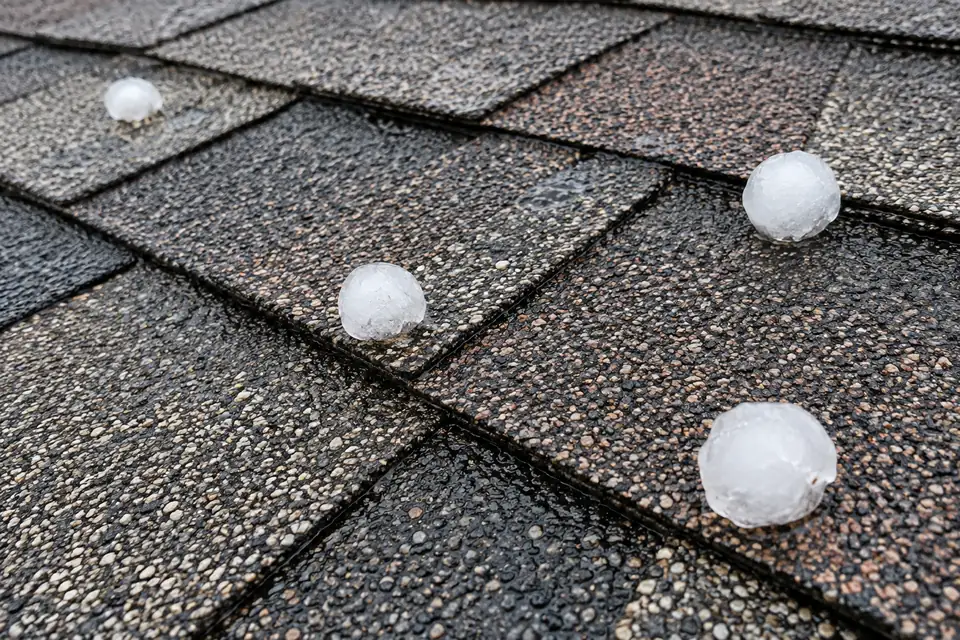
A Class 4 impact-resistant shingle has passed the hardest level of a standard lab test: a 2-inch ball, steel under UL 2218 or ice under FM 4473, strikes the same spot twice without cracking the shingle through. Such shingles do resist hail better than ordinary ones. In a cost survey by IBHS, the Insurance Institute for Business & Home Safety, the best-performing impact-resistant shingles cost about 9% more per square than standard shingles, and some insurers lower premiums for a rated roof. The rating has limits, though. It is a pass on a new product in a lab, not a promise that the roof will come through a storm unmarked, and IBHS research shows that shingles with the same Class 4 label can perform quite differently.
What the Class 4 rating means
There are two standard tests, and each sorts products into four classes by the size of the projectile. Class 4 is the highest.
| UL 2218 | FM 4473 | |
|---|---|---|
| What strikes the roof | steel balls, dropped | ice balls, fired from a launcher |
| Class 1 | 1.25-inch ball | 1.25-inch ice ball |
| Class 2 | 1.5-inch ball | 1.5-inch ice ball |
| Class 3 | 1.75-inch ball | 1.75-inch ice ball |
| Class 4 | 2-inch ball | 2-inch ice ball |
| Written for | prepared roof coverings, including asphalt shingles | rigid roofing, such as tile, slate, concrete and clay |
| What counts as a failure | a crack or tear visible on the back of the shingle | any visible cracking or breakage |
In UL 2218, the steel balls fall from 12 to 20 feet, according to ARMA, the asphalt shingle makers' association, so that each ball hits with about the energy a hailstone of the same size would carry in a storm. FM 4473 fires ice balls at set energies instead; for Class 4 the target is 26.81 foot-pounds. Both tests hit each chosen spot twice, including edges, corners and joints.
Read the pass rule closely. Under UL 2218, crushed granules, dents and marks that show only on the top surface do not count as a failure. A Class 4 shingle is one that did not break through, not one that came out looking new.
Why steel and ice give different results
Ice is closer to real hail than steel. FM 4473 itself says ice balls are the nearest approximation of hailstones known, though generally harder and denser than natural hail. A 2025 article published by IIBEC, the building enclosure consultants' association, notes that steel balls do not deform or shatter the way hail does, so they deliver a more concentrated blow, and that they can exaggerate damage to tile and slate. FM 4473 is written for rigid materials such as tile and slate, while ARMA lists UL 2218 among the test standards for asphalt shingles. Ask which standard stands behind the rating on your estimate.
What IBHS found when it tested rated shingles
IBHS has tested shingles bought from ordinary suppliers, the way a roofer would buy them, for more than a decade.
Its first round, in 2014, put 22 asphalt shingle products from five manufacturers through UL 2218 with its own drop rig. Impact-resistant shingles did clearly better than basic ones: rated 3-tab shingles passed at about 55 to 225 percent higher rates than basic 3-tab across all four ball sizes, and rated architectural shingles about 25 to 80 percent higher than basic architectural. But none of the 22, basic or rated, got through more than the Class 2 ball without at least one test spot failing. Rated shingles made with polymer-modified asphalt did better than those that relied on a mesh or scrim on the back.
Since 2019, IBHS has rated impact-resistant shingles with its own test, which uses lab-made hailstones and scores dents, tears and granule loss rather than giving a simple pass or fail. Products are rated Excellent, Good, Marginal or Poor. The 2025 ratings, released November 19, 2025, covered 24 products, which IBHS says make up about 95% of the impact-resistant shingles sold in the country each year. Most earned Good. None earned Excellent. IBHS says it does not recommend a product rated Marginal or Poor where hail is common, and from 2025 it publishes each product's numerical score as well.
IBHS's summary of this work adds several findings:
- At 1.5 inches, every product tested new rated Good or Excellent, rated or not. Impact-resistant shingles scored about 16% better overall.
- At 2 inches, rated shingles pulled ahead. Where the maker's rated shingle beat its standard one, the Good and Excellent rated shingles scored 14% higher on average, and up to 34% higher for some products.
- Every rated shingle that scored Good or Excellent at 2 inches was made of polymer-modified asphalt. Where a manufacturer sold two rated shingles, the one built on older technology, such as a scrim backing, did worse than that maker's standard shingle.
- Dents and ridges were the weakest scores, and IBHS links dents, ridges and tears most closely to water getting in.
The practical point: "Class 4" on the wrapper is a floor, not a grade. If hail is a real risk where you live, ask your roofer for the exact product line and look up its IBHS rating before you sign.
What they cost
IBHS surveyed prices in seven markets and found that shingles rated Good or Excellent cost 9% more per square (100 square feet of material) on average than shingles without an impact rating. The gap varied a lot from market to market: in some it was 2 to 4%, and where rated shingles were harder to find it was wider.
Cost websites give larger figures. Fixr, in a page last updated August 2, 2022, says Class 4 shingles cost up to 20% more than regular asphalt shingles. The two come from different years and methods, and IBHS's is the only one that says how it was measured. We found no current, national source that reliably prices a full Class 4 roof against a standard one, so ask for both on your estimate, as separate lines for the same roof. Our guide to roof replacement cost covers what the rest of the job costs.
Insurance discounts
Some insurers charge less for a roof built to resist hail. Triple-I, the insurance industry's information group, lists stronger roofing materials among the ways you may be able to lower your premium. A FEMA case study describes an insurer's ten-year study of 40 homeowners in a hail-prone town who installed Class 4 shingles; the insurer reported fewer claims after hail and wind and gave those homeowners premium reductions. This Old House reports discounts as high as 33% at some insurers, but amounts vary by company and by state, and Fixr notes that whether you can get one at all depends on your insurer.
A related program is FORTIFIED, the IBHS re-roofing standard for high wind and hail. IBHS says shingles rated Good or Excellent in its tests qualify for the FORTIFIED Home High Wind & Hail standard. According to a 2023 summary by NAIC, the national association of state insurance regulators, some states run grant programs to help homeowners re-roof to FORTIFIED, and some require or encourage premium discounts for it.
Before you pay extra for a rated roof, ask your insurer:
- Whether it gives a discount for an impact-resistant roof, and how much.
- Whether the discount applies to the whole premium or only the wind and hail part.
- What proof it wants: the product data sheet, the invoice, a certificate or an inspection.
- Whether your policy limits payment for hail damage that only changes how the roof looks. Our guide to hail damage explains cosmetic damage exclusions.
Check your state's rules as well; this is general information, not insurance advice. Our guide to roof age and home insurance covers how insurers treat a new roof.
The limits of the rating
- It tests new shingles. FM 4473 says weathering over time can significantly lower a roof's hail resistance, and its test is meant for new materials. IBHS reports that most asphalt shingles, impact-rated ones included, keep strong hail performance for roughly five years, and that all products eventually decline with age.
- It stops at 2 inches. A Class 4 rating says nothing about hail larger than the biggest test ball.
- It is a lab test. IBHS stresses that standard tests do not exactly reproduce natural hail. Wind-driven hail and repeated storms differ from two straight strikes in a lab.
- The deck matters. The IIBEC article points out that neither standard accounts for how firm the surface under the roof covering is, which strongly affects real hail performance.
- Small hail adds up. IBHS found that repeated small hail strips granules and can leave weathered shingles up to ten times more vulnerable to the next large storm.
- Dents still happen. Because dents and granule loss do not fail UL 2218, a rated roof can still be marked by hail. Whether that is paid for depends on your policy.
How to confirm what you are getting
- Ask for the product line, not just "Class 4". An estimate should name the manufacturer, the exact shingle and the standard it is rated under.
- Get the product data sheet. It should state the impact class and the standard. FM's listing program under FM 4473 requires the classification to be marked on the packaging and the product.
- Look up the IBHS rating of that shingle on its public scorecard if hail is common where you live.
- Keep the paperwork. Save the invoice, the data sheet and a bundle wrapper. Your insurer may ask for them.
Frequently asked questions
Are Class 4 shingles hail-proof?
No. They resist impact better than standard shingles, but the rating means the new shingle did not crack through when struck by a 2-inch ball in a lab. Larger hail, older shingles and repeated storms can still damage them.
Is Class 3 good enough?
A Class 3 shingle passed with a 1.75-inch ball rather than a 2-inch one. IBHS's tests found that almost every shingle, rated or not, performs well against 1.5-inch hail when new, and that rated shingles stood out at 2 inches. IBHS counts both Class 3 and Class 4 products as impact-resistant, and the FORTIFIED standard looks to its Good and Excellent ratings. Ask your insurer which class, if any, earns a discount.
Do all Class 4 shingles perform the same?
No. IBHS's ratings show wide differences between products that carry the same Class 4 label, and the older scrim-backed designs did worse than polymer-modified ones.
Will my insurer give me a discount?
It depends on the insurer and your state. Some give a discount for a rated roof and some do not. Ask before you buy, and ask what proof they need.
Can metal or tile roofs be Class 4?
They can be. Ratings belong to products, not materials, and FM 4473 is written specifically for rigid roofing such as tile and slate. Ask for the class and the standard of the exact product. Our guide to metal roofs and shingles compares the two.
Where this information comes from
HomeAnvil does not yet publish price data of its own. Every figure on this page comes from the sources below, read on September 26, 2026:
- IBHS, Relative Impact Resistance of Asphalt Shingles: Summary of UL 2218 Impact Tests, August 2014: the UL 2218 ball sizes and pass rule, and the results for 22 products.
- IBHS, Hail Impact Performance of Asphalt Shingles: At a Glance, undated: the lab hailstone ratings, the 9% cost difference and qualification for FORTIFIED.
- IBHS, IBHS releases its most expansive impact-resistant shingle ratings to date, November 19, 2025: the 2025 ratings.
- IBHS, 2025 Year in Review: hail performance by shingle age.
- IBHS, Impact testing of high concentrations of small hail: small hail and later vulnerability.
- FM Approvals, Class 4473 Specification Test Standard, July 2005: ice ball sizes, energies, pass rule, scope and marking.
- ARMA, Asphalt shingle product and test standards: UL 2218 drop heights and FM 4473.
- IIBEC, Impact resistance of roof coverings, by Patterson and Beckner, 2025: steel against ice, and the role of the substrate.
- Fixr, Class 4 shingles, updated August 2, 2022: the up-to-20% premium.
- Triple-I, 12 ways to lower your homeowners insurance costs: stronger roofing materials and premiums.
- FEMA, Hail, hail, the roof's still here, updated February 11, 2021: an insurer's ten-year study of Class 4 shingles.
- This Old House, Impact-resistant roofs, updated April 14, 2026: the reported upper range of discounts.
- NAIC, State mitigation programs, 2023: state grant and discount programs for FORTIFIED roofs.
We will update this page when these sources publish new findings, and the date above will say when.
Related guides
 How do you know if hail damaged your roof?Quarter-size (1 inch) hail can start to damage older 3-tab shingles, laminated ones at 1.25 inches. How to spot real damage and when to call your insurer.
 How does your roof's age affect your homeowners insurance?Many insurers inspect or decline roofs over 20 years old, and older roofs are often paid at depreciated value. What to check in your policy and at renewal.
 How does a roof insurance claim work after a storm?Insurance usually pays for sudden wind or hail damage, not wear. Wind/hail deductibles often run 1% to 5% of your home's insured value. How a claim works.
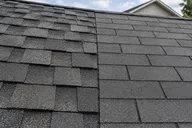 Are architectural shingles worth it over 3-tab shingles?Architectural shingles start near $3.50 a square foot against $1.50 for 3-tab, last about 30 years instead of 20, and carry longer warranties.
 Is a metal roof worth it over asphalt shingles?A standing-seam metal roof costs about 1.6 times as much as asphalt shingles ($51,865 against $31,871) but is rated to last 40 to 80 years instead of 20 to 30.
 How do the major shingle brands compare?Shingle makers sell a standard warranty with every roof and longer system warranties only through credentialed roofers. How to compare lines on your estimate.