
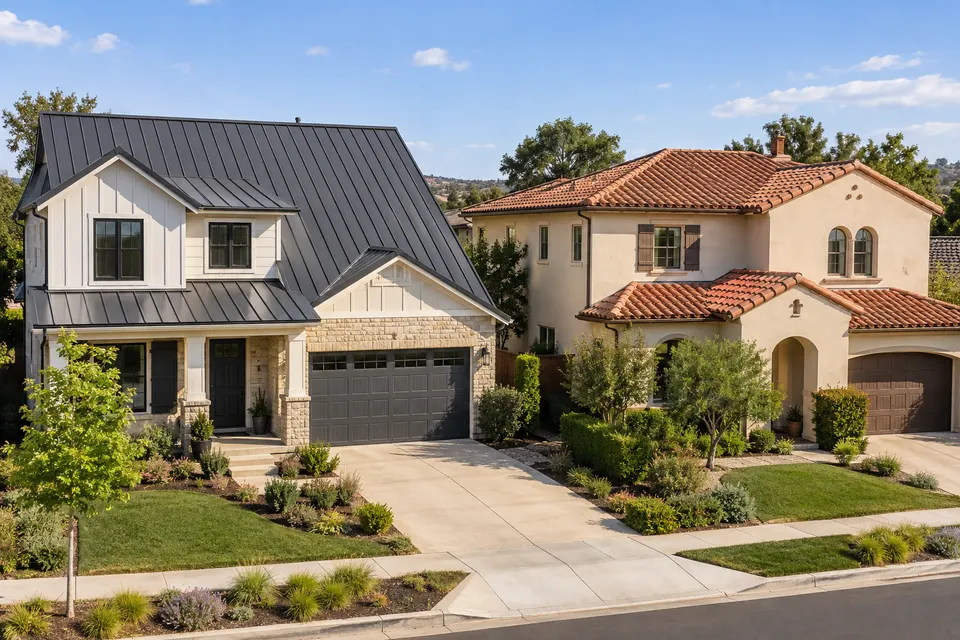
Metal usually costs less to put on, and tile usually lasts longer. HomeAdvisor's survey of its customers puts a typical metal roof at $6,045 to $18,341, averaging $11,765, and a typical tile roof at $8,476 to $26,223, averaging $17,349. Tile is the heavier choice by far: concrete tile weighs 900 to 2,000 pounds per square, according to the home inspectors' association InterNACHI, while one metal roofing maker puts steel standing seam at 85 to 120 pounds per square. A square is 100 square feet of roof. Metal suits a house built for a light roof, a low slope or a budget; tile suits a sound, strong frame, a hot climate and an owner who plans to stay for decades.
Metal and tile side by side
| Metal | Clay or concrete tile | |
|---|---|---|
| Typical total (HomeAdvisor, June 2026) | $6,045 to $18,341 | $8,476 to $26,223 |
| Average total (HomeAdvisor) | $11,765 | $17,349 |
| Installed, per square foot (HomeAdvisor) | $4 to $30 | $7 to $25 |
| Life (InterNACHI chart) | 40 to 80 years; copper 70 or more | more than 100 years |
| Weight per square | 85 to 120 pounds, steel standing seam (Englert) | 900 to 2,000 pounds, concrete (InterNACHI) |
| Fire | Class A, often only as an assembly (Building America) | Class A (InterNACHI) |
| Hail rating to ask for | UL 2218 Class 4 | FM 4473 Class 4 |
| Average repair (HomeAdvisor) | $1,700 to $1,919, by page | $1,000 |
Each row is explained below, with the source for every figure.
What each roof costs
| Source | Metal | Tile |
|---|---|---|
| HomeAdvisor, updated June 19, 2026, typical total | $6,045 to $18,341 | $8,476 to $26,223 |
| HomeAdvisor, average | $11,765 | $17,349 |
| HomeAdvisor, per square foot installed | $4 to $30 | $7 to $25 |
| Fixr, updated January 31, 2025 | not read for this page | $19,000 to $35,000; about $27,000 for a 1,500-square-foot roof |
On HomeAdvisor's averages, tile costs about $5,600 more than metal (our subtraction: $17,349 less $11,765). The ranges overlap because the type of metal and panel, and the type of tile, move the price more than the category does. Painted steel with exposed fasteners sits at the bottom of metal's range and copper standing seam at the top; our guide to what a metal roof costs breaks it down by metal and panel. Concrete tile generally costs less than clay; our guide to what a tile roof costs covers the two.
Two costs fall mostly on tile:
- Strengthening the frame. Fixr puts it at $1,000 to $10,000 when a house needs it. See the weight section below.
- Specialist labor. HomeAdvisor says tile flashing is different from other roofs and should be installed by tile roof professionals to prevent leaks.
To price your own roof in both materials, measure it in squares and use the roof cost calculator.
How long each lasts
| Source | Metal | Tile |
|---|---|---|
| InterNACHI, the home inspectors' association | 40 to 80 years; copper 70 or more | more than 100 years, clay or concrete |
| HomeAdvisor | 40 to 70 years; copper more than 100 | concrete 30 to 50 years; clay more than 100 |
| Fixr | not read for this page | concrete about 50 years; clay about 100 |
| DOE Building America Solution Center | up to 50 years or more | can exceed 100 years |
| Metal Roofing Alliance, the metal industry's trade group | 30 to 50 years or more | not given |
Every source puts clay tile at the top. The sources disagree most on concrete tile, which HomeAdvisor and Fixr put at 30 to 50 years and InterNACHI at more than 100. InterNACHI notes that a roof's life depends on the weather, the design, the quality of the material and the care it gets.
The tile is not the whole roof. Under it sits an underlayment that wears out long before the tile does, and replacing it means lifting and relaying the tile. Our tile roof cost guide explains that job and what to ask about it. On metal, the paint finish and, on exposed-fastener panels, the screws are what age first; our guide to standing seam and exposed-fastener metal roofs covers both. For every material side by side, see how long a roof lasts.
Weight and your roof frame
This is the difference that can decide the choice before any other.
| Covering | Weight per square (100 square feet) | Source |
|---|---|---|
| Aluminum standing seam | about 70 pounds | Englert, a metal roofing maker |
| Steel standing seam | 85 to 120 pounds | Englert |
| Clay or concrete tile | 550 to 1,000 pounds | Englert gives 5.5 to 10 pounds per square foot; we multiplied by 100 |
| Concrete tile | 900 to 2,000 pounds | InterNACHI |
The Department of Energy's Building America Solution Center says tile is about three times heavier than asphalt roofing, and that the framing and sheathing must be strong enough to carry it. InterNACHI suggests a structural engineer's review where the framing may not be adequate. By the figures above, a concrete tile roof can weigh roughly 7 to 20 times as much as steel standing seam (our division of InterNACHI's range by Englert's). Fixr gives a much lower tile weight of about 225 pounds per square, which conflicts with both InterNACHI and Englert, so we have not used it.
What that means for you:
- Replacing tile with metal takes a large load off the frame and needs no strengthening for the metal.
- Replacing shingles or metal with tile may need the frame checked and strengthened first. Ask for that assessment, and its price, before you sign.
- Replacing tile with tile usually means the frame has carried the load before, but have it checked for sagging or damage when the old tile comes off.
Heat and energy
Both can be made into a cool roof. The Department of Energy's consumer guide to cool roofs lists clay tile, concrete tile and metal among the cool products available for steep roofs, and says a cool-colored roof can cut at least 5 to 20% from the cooling part of an energy bill, with the most savings in hot and warm climates. It adds that a cool roof can raise heating needs a little in winter.
Each material has its own way of dealing with heat:
- Metal. The Building America guidance recommends a metal roof with a solar reflectance index of at least 29 on a steep roof, which a light or cool-colored factory finish can reach. The Metal Roofing Alliance says metal can save 10 to 40% in energy costs; that is the industry's own claim, and the savings depend on the color, the climate and the insulation.
- Tile. The Building America guidance says the weight of tile gives it thermal mass that can help regulate indoor temperatures in hot climates. The tile industry also points to the air space under each tile, but we did not find a published neutral measurement of it, so we do not give a figure.
Our guide to cool roofs and energy bills explains reflectance and emittance and what savings to expect.
Hail, wind and fire
Both materials can earn top ratings. The rating belongs to a specific product and installation, so ask for the rating of the one on your estimate.
| Metal | Tile | |
|---|---|---|
| Hail test | UL 2218, steel balls dropped on the roofing | FM 4473, ice balls fired at the tile |
| What the IBHS FORTIFIED hail standard requires | UL 2218 Class 4 | FM 4473 Class 4 |
| How hail usually shows | Dents, often cosmetic | Cracked or broken tiles |
| Wind (industry claims) | 140 mph rating (Metal Roofing Alliance) | can be designed for up to 200 mph (Tile Roofing Industry Alliance) |
| Wind (InterNACHI) | not given | more than 125 mph when properly installed |
| Fire | Class A, usually needing a noncombustible deck or fire-resistant underlayment | Class A |
Hail. The FORTIFIED Home hail supplement from IBHS, the insurance industry's research institute, says a Class 4 metal roof is likely to survive most hailstones without functional damage but can be left with permanent dents; a granular coating can make small dents less visible. InterNACHI says metal panels resist hail better than metal shingles, because the deck supports the whole panel. For tile, InterNACHI says concrete and clay typically reach Class 3 or 4, with more variation in clay. The Building America guidance warns that tile can still break under a heavy impact such as a falling branch. HomeAdvisor notes that insurers may exclude cosmetic damage or pay only part of it. What your policy covers is set by its wording; this is not insurance advice. Our guide to hail damage explains the damage and the classes.
Wind. The trade groups' numbers are the best a product can do, not what every roof achieves. The Building America guidance says tile must be rated for the local wind zone, and that a metal roof's resistance depends on the spacing of its clips or screws. Ask for the tested uplift rating of the exact product and the fastening pattern the crew will use.
Fire. Both are noncombustible. On both, gaps at the eaves and ridge can hold nests and debris that embers can ignite, which our guide to fire-resistant roofing covers along with vents and gutters.
Noise
The Metal Roofing Alliance says there is little difference between metal and other roofing in noise from rain or hail, and HomeAdvisor says a properly insulated and installed metal roof should not sound much different from shingles in the rain. Both statements assume metal over a solid deck with insulation. We did not find a neutral measurement comparing metal with tile. If noise matters to you, ask what goes between the metal and your ceiling: the deck, the underlayment and the attic insulation.
Maintenance and repairs
| Metal | Tile | |
|---|---|---|
| Average repair (HomeAdvisor, June 2026) | $1,919 on its metal repair page; $1,700 on its general repair page | $1,000 |
| Typical metal repair (HomeAdvisor) | $640 to $3,199 | |
| Typical tile leak repair (HomeAdvisor) | $100 to $2,000 | |
| Main upkeep | Screws on exposed-fastener panels, paint finish | Broken tiles, underlayment, sealing |
HomeAdvisor gives two averages for metal repairs on two pages updated the same day; we show both.
Metal. Standing seam hides its fasteners and needs little beyond inspection and cleaning. Exposed-fastener panels have screws that loosen as the metal moves with heat and cold; our standing seam guide explains that upkeep and its cost.
Tile. Tiles break underfoot. InterNACHI warns that walking on concrete tile risks breaking it, and says to step on the lower 3 inches of flat tiles and avoid the fragile edges of interlocking ones. Keep anyone who does not know how to cross a tile roof off it, including satellite and solar installers. HomeAdvisor says regular cleaning can add 10 to 20 years to a tile roof's life and puts sealing at an average of $1,400, which it says may be needed every few years; ask your roofer whether your tile needs sealing at all. The Tile Roofing Industry Alliance calls clay and concrete tile virtually maintenance-free, which is true of the tile more than of the underlayment beneath it.
Looks and resale
Tile comes in curved and flat profiles, and Fixr says tile is more versatile in color and shape than metal. Metal comes as standing seam panels or as metal shingles and tiles pressed to look like other roofing; Fixr prices metal tiles at $5 to $10 a square foot for material. A metal roof shaped like tile is lighter but will not look identical from the street, so ask to see an installed example.
On resale, the Metal Roofing Alliance says metal adds to a home's value, which is the industry's own claim. The national Cost vs Value report tracks metal and asphalt roof replacement but not tile, so there is no like-for-like national figure for the two. Our guide to whether a new roof adds value covers what a roof does at sale. A new roof of either kind rarely pays for itself when you sell; choose for how long you will stay and how the roof must perform.
Which fits your house
Metal tends to fit when:
- The frame was built for shingles and you do not want to strengthen it.
- The roof has a low slope. InterNACHI says tile needs at least 2 in 12; our standing seam guide gives the lower minimums for metal panels.
- The budget is closer to HomeAdvisor's metal average than its tile average.
- Hail is common and you want a Class 4 product that dents rather than breaks.
Tile tends to fit when:
- The house already carries tile, or an engineer confirms the frame can.
- The climate is hot and sunny, where thermal mass and a light-colored tile help.
- You want the longest-lived covering and plan to stay for decades.
- The look of tile suits the house and its neighbors.
What to ask before you sign
- For tile: has the frame been assessed for the weight, by whom, and what would strengthening cost?
- The exact product: the metal, gauge, panel and finish, or the tile maker, profile, and clay or concrete.
- The hail rating (UL 2218 or FM 4473 class), the tested wind uplift rating and the fire class of that product as installed.
- The underlayment, its expected life, and for tile, how it laps on your roof's slope.
- For tile: how many tiles they expect to break, and whether extra tile for future repairs is included.
- The manufacturer's warranty, whether it covers leaks or only the finish, and the contractor's own warranty on labor, in writing.
- How many roofs of this exact material the crew has installed.
Check the contractor as well as the estimate: our guide to what to check before you hire a contractor covers licenses, insurance and references, and questions to ask a roofer has more.
Frequently asked questions
Is metal or tile cheaper?
Metal, on average. HomeAdvisor's customers report an average of $11,765 for metal and $17,349 for tile, and tile may also need the frame strengthened, which Fixr puts at $1,000 to $10,000. The ranges overlap, so a copper roof can cost more than a concrete tile one.
Which lasts longer, metal or tile?
Clay tile, in every source we read, at around 100 years or more. Metal is rated at 40 to 80 years by InterNACHI. Concrete tile estimates vary from 30 to 50 years (HomeAdvisor) to more than 100 (InterNACHI). On a tile roof, the underlayment usually needs replacing well before the tile.
Can I replace a tile roof with metal?
Yes. Metal is far lighter, so the frame carries less load, not more. The old tile has to come off first, and the Building America guidance says to remove all existing roofing and underlayment before a metal roof goes on.
Is a metal roof louder than tile in the rain?
The Metal Roofing Alliance and HomeAdvisor both say a properly installed and insulated metal roof is not much louder than other roofing. We found no neutral measurement comparing metal with tile directly.
Which is better in hail?
Both can earn Class 4 ratings, UL 2218 for metal and FM 4473 for tile. Metal tends to dent, often cosmetically; tile tends to crack or break. Ask for the class of the exact product and check how your insurance policy treats cosmetic damage.
How we got these numbers
HomeAnvil does not yet publish price data of its own. Every figure on this page comes from a published source, read on September 27, 2026:
- HomeAdvisor, metal roof cost, updated June 19, 2026: metal totals, average, price per square foot, lifespan and its note on noise. HomeAdvisor says its figures come from surveying its customers, combined with other published research.
- HomeAdvisor, tile roof cost, updated June 19, 2026: tile totals, average, price per square foot, lifespans, flashing, cleaning, sealing and leak repair costs.
- HomeAdvisor, metal roof repair cost, updated June 19, 2026, and roof repair cost, updated June 19, 2026: metal and tile repair averages and the note on cosmetic damage.
- Fixr, tile roof installation cost, updated January 31, 2025: tile totals, reinforcement, lifespans, the price of metal tiles and its comment on tile's range of colors and shapes. Its tile weight of about 225 pounds per square conflicts with InterNACHI and Englert, so we have not used it.
- InterNACHI, the International Association of Certified Home Inspectors: life expectancy chart; tile roofs part 1 (fire, hail and wind), part 2 (minimum slope) and part 4 (concrete tile weight, structural review, walking on tile); and metal roofs part 10 (hail on panels and metal shingles).
- U.S. Department of Energy, Building America Solution Center: metal roofs (lifespan, reflectance, fire rating, removing existing roofing, wind attachment) and clay or concrete tile roofs (weight, thermal mass, fire, hail, wind, lifespan and breakage).
- U.S. Department of Energy, Consumer Guide to Cool Roofs, posted August 2021: cool tile and metal products and cooling savings.
- IBHS, FORTIFIED Home Hail Supplement, 2020: the UL 2218 and FM 4473 Class 4 requirements and dents on metal.
- Englert, metal roofs versus other roof choices: weights of standing seam and of tile, from a metal roofing maker. We cite it as a manufacturer's statement, not a recommendation.
- Metal Roofing Alliance, frequently asked questions: lifespan, wind rating, energy savings, noise and resale, from the metal roofing industry's trade group.
- Tile Roofing Industry Alliance, durability and longevity: wind, hail and maintenance claims, from the tile industry's trade group.
- The price difference, the per-square tile weights from Englert and the weight ratio are our own arithmetic from the figures above.
We will update this page when these sources publish new figures, and the date above will say when.
Related guides
 How much does a metal roof cost?A metal roof typically costs $6,045 to $18,341 installed, or $5 to $16 per square foot. Prices by metal and panel type, repair costs and lifespan.
 How much does a tile roof cost? Clay vs concreteA tile roof typically costs $8,476 to $26,223, or $7 to $25 a square foot installed. Clay vs concrete, weight, underlayment and repair costs compared.
 Standing seam vs exposed-fastener metal roofsStanding seam costs $9 to $16 per square foot installed against $5 to $12 for exposed-fastener panels. It hides its screws, needs less upkeep and lasts longer.
 What makes a roof fire-resistant?Roofs are rated Class A, B or C for fire under ASTM E108 and UL 790. Asphalt shingles, tile, slate and metal can rate Class A. Why embers and vents matter.
 How do you know if hail damaged your roof?Quarter-size (1 inch) hail can start to damage older 3-tab shingles, laminated ones at 1.25 inches. How to spot real damage and when to call your insurer.
 How long does a roof last?Architectural shingles last about 30 years, 3-tab about 20, metal 40 to 80, slate 60 to 150. What shortens a roof's life, and why a warranty isn't a lifespan.