
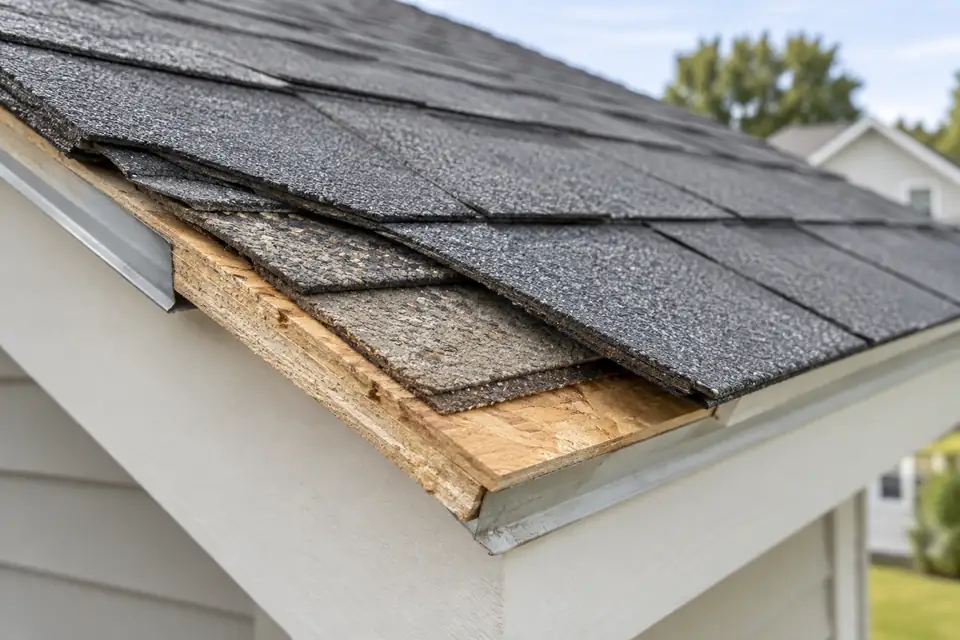
Often you can, but only once. Where your local code follows the International Residential Code, section R908.3.1.1 does not allow new shingles over a roof that already has two or more layers of any covering, over a roof that is water-soaked or too deteriorated to be a base, or over slate, clay, cement or asbestos-cement tile. A layover, also called a roof-over or recover, skips the cost of tearing off and hauling away the old roof, which HomeAdvisor puts at $1,500 to $4,500 together. In exchange, the deck stays hidden, the roof gets heavier, some warranties are off the table, and the next roof has two layers to remove.
What the building code says
The International Residential Code calls a new covering over an old one a roof recover, and section R908.3.1.1 lists the three cases where it is not allowed:
- the existing roof or roof covering is water-soaked, or has deteriorated so far that it is not an adequate base for more roofing;
- the existing covering is slate, clay, cement or asbestos-cement tile;
- the existing roof already has two or more applications of any type of roof covering.
So a roof with one layer of asphalt shingles in reasonable shape can usually take a second layer, and a roof with two layers cannot take a third. Codes are adopted and amended place by place, and some are stricter: InterNACHI, the home inspectors' association, notes that in a few places the limit is a single layer. Ask your roofer or your local building department what applies to your house before you decide, and make sure the permit, where one is required, describes the work that is actually being done.
When a layover can work, and when it can't
The Asphalt Roofing Manufacturers Association (ARMA) says a tear-off may not be needed when the roof has only one layer of shingles that lie flat and the deck is in good condition. In that case the old layer even serves as a backup under the new one.
ARMA says the old shingles will probably have to come off when:
- an inspection finds rotted or warped wood, or large gaps between deck boards;
- there are already more than two layers, or your local code requires removal sooner;
- the roof sags along the ridge or between the rafters or trusses, in which case ARMA advises having a structural engineer inspect it;
- the old shingles are so curled or distorted that the new ones could not be made to lie flat.
If any of these describe your roof, a layover is not a cheaper version of the same job. It is a new roof on a base that will not hold it well.
Layover or tear-off at a glance
| Layover | Tear-off | |
|---|---|---|
| Old roof removed | No | Yes, down to the deck |
| Removal and disposal cost | None | $1,000 to $3,000 to remove, plus $500 to $1,500 to haul away (HomeAdvisor) |
| Deck inspected | Only from the attic and by walking the roof | Every sheet, in the open |
| Rotten decking replaced | Only where it is found without removing the roof | Wherever it is found |
| Weight on the structure | Old layer plus new layer | New layer only |
| Allowed on a roof with two layers | No, under IRC R908.3.1.1 | Yes |
| Top-tier manufacturer warranties | May not qualify; Owens Corning's Platinum Protection requires the old roof removed | Eligible, if the other conditions are met |
| The next reroof | A full tear-off of two layers | Can be a tear-off of one layer, or perhaps a layover |
What a layover saves
The saving is the tear-off. HomeAdvisor's roof replacement cost guide, updated June 17, 2026, puts removal of an old roof at $1,000 to $3,000 and hauling and disposal at $500 to $1,500, and says a roof with several layers costs more to strip because each layer has to be stripped and disposed of. A HomeAdvisor article written for roofers estimates that a typical 20-square roof, 2,000 square feet, costs at least $1,000 less to recover than to tear off.
The new shingles and the labor to lay them are still in the price, so the saving is limited to what the tear-off would have cost, and some of it comes back later: when the layered roof wears out, both layers have to come off at once. Our guide to what a roof replacement costs shows how to compare estimates per square.
The extra weight
A second layer roughly doubles the weight of shingles on the roof. CertainTeed's data sheet for its Landmark architectural shingles puts their weight at 211 to 225 pounds per square, depending on where they were made. On a roof of about 19 squares, that is roughly 4,000 to 4,300 pounds of new shingles resting on top of the old ones, which stay in place.
ARMA lists a sagging roof structure as a reason to tear off rather than recover. HomeAdvisor's guide makes the same point in plainer terms: leaving the old roof in place adds load to your roof. If your roof already has a dip along the ridge or between the rafters, have it looked at before anyone adds a layer.
The deck you can't see
The biggest cost of a layover is information. With the old roof left on, no one sees the wood deck underneath. HomeAdvisor notes that leaving the old roof in place makes rotting wood and leaks hard to detect, and ARMA lists rotted or warped decking as a reason to tear off.
Before you agree to a layover, ask the roofer to:
- Inspect the attic for water stains, dark or soft sheathing, daylight through the boards and damp insulation.
- Walk the whole roof for soft or spongy spots, and show you photos.
- Explain the nails. Owens Corning's installation instructions require each nail to go at least 3/4 inch into the wood deck, or through it by at least 1/4 inch, so nails driven through two layers of shingles need to be long enough to reach it.
- Say what happens to the flashing around chimneys, walls and vents, and to the drip edge.
A tear-off lets the crew replace every rotten sheet it finds, as our guide to the roof replacement process describes. A layover can only treat what shows from above and below.
Warranties
Manufacturer terms vary, so read the warranty for the exact shingle before you sign.
- Standard shingle warranties. Owens Corning's installation instructions say its Duration shingles are designed for new roofs or for reroofing over a properly built and supported wood deck, so a layover is not ruled out by the instructions themselves.
- Top-tier system warranties. Owens Corning's Platinum Protection warranty requires the roofing system to be installed over a clean deck with all existing roofing material removed, down to the old felt, flashings and vents. A layover does not qualify.
- What a claim pays. IKO's standard limited warranty does not cover labor, tear-off or disposal of the shingles. On a layered roof, removal means two layers.
- Inspectors' view. InterNACHI's roof inspection course goes further and tells inspectors that shingles installed over other shingles will void any manufacturer's warranty. The manufacturers' own documents are the ones that count for your roof, so ask the roofer to show you the terms in writing.
Your roofer's own workmanship warranty is separate. Ask whether it covers a layover on the same terms as a tear-off.
Heat, lifespan, resale and insurance
A second layer changes how the roof ages. InterNACHI notes that shingles over another layer shed heat more slowly, which shortens their life, and may send more heat into the living space; it also notes that the extra layer makes a leak less likely. For typical lifespans, see our guide to how long a roof lasts.
When you sell, a buyer's home inspector is likely to notice. InterNACHI's inspection course teaches inspectors to spot nested shingles, where the top edge of each new shingle butts against the bottom edge of an old one, and to report the number of layers. A buyer who reads that there are two layers knows that the next roof is a full tear-off of two layers, which HomeAdvisor says costs more than removing one.
On insurance, a layover can rule out some programs. The FORTIFIED Roof standard from IBHS, a voluntary standard for storm-resistant roofing, requires all existing roofing material to be removed and the deck renailed. If you are considering a FORTIFIED roof, or a discount tied to one, a layover will not qualify. Ask your insurer how a layered roof affects your policy before you choose; our guide to roof insurance claims explains how a roof's age and condition come into a claim.
Frequently asked questions
How many layers of shingles are allowed on a roof?
Where your local code follows the International Residential Code, a new layer is not allowed over a roof that already has two or more layers, so two is the practical maximum. Some places allow only one. Check with your building department.
How much cheaper is a layover than a tear-off?
It saves the tear-off: HomeAdvisor puts removal at $1,000 to $3,000 and hauling and disposal at $500 to $1,500. A HomeAdvisor article for roofers estimates at least $1,000 saved on a typical 2,000-square-foot roof. The new shingles and their installation are still part of the price.
How can I tell if my roof already has two layers?
Look at the edge of the roof, at the eaves or the rakes, where you may see two sets of shingle edges. InterNACHI describes nested shingles as new shingles whose top edges butt against the bottom edges of the old ones. A roofer can confirm it by lifting a shingle.
Can you put new shingles over wet or damaged ones?
Not under the International Residential Code, which bars a recover over a roof that is water-soaked or too deteriorated to serve as a base. ARMA also advises removing shingles that are too curled or distorted for new ones to lie flat.
Does a layover void the shingle warranty?
It depends on the manufacturer and the warranty. Owens Corning's instructions allow its Duration shingles on reroofing work, but its Platinum Protection warranty requires the old roof removed. Read the warranty for the exact shingle, and get it in writing.
Where this information comes from
HomeAnvil does not yet publish data of its own on roofing jobs. Every figure and rule on this page comes from a published source, read on September 26, 2026:
- International Residential Code, section R908.3.1.1, the conditions under which a roof recover is not allowed, read in the published code text at UpCodes. Building codes are adopted, and often amended, place by place.
- HomeAdvisor, roof replacement cost, updated June 17, 2026: the cost of removing and disposing of an old roof, extra layers, and the drawbacks of leaving the old roof in place.
- HomeAdvisor, reroofing over asphalt shingles, an article for roofers: the saving of at least $1,000 on a 20-square roof. The page carries no date.
- Asphalt Roofing Manufacturers Association, asphalt shingle reroofing: replacement vs. recover, revised May 2017.
- CertainTeed, Landmark shingles technical data sheet: weight per square. The sheet carries no date.
- Owens Corning, Duration series shingles installation instructions, January 2026: new or reroofing work, and nail penetration into the deck.
- Owens Corning, Platinum Protection limited warranty, publication 10020608-F, January 2020, as posted by a contractor: removal of all existing roofing.
- IKO, limited warranty for asphalt shingles, for shingles installed on or after February 1, 2025: tear-off and disposal not covered.
- InterNACHI, Mastering Roof Inspections: Asphalt Composition Shingles, Part 28: nested shingles, layer limits, heat and lifespan, reporting layers and its view on warranties. The page carries no date.
- FORTIFIED, a program of IBHS, re-roofing checklist for FORTIFIED Home designations, version 2024.1, for the 2025 FORTIFIED Home standard: removal of all existing roofing and renailing the deck.
The removal and disposal range at the top adds HomeAdvisor's two ranges together. The weight example multiplies CertainTeed's weight per square by a 19-square roof. We will update this page when these sources change, and the date above will say when.
Related guides
 Should you repair or replace your roof?Most roof repairs cost $395 to $1,967; a replacement typically costs $5,900 to $13,400. How age, damage, layers and repair history decide which one you need.
 How much does a roof replacement cost?A roof replacement typically costs $5,900 to $13,400, or $400 to $1,100 per square installed. How to measure your roof, what moves the price and how to compare estimates.
 What happens during a roof replacement, step by step?An asphalt shingle roof usually goes on in one to three days. What happens before, during and after, from tear-off and deck repair to flashing and cleanup.
 How long does a roof last?Architectural shingles last about 30 years, 3-tab about 20, metal 40 to 80, slate 60 to 150. What shortens a roof's life, and why a warranty isn't a lifespan.
 How does a roof insurance claim work after a storm?Insurance usually pays for sudden wind or hail damage, not wear. Wind/hail deductibles often run 1% to 5% of your home's insured value. How a claim works.
 What are the signs you need a new roof?The signs a roof needs replacing, outside and in: age past 20 to 30 years for shingles, bald or curling shingles, repeat leaks, a sagging line. What each means.