
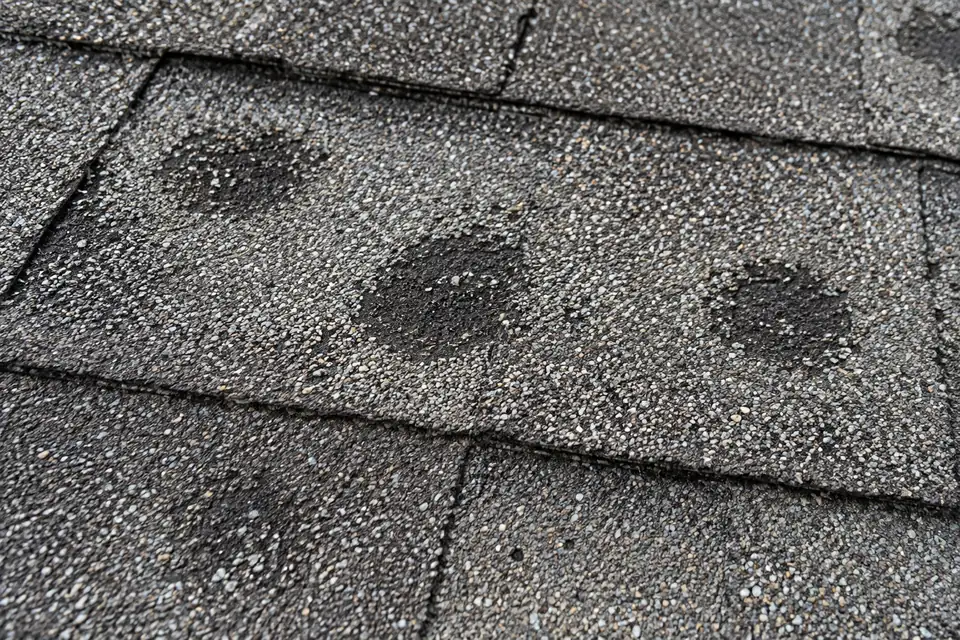
Hail damage on an asphalt shingle roof shows up as dark spots where granules were knocked off, soft "bruises" you can feel with a finger, and cracks or torn edges; on the metal around it, as round dents in vents, flashing and gutters. The National Weather Service calls hail severe at 1 inch across, about the size of a quarter, and that is roughly where damage begins: in impact tests and field surveys by engineers at Haag Engineering, 1-inch hail began to damage 3-tab shingles and laminated (architectural) shingles at about 1.25 inches. Not every mark matters. The roofing contractors' association NRCA says most hail damage is cosmetic and does not shorten the life of the shingles; what counts is damage that lets water in or wears the roof out sooner.
Hail size and the damage it can do
The size of the stones is the first clue. The National Weather Service asks people to report hail by comparing it with everyday objects, and the Haag researchers recorded the smallest hail that started to damage each roofing product in real storms.
| Hail diameter | What it looks like | Roughly how fast it falls | What field surveys found it can start to damage |
|---|---|---|---|
| 0.75 inch | penny | not given | below the smallest threshold in the field surveys |
| 1 inch | quarter | about 50 mph | 3-tab asphalt shingles |
| 1.25 inches | half dollar | about 56 mph | laminated asphalt shingles, cedar shingles |
| 1.5 inches | walnut or ping pong ball | about 61 mph | medium cedar shakes, fiber-cement tiles |
| 1.75 inches | golf ball | about 66 mph | concrete tiles |
| 2 inches | hen egg | about 72 mph | every product in the lab tests showed some damage |
| 2.75 inches | baseball | about 84 mph | above every threshold in the field surveys |
The fall speeds are the terminal velocities the Haag paper lists for hailstones of each size. Treat the thresholds as a starting point, not a rule. The same paper found that older, thinner and lighter products fail at smaller sizes, and that the hail's shape, hardness, speed and angle of impact all change the result.
Size is not the whole story: roof age and small hail
A roof's age matters as much as the size of the hail. IBHS, the insurance industry's building research institute, says most asphalt shingles, including impact-rated ones, perform well for roughly the first five years, and that conventional shingles between five and ten years old lose much of that resilience, even in moderate storms. InterNACHI, the home inspectors' association, adds that shingles grow more brittle in the cold, so the same hail does more harm on a cool, rain-soaked roof.
Small hail adds up. IBHS published research in 2025 on hail under 1 inch across. Shingles that were weathered and hit by repeated small hail became up to ten times more susceptible to damage from a later, larger hailstorm, because the small stones knock off the protective granules and leave the asphalt exposed to the sun.
What hail damage looks like on shingles
- Granule loss at the point of impact. Dark, roughly round spots where the colored granules are gone and the black asphalt shows. InterNACHI says granule loss has to be plain to a casual observer to count as functional damage.
- Bruises. When a hailstone flexes a shingle, the mat underneath can fracture without breaking the surface. InterNACHI describes the result as a soft spot you can feel with a finger, and treats it as functional damage.
- Cracks, tears and punctures. NRCA lists granule loss, material knocked off the edges of shingles, and penetration as the forms of hail damage on asphalt shingles.
- Damage at edges and ridges first. InterNACHI notes that the edges of shingles are more fragile, and that ridge and hip caps are poorly supported and more likely to be hurt.
Some marks are not hail. InterNACHI points out that new shingles shed loose "hitchhiker" granules in their first months, and that general granule loss from age, the kind that collects in gutters on an old roof, is not functional damage. NRCA describes blisters as swelling caused by gas trapped in the shingle.
Blisters, worn granules and foot traffic can look like hail. To tell them apart, see hail damage vs blistering.
Metal roofs, vents, flashing and gutters
Soft metal is where hail leaves its clearest record. Thin aluminum parts such as vent caps dent easily, and both NRCA and InterNACHI say inspectors use those dents to help confirm that hail struck the roof.
- Metal roofs. InterNACHI says hail may dent metal panels but seldom does functional damage, because panels are supported by the deck beneath them. Metal shingles, which rest on their edges, dent more easily. The damage that counts is at seams, ridge and hip caps and trim, where a severe dent can open a joint to water or weaken the roof against wind.
- Vents. InterNACHI classes hail dents in metal vents as cosmetic on their own, but they are the first place to look for proof of the storm.
- Gutters and downspouts. InterNACHI classes hail dents in gutters and downspouts as cosmetic. They are still worth photographing as evidence of the storm, and a heavy wash of fresh granules at the downspouts after a storm is a reason to have the roof looked at.
If you are deciding between materials for a replacement, our guide to metal roofs and asphalt shingles compares them.
Cosmetic or functional damage
Roofing and insurance both draw the same line. InterNACHI defines functional damage as damage that reduces a roof's ability to shed water or shortens its expected service life; anything else is cosmetic. A manufacturer of stone-coated metal roofing, DECRA, draws the same line for its warranty and treats dents and granule loss at the impact site as appearance only.
| Usually functional | Usually cosmetic |
|---|---|
| A bruise or fracture through the shingle mat | A small patch of granules knocked off |
| A tear, puncture or broken shingle edge | A dent in a metal gutter or downspout |
| A metal seam or trim piece bent open | A round dent in a supported metal panel |
| Granule loss plain to see across the roof | Scattered pock marks that do not reach the mat |
The line matters for insurance. Some homeowners policies limit or exclude hail damage that only changes how the roof looks, often through an endorsement called a cosmetic damage exclusion. Search your policy for the words "cosmetic", "appearance" and "functional" before a storm, not after.
What impact ratings mean
Impact-resistant shingles are tested under UL 2218, which drops steel balls on a roof covering, striking the same spot twice. IBHS explains the classes by ball size: Class 1 uses a 1.25-inch ball, Class 2 1.5 inches, Class 3 1.75 inches and Class 4 2 inches, each dropped from the height that gives it the energy of a hailstone that size. A product passes when no crack or tear shows on the back. Dents, crushed granules and marks only on the top surface do not count as a failure. IBHS stresses that the test does not exactly reproduce real hail, and its 2025 review says that most shingles, impact-rated ones included, keep their strongest performance for roughly the first five years. A Class 4 roof resists damage better; it is not hail-proof. Our guide to architectural and 3-tab shingles covers the difference between common shingle types.
What to do after a hailstorm
- Stay on the ground. NRCA advises homeowners to inspect a storm-damaged roof only from ground level.
- Measure and photograph the hail, if you can do it safely, next to a coin or a ruler. Then photograph the roof from the yard, the dented vents and gutters, and any stains inside, with the date.
- Look indoors. NRCA suggests checking for cracked paint, discolored drywall and peeling wallpaper, which can point to water getting in.
- Cover openings, but do not repair. NRCA says a tarp over an opening is fine, but spreading roof cement or popping blisters can hide the evidence a roofer and an adjuster need. Keep receipts for temporary repairs; NRCA says your insurer is likely to reimburse them.
- Call your insurer promptly if you see damage (see below).
- Get a roofer's inspection and a written estimate. NRCA suggests asking a professional roofing contractor for their own assessment alongside the adjuster's.
- Be careful with door-knockers. NRCA advises healthy skepticism about the lowest bid after a storm, and warns against contractors who want cash only, want money before materials arrive, or offer "specials". Our guide to what to check before you hire a home improvement contractor walks through licenses and insurance.
There is no rush to decide the same day. NRCA notes that hail inspections usually happen anywhere from several days to several months after the storm, and that weather reports and witness statements can help show that hail fell at your address.
When to call your insurer
NRCA advises gathering your policy or policy number and calling your insurance company promptly after the storm to request an assessment. AAA's consumer guide says to report promptly, within your policy's reporting window, because prompt documentation helps show the damage came from the storm. Call when you see any of these:
- Water stains or drips inside after the storm.
- Missing, torn or cracked shingles, or bare spots visible from the ground.
- Dented vents, flashing or gutters after a storm with hail around 1 inch or larger.
- A roofer's inspection that finds bruises or fractures.
The adjuster your insurer sends works at no charge to you. If the adjuster's findings and your roofer's differ, NRCA says you can ask for a reinspection with both present, and notes that reinspections are common. Our guide to how a roof insurance claim works covers deductibles, depreciation and the rest of the process, and should you repair or replace your roof helps if the damage is limited to part of it.
Storm records and insurance rules differ from state to state. Our roof cost pages by state list each state's billion-dollar storm history, building code and contractor licensing rules.
Frequently asked questions
What size hail damages a roof?
Hail about 1 inch across, the size of a quarter, can start to damage older 3-tab shingles, and laminated shingles held until about 1.25 inches in the Haag field surveys. Older roofs and cold, brittle shingles can be damaged by smaller stones.
Can I see hail damage from the ground?
Sometimes. Dented gutters, vent caps and downspouts, torn shingles, and a heavy wash of granules at the downspouts are visible from the yard. Bruises in shingles are not; they have to be felt on the roof, which is a job for a roofer or an adjuster, not for you.
Are dents in my gutters a reason to file a claim?
On their own, dents in gutters and downspouts are usually cosmetic. They are good evidence that hail large enough to damage shingles may have fallen, so photograph them and have the roof itself inspected.
Do impact-resistant shingles stop hail damage?
They resist it better, but they are not hail-proof. A Class 4 rating means the shingle passed a steel-ball test with a 2-inch ball, and IBHS says most shingles, impact-rated ones included, keep their strongest performance for roughly the first five years.
Will a small hailstorm hurt my roof?
A single small storm usually leaves only cosmetic marks. IBHS research found that repeated storms with hail under 1 inch strip granules and can make shingles far more vulnerable to the next large hailstorm.
Where this information comes from
HomeAnvil does not publish hail or claim data of its own. Each fact on this page comes from the source named beside it, all read on September 26, 2026:
- National Weather Service, Severe weather definitions: the 1-inch severe hail threshold and the size comparisons.
- Timothy P. Marshall, Richard F. Herzog, Scott J. Morrison and Steven R. Smith, Haag Engineering Co., Hail damage threshold sizes for common roofing materials, a paper presented at an American Meteorological Society conference: the damage threshold sizes found in field surveys, the lab impact tests and the fall speeds of hailstones.
- IBHS, 2025 Year in Review: how shingle age affects hail performance, including impact-rated shingles.
- IBHS, Impact testing of high concentrations of small hail: hail under 1 inch, granule loss and the up-to-ten-times increase in susceptibility.
- IBHS, Relative impact resistance of asphalt shingles: summary of UL 2218 impact tests, August 2014: the UL 2218 ball sizes, the drop height principle and what counts as a pass or a failure.
- NRCA, Roof repair after a hailstorm: the forms of shingle damage, most hail damage being cosmetic, soft metal as evidence, temporary repairs, calling the insurer, reinspections and contractor warnings.
- NRCA, Consumer resources: the signs of roof damage to look for indoors.
- NRCA, NRCA urges homeowners affected by severe weather to use caution, July 27, 2022: inspecting only from the ground.
- InterNACHI, Mastering roof inspections: hail damage, part 2: functional and cosmetic damage, and dents in gutters and downspouts.
- InterNACHI, Mastering roof inspections: hail damage, part 6: cold and brittle shingles, weak points at edges and ridges, and age-related granule loss.
- InterNACHI, Mastering roof inspections: asphalt composition shingles, part 44: bruises and fractures in the shingle mat.
- InterNACHI, Mastering roof inspections: asphalt composition shingles, part 46: when granule loss counts as damage, and "hitchhiker" granules.
- InterNACHI, Mastering roof inspections: metal roofs, part 10: hail on metal panels and metal shingles, seams and trim, and dented vent caps.
- DECRA, Hail: understanding impact resistance: a manufacturer's definition of aesthetic and functional hail damage, and the UL 2218 ball striking the same spot twice. This is a manufacturer's document.
- Triple-I (Insurance Information Institute), Settling insurance claims after a disaster: the insurer's adjuster at no charge.
- AAA, Hail and roof damage: what homeowners insurance covers, May 12, 2026: reporting promptly and policies that limit cosmetic damage. This is AAA's consumer guide.
- Insurance.com, What is a wind and hail cosmetic damage exclusion?, June 9, 2026: what the exclusion is and how to find it in a policy.
Insurance rules and policy terms vary. When this page and your policy differ, your policy decides. We will update this page when these sources change, and the date above will say when.
Related guides
 How does a roof insurance claim work after a storm?Insurance usually pays for sudden wind or hail damage, not wear. Wind/hail deductibles often run 1% to 5% of your home's insured value. How a claim works.
 Should you repair or replace your roof?Most roof repairs cost $395 to $1,967; a replacement typically costs $5,900 to $13,400. How age, damage, layers and repair history decide which one you need.
 What are the signs you need a new roof?The signs a roof needs replacing, outside and in: age past 20 to 30 years for shingles, bald or curling shingles, repeat leaks, a sagging line. What each means.
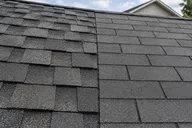 Are architectural shingles worth it over 3-tab shingles?Architectural shingles start near $3.50 a square foot against $1.50 for 3-tab, last about 30 years instead of 20, and carry longer warranties.
 Is a metal roof worth it over asphalt shingles?A standing-seam metal roof costs about 1.6 times as much as asphalt shingles ($51,865 against $31,871) but is rated to last 40 to 80 years instead of 20 to 30.
 How much does a roof replacement cost?A roof replacement typically costs $5,900 to $13,400, or $400 to $1,100 per square installed. How to measure your roof, what moves the price and how to compare estimates.