
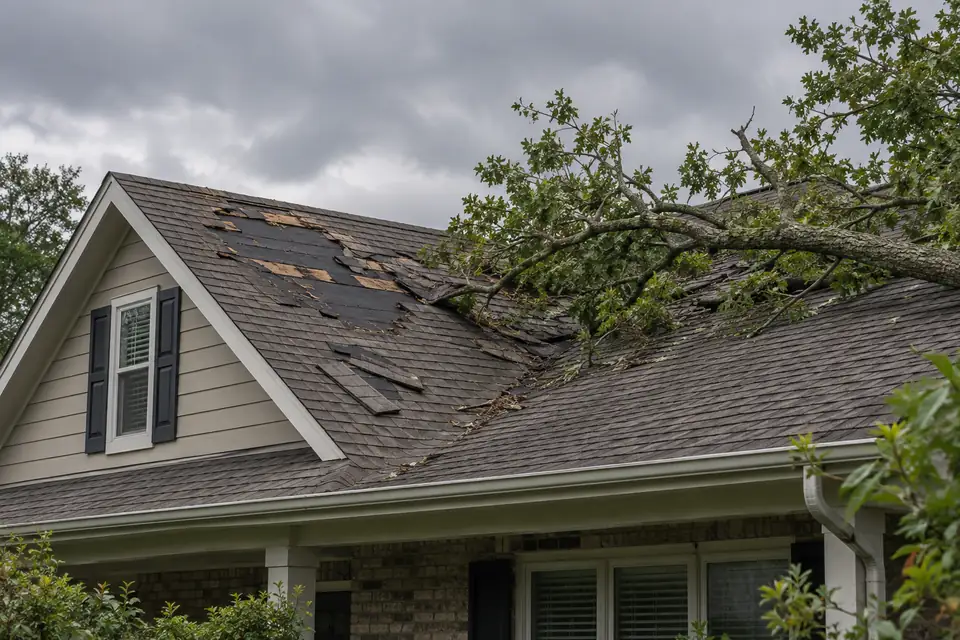
Storm damage on a shingle roof usually shows up as shingles that are missing, lifted, creased or torn, as branches or other debris on the roof, and as water stains inside the house. NRCA, the roofing contractors' association, says most wind damage begins at the edges of a roof and grows with each gust, so the eaves, rakes and ridge are the first places to look. In the first day or two: stay off the roof, keep clear of downed power lines, photograph everything, cover openings with a tarp if water is getting in, dry anything wet within 24 to 48 hours, and call your insurer. This page covers wind, trees and water. For hail, see our guide to how to tell if hail damaged your roof.
What storm damage looks like
| Kind of damage | What you see | Why it matters |
|---|---|---|
| Lifted or unsealed shingles | Tabs that stand up or flap, or a line of shadow under a row | The seal that holds a shingle down is broken, so the next wind can catch it |
| Creased or torn shingles | A straight horizontal line across a tab, or a torn corner | The seal failed while the nails held, and the tab bent until it creased or tore (InterNACHI) |
| Missing shingles | Bare patches, dark underlayment or wood showing | Rain can get under the roof, and the exposed edge gives the wind more to grab (NRCA) |
| Debris impact | Branches on the roof, punctures, dents in vents and flashing | A limb or flying object can break shingles and the deck below them |
| Clogged drains | Leaves, grit and shingle pieces in gutters and downspouts | NRCA says windblown debris collects there and causes drainage problems later |
| Water inside | Stains on ceilings, wet insulation, drips in the attic | The roof has been opened somewhere, even if you cannot see where from the yard |
Look from the ground, with binoculars if you have them, and check the yard for pieces of shingle. Then look in the attic with a flashlight for daylight, wet wood or damp insulation.
How wind damages shingles
Wind does not push evenly on a roof. NRCA explains that, depending on its direction and the shape of the roof, wind can suck upward on one part while it pushes on another, and that most wind damage starts at the edges. Once a piece of roofing is loose, the wind gets under it, lifts more of it, and the damage spreads across the roof over repeated gusts. That is why a few loose shingles after one storm can become a bare corner after the next.
InterNACHI, the home inspectors' association, describes three stages. First the wind lifts a tab when its pull is stronger than the sealant strip, the shingle's weight and its stiffness together. If the seal breaks, the tab can be pulled up over its nails. If the nails hold but the seal does not, the tab can bend far enough to crease or tear. InterNACHI says the damage is usually worst at the eaves, rakes and ridges.
The seal matters most. IBHS, the insurance industry's building research institute, calls the strength of the bond between shingles the most important factor in how asphalt shingles hold up in high wind. A roofer who inspects the roof should check that the tabs along the edges are still sealed, not only count the missing ones.
Fallen trees and flying debris
A tree or a large limb on the roof is a different kind of damage from lost shingles, and it can come with fallen power lines.
- Keep your distance. Ready.gov, the federal preparedness site, says to stay clear of fallen power lines and broken utility lines. NRCA says to shut off the power at the main breaker and call the power company if you see frayed wiring or sparks or smell something burning.
- Leave the tree to professionals. NRCA warns that inspecting a storm-damaged roof means climbing onto a structure that may not be sound; a tree on the roof is work for a tree service and a roofer.
- Check for smaller debris too. NRCA notes that glass, branches and other windblown objects can severely damage a roof, and that an inspection after strong winds should include what blew onto or across the roof, not only what blew off it.
Triple-I, the insurance industry's information group, says a standard homeowners policy covers a tree that falls on the house in a storm, and that tree removal is generally limited to $500. Your policy's own wording decides what is paid.
Water getting in
Water is what turns roof damage into house damage. The EPA says wet materials should be dried within 24 to 48 hours to prevent mold. Move belongings away from drips, catch the water, and photograph it before you clean it up. Triple-I advises not throwing away damaged items until the adjuster has seen them.
A standard homeowners policy does not cover flood, according to Triple-I; flood insurance is a separate policy. When you report the claim, say exactly where the water came in.
The first 24 to 72 hours
- Make sure everyone is safe. NRCA's storm guides say to shut off electricity and gas if you suspect damage to the house, to leave at once if you smell gas, and to notify the gas company, the police or the fire department.
- Stay on the ground. NRCA advises inspecting a storm-damaged roof only from ground level. Never go up in the dark.
- Photograph and video everything before anything is moved (see the next section).
- Stop the water. Cover openings with a tarp and protect the rooms below. Our guide to emergency roof repair covers what counts as an emergency and how tarping is done.
- Dry what is wet within 24 to 48 hours, as the EPA advises.
- Call your insurer as soon as you can. NRCA suggests having your policy or policy number ready and asking for an assessment.
- Ask a roofer for an inspection and a written estimate. NRCA suggests getting a roofer's own assessment alongside the adjuster's.
- Slow down with strangers. Contractors who knock after a storm are not all dishonest, but read our guide to roofing scams before you sign anything.
Document the damage
The NAIC, the group of state insurance regulators, says to document all losses before you remove debris or belongings, with photos or video and a written list. Good records answer the questions an adjuster will ask:
- The roof, from every side of the house, including close-ups of missing shingles and anything lying on the roof.
- The ground: shingle pieces, fallen limbs and the tree they came from, with something in the frame for scale.
- The inside: ceiling stains, wet insulation and damaged belongings, before you move them.
- The date and the storm: keep the weather alert or a news report that shows the storm reached your address.
- Every receipt for tarps, fans, a tree service or an emergency roofer. Triple-I says to save them because you may be reimbursed.
Keep the originals, and send your insurer copies.
Temporary protection, not repairs
Cover the damage; do not fix it yet. NRCA says that, except in extreme situations, homeowners should not attempt roof repairs after a storm, because spreading roof cement or popping a blister hides the evidence a roofer needs to find the problem. Openings should be covered with tarps to keep the rain out.
Temporary protection is expected of you. Triple-I says to take reasonable steps to protect your property from further damage and to save the receipts. It also notes that what your insurer pays for temporary repairs comes out of the total settlement, so an expensive temporary fix can leave less for the permanent one. Get a price before a crew starts.
Repair or replacement
Whether a storm-damaged roof is repaired or replaced depends on how much of it was damaged and how old it was. NRCA says the insurer decides two things when it assesses the loss: whether the roof is damaged enough to be declared a total loss, and how big the roof is, which sets how many shingles a replacement needs.
- A repair usually fits a few missing or creased shingles in one area on a roof that is otherwise sound.
- A replacement is more likely when damage is spread over several slopes, when the deck is broken, or when the roof was already near the end of its life.
If the adjuster and your roofer disagree, NRCA says you can ask for a reinspection with both of them on the roof, and that reinspections are common. Our guides to should you repair or replace your roof and how a roof insurance claim works cover the decision and the claim in detail. This page is general information, not insurance or legal advice; your policy decides what is covered.
Storm records and insurance rules differ from state to state. Our roof cost pages by state list each state's billion-dollar storm history, building code and contractor licensing rules.
Frequently asked questions
Can wind damage a roof without tearing shingles off?
Yes. Wind can break the seal under a shingle or crease it without removing it. A creased tab may lie flat afterward, so the damage is easy to miss from the ground. InterNACHI says wind damage is usually worst at the eaves, rakes and ridges, which are the places to have checked first.
Should I get on the roof to check for storm damage?
No. NRCA advises homeowners to inspect a storm-damaged roof only from the ground. A storm-damaged roof may not be sound, and a fall from a roof is far more dangerous than the damage itself.
A tree fell on my roof. Who pays to remove it?
Triple-I says a standard homeowners policy covers a tree that falls on the house in a storm, with tree removal generally limited to $500. Check your policy for the exact limit and call your insurer before a tree service starts, unless the tree has to come off right away to prevent more damage.
How soon should I report storm damage to my insurer?
As soon as you can. NRCA suggests calling promptly after the storm to request an assessment, and your policy sets its own time limit for reporting. Photograph the damage first, then call.
Is storm damage the same as hail damage?
Hail is one kind of storm damage, and it leaves different marks: bruises, granule loss and dents rather than lifted or creased shingles. Our guide to how to tell if hail damaged your roof covers it.
Where this information comes from
HomeAnvil does not publish storm or claim data of its own. Each fact on this page comes from the source named beside it, all read on September 26, 2026:
- NRCA, Roof repair after strong winds: how wind acts on a roof, damage starting at the edges, windblown debris and clogged drains, not repairing before an inspection, tarping openings, the insurer's two questions, reinspections and keeping receipts.
- NRCA, Roof repair after a tornado: shutting off power and gas, frayed wiring and sparks, and leaving if you smell gas.
- NRCA, NRCA urges homeowners affected by severe weather to use caution, July 27, 2022: inspecting only from the ground.
- InterNACHI, Mastering roof inspections: asphalt composition shingles, part 50: tab uplift, pull-over, creasing and tearing, and where wind damage is worst. The page carries no date.
- IBHS, Wind uplift of asphalt shingles: the seal between shingles as the most important factor in wind performance.
- Ready.gov, Tornadoes: staying clear of fallen power and utility lines.
- EPA, A brief guide to mold, moisture and your home: drying wet materials within 24 to 48 hours.
- Triple-I, Am I covered?: falling trees, the $500 tree removal limit and the flood exclusion.
- Triple-I, Settling insurance claims after a disaster: reasonable temporary protection, receipts, temporary repairs counting toward the settlement, and keeping damaged items for the adjuster.
- NAIC, What to do after a storm: read the fine print and be aware of assignment of benefits, September 13, 2023: documenting losses before removing debris.
Insurance rules and policy terms vary. When this page and your policy differ, your policy decides. We will update this page when these sources change, and the date above will say when.
Related guides
 How do you know if hail damaged your roof?Quarter-size (1 inch) hail can start to damage older 3-tab shingles, laminated ones at 1.25 inches. How to spot real damage and when to call your insurer.
 How does a roof insurance claim work after a storm?Insurance usually pays for sudden wind or hail damage, not wear. Wind/hail deductibles often run 1% to 5% of your home's insured value. How a claim works.
 Roofing emergency: what to do and who should tarp itAn open roof or active leak needs a tarp, not a repair. Emergency tarping costs $150 to $3,300, about $450 on average (HomeAdvisor). Safety, receipts, the fix.
 How do you spot a roofing scam or a storm chaser?Storm chasers knock unasked, want money up front, offer to cover your deductible or ask you to sign over your claim. How to check a roofer and report one.
 Should you repair or replace your roof?Most roof repairs cost $395 to $1,967; a replacement typically costs $5,900 to $13,400. How age, damage, layers and repair history decide which one you need.
 How to find and fix a roof leak, and what it costsA roof leak repair typically costs $350 to $1,500, about $800 on average. How to trace a leak from the attic, what to do first and what each fix costs.