
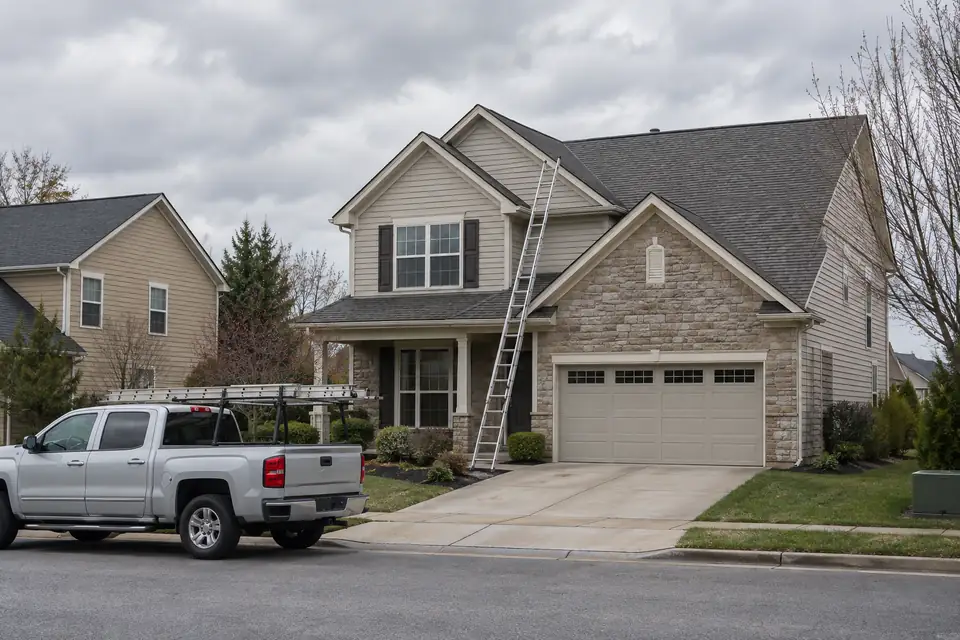
A roofing scam usually starts with a knock on the door after a storm. The warning signs are a roofer who came unasked, wants the whole price or a large deposit before work starts, offers to waive or cover your insurance deductible, asks you to sign your insurance claim over to them, or says they are "FEMA certified". Call your insurer before you sign anything, check the roofer's license and insurance yourself, pay by check or credit card as the work progresses, and report a scam to the FTC at ReportFraud.ftc.gov, to your state attorney general, and to the NICB at 800-835-6422. The NICB, the insurance industry's anti-fraud group, says reported contractor fraud rose 38% from 2023 to 2025.
The warning signs at a glance
| What the roofer does | Why it is a warning | Who says so |
|---|---|---|
| Knocks unasked after a storm and offers a free inspection | Almost all disaster repair scams start this way | NICB, FTC |
| Wants full payment, or money before materials arrive | A crew that is paid in full has no reason to finish | NICB, NRCA, FTC |
| Takes cash only, or asks for a wire, gift card, payment app or crypto | The FTC says to pay by check or credit card instead | FTC, NRCA |
| Offers to waive, rebate or "eat" your deductible | It can pull you into an inflated or false claim | NICB |
| Asks you to sign an assignment of benefits | You hand control of your claim to the contractor | NAIC, NICB |
| Says they are "FEMA certified" or approved by the government | FEMA certifies no contractors | FEMA |
| Pushes you to sign today for a discount | A rushed decision leaves no time to check the company | FTC, NICB |
| Offers to read your policy or tells you not to call your insurer | The NICB says never to let a contractor interpret your policy | NICB |
| Leaves blanks in the contract | Terms you never agreed to can be written in later | FTC, NICB |
Storm chasers and door-to-door inspections
A storm chaser is a crew that follows severe weather from place to place, looking for damaged roofs. Not every contractor who knocks is dishonest, and the NICB says so itself. But it also says that almost all disaster repair scams are unsolicited and begin with a contractor's visit, and it sums up its advice as: if you didn't request it, reject it.
The free roof inspection is the usual opening. It puts a stranger on your roof, out of your sight, with the job of finding damage. The NICB lists the most common contractor fraud schemes as manufactured roof damage, inflated water damage claims, abuse of assignment of benefits agreements, exploitation of elderly homeowners and falsified documents. It also warns that dishonest roofers exaggerate damage or create it.
If someone knocks:
- Take a card and a written estimate, and sign nothing. Triple-I, the insurance industry's information group, advises not being rushed into signing a contract with anyone.
- Keep them off the roof until you have called your insurer and checked the company.
- Write down who they are. The NICB suggests asking to see the salesperson's driver's license and noting its number and the vehicle's license plate. It says out-of-state licenses and vehicle registrations can be a sign of a fraudulent contractor.
- Notice the pitch. The FTC lists "we're working in the area", leftover materials from another job and pressure to decide on the spot as signs of a home improvement scam.
Upfront payment demands
The NICB says dishonest roofers may insist on full payment in advance and then never finish the job, or never start it. NRCA, the roofing contractors' association, tells homeowners to be wary of a contractor who wants money before the materials are on site, or who wants only cash.
How to pay safely, from the FTC's advice:
- Never pay the full price up front. Agree a reasonable down payment.
- Pay by check or credit card, never by wire transfer, gift card, payment app, cryptocurrency or cash.
- Tie each payment to finished work, and do not make the final payment until the job is done and you are satisfied.
- Get a receipt or invoice for every payment.
The NICB adds: never pay a contractor in full, or sign a completion certificate, until the work is finished. Our guide to how to compare roofing estimates covers what a fair payment schedule looks like.
Offers to waive or cover your deductible
Your deductible is the part of the claim you pay. A roofer who offers to "absorb" it, rebate it or bill the insurer so that you pay nothing is not giving you a discount. The NICB says roofers use deductible rebates to lure homeowners into unnecessary or inflated claims. The money has to come from somewhere, usually a claim padded with damage or work that is not real, and your name is on that claim.
The NICB urges states to prohibit deductible rebates, and says at least one state has made it illegal for a contractor to promise to waive a deductible; check your state's rules. Also know that, according to the NICB, insurers never ask you to pay your deductible up front or over the phone. A caller who says they are from your insurer and asks for it is a warning sign; hang up and call the number on your policy.
Assignment of benefits pressure
An assignment of benefits, or AOB, is a document that lets someone else, such as a roofer, deal with your insurer and collect your claim payment directly. The NAIC, the group of state insurance regulators, explains what you give up when you sign one:
- Control. The contractor files the claim, decides on the repair and collects the payments without you.
- Contact. Your insurer then deals only with the contractor.
- Rights. The contractor can sue your insurer, and you can lose your right to mediation.
The NAIC notes that you can always file a claim directly with your insurer yourself, and suggests having your adjuster review estimates before repairs begin. The NICB lists abuse of AOB agreements among the most common contractor fraud schemes. If a roofer will not work for you unless you sign one, find another roofer. This page is general information, not legal or insurance advice; read anything you are asked to sign, and ask your insurer about it first. Our guide to how a roof insurance claim works covers the claim itself.
"FEMA certified" and other false credentials
FEMA says plainly that it does not approve, endorse, certify or recommend any contractors, and that contractors may not call themselves "FEMA approved" or "FEMA certified". A sign on a truck or a shirt that says otherwise is false. The FTC adds that a person who offers to help you get FEMA relief for a fee is a scammer.
The same goes for other borrowed authority. The NICB warns about contractors who say they are approved by a government agency, or who say they work with many insurance companies and can interpret your policy for you. Real credentials, such as a state or local license or a manufacturer's installer program, can be checked with whoever issued them.
How to check a roofer before you sign
These checks take an afternoon and cost nothing:
- Call your insurer first. The NICB says to call your insurance company before you hire any contractor for storm damage, and the NAIC suggests having your adjuster review estimates before repairs begin.
- Confirm the license. The FTC says to check with your state or county government that the contractor is licensed. Rules vary; check your state's.
- Get proof of insurance. NRCA says to ask for copies of the contractor's liability and workers' compensation certificates and make sure both stay in effect for your whole job.
- Look for a permanent business. NRCA says to check for a permanent place of business, a phone number, a tax ID number and a business license where required.
- Call references, from recent jobs near you. NRCA's storm guidance suggests caution when all of a contractor's references are out of state.
- Search for complaints. The FTC suggests searching the company's name with words like "scam", "review" and "complaint". NRCA suggests checking with the Better Business Bureau.
- Get everything in writing, with no blank spaces. The FTC says the contract should include the contractor's name, address, phone and license number, the start and finish dates, the payment schedule and every promise made to you.
Our guides to what to check before you hire a contractor and questions to ask a roofer go further.
If you signed, paid or were scammed
If you signed at your door, you may be able to cancel. The FTC's Cooling-Off Rule lets you cancel many sales of $25 or more made at your home until midnight of the third business day after the sale, and the seller should tell you about that right in writing. Send the cancellation by certified mail, postmarked before that deadline, and keep a copy. The rule does not cover repairs you asked the seller to come and make, and it does not cover purchases needed to meet an emergency. The NICB notes that some states also let homeowners cancel a roofing contract within 72 hours of learning that their insurance claim was denied; check your state's rules.
Report it, even if you did not lose money. Reports help investigators find the same crew at the next house:
| Report to | For | How |
|---|---|---|
| The FTC | Any scam or bad business practice | ReportFraud.ftc.gov |
| Your state attorney general | Consumer complaints against a contractor | Find your office through the National Association of Attorneys General |
| The NICB | Insurance fraud, including padded or faked roof claims | 800-TEL-NICB (800-835-6422) or the form at nicb.org |
| FEMA's Disaster Fraud Hotline | Someone claiming to be from FEMA or FEMA certified | 866-223-0814 |
| Your insurer | Any contractor fraud involving your claim | The number on your policy |
The FTC also points to your local consumer protection office. Keep the contract, receipts, business cards, photos of the truck and any texts or emails in one place before you report.
Frequently asked questions
Are all door-to-door roofers scammers?
No. The NICB says many contractors who come after a storm are honest. The problem is that a stranger at the door is hard to check on the spot. Take their details, call your insurer, and check them the same way you would check any other roofer before you let them on the roof.
Is it legal for a roofer to pay my deductible?
It depends on where you live; the NICB says at least one state has made the promise illegal. Either way, the NICB warns that deductible rebates are used to draw homeowners into inflated or unnecessary claims, and the claim is in your name. Check your state's rules.
How much of a deposit is normal for a roof?
There is no single national figure. The FTC says some states limit how much a contractor can ask for as a down payment, and never to pay the full amount up front and to negotiate a reasonable down payment, and NRCA warns about roofers who want money before materials are delivered. Tie later payments to finished stages of the work.
Should I let a roofer talk to my insurance company for me?
You can ask your roofer to meet the adjuster on the roof; NRCA says such reinspections are common. Signing an assignment of benefits is different: the NAIC says it lets the contractor file your claim, decide the repair and collect the payments without you. Keep the claim in your own name.
What if a roofer says they are FEMA certified?
It is not true. FEMA says it does not certify, approve or recommend any contractor. You can report the claim to FEMA's Disaster Fraud Hotline at 866-223-0814.
Where this information comes from
HomeAnvil does not publish fraud data of its own. Each fact on this page comes from the source named beside it, all read on September 26, 2026:
- NICB, NICB warns Americans contractor fraud continues to rise nationwide, May 18, 2026: the 38% rise in reported contractor fraud from 2023 to 2025, the most common schemes, calling your insurer first, AOBs, insurers never asking for the deductible up front or by phone, the salesperson's license and plate, out-of-state licenses and registrations, "if you didn't request it, reject it", contracts without blanks, completion certificates and the 800-TEL-NICB line.
- NICB, Roofing fraud requires vigilance, no date shown: full payment in advance, exaggerated or created damage, deductible rebates, state rebate prohibitions and the 72-hour cancellation right some states give after a denied claim.
- NICB, Avoid becoming a storm victim twice, no date shown: almost all disaster repair scams being unsolicited, and a state law against promising to waive a deductible.
- NICB, Contractor fraud surges after catastrophic weather events, June 28, 2023: unsolicited approaches, claims of government approval, and contractors offering to interpret your policy.
- FTC Consumer Advice, How to avoid scams after weather emergencies and natural disasters, September 2025: scam warning signs, payment methods, checking licenses and complaints, contract contents, FEMA relief for a fee, and where to report.
- FTC Consumer Advice, How to avoid a home improvement scam, July 2022: door-to-door pitches, leftover materials, pressure, state limits on down payments, not paying in full up front, and the final payment.
- FTC Consumer Advice, Buyer's remorse: the FTC's Cooling-Off Rule may help, September 2025: the $25 threshold, the three-business-day deadline, certified mail and the exclusions for requested repairs and emergencies.
- FEMA, Does FEMA approve, endorse, or certify any products or companies?, last updated November 19, 2021.
- FEMA, Beware of post-disaster contractor fraud, September 9, 2025: FEMA does not license or certify contractors, and the Disaster Fraud Hotline number.
- NAIC, What to do after a storm: read the fine print and be aware of assignment of benefits, September 13, 2023: what an AOB is and what you give up by signing one.
- NRCA, Selecting a contractor: permanent place of business, insurance certificates, references and the Better Business Bureau.
- NRCA, Roof repair after strong winds: contractors who want cash only, money before materials are on site, out-of-state references, and reinspections.
- Triple-I, Avoiding scams after a disaster, no date shown: not being rushed into signing and caution with door-to-door solicitors.
- National Association of Attorneys General, Find my AG: the directory of state and territorial attorneys general.
Laws on contractor licensing, deposits, deductibles and cancellation differ from state to state. We will update this page when these sources change, and the date above will say when.
Related guides
 Storm damage to your roof: how to tell and what to doWind damage usually starts at a roof's edges. How to spot lifted, creased and missing shingles and debris damage, and what to do in the first 72 hours.
 How does a roof insurance claim work after a storm?Insurance usually pays for sudden wind or hail damage, not wear. Wind/hail deductibles often run 1% to 5% of your home's insured value. How a claim works.
 What to check before you hire a contractorFive things to ask for before you sign with a roofing, siding, window, bath or HVAC contractor, wherever you live in the United States.
 What questions should you ask a roofer before you sign?The roofing questions to ask before you sign: tear-off, decking, ice barrier, ventilation, permit, crew, cleanup, payment and warranty papers, plus red flags.
 How do you know if hail damaged your roof?Quarter-size (1 inch) hail can start to damage older 3-tab shingles, laminated ones at 1.25 inches. How to spot real damage and when to call your insurer.
 Roofing emergency: what to do and who should tarp itAn open roof or active leak needs a tarp, not a repair. Emergency tarping costs $150 to $3,300, about $450 on average (HomeAdvisor). Safety, receipts, the fix.