
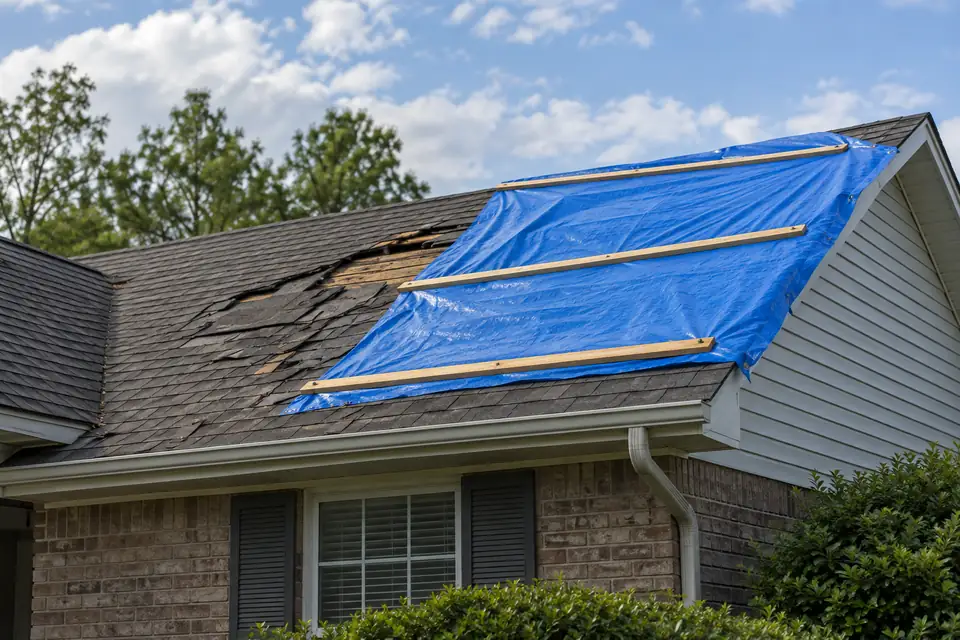
A roofing emergency is water coming into the house now, or a roof opened by wind, a fallen tree or debris so that the next rain will come in. The first job is to keep people safe and stop the water, not to repair the roof. Keep off the roof, protect the rooms below, have the opening covered with a tarp, dry anything wet within 24 to 48 hours as the EPA advises, and keep every receipt for your insurer. HomeAdvisor puts emergency roof tarping at $150 to $3,300, with most homeowners paying around $450. The permanent repair is billed separately. It comes later, after your insurer and a roofer have seen the damage.
What counts as a roofing emergency
Not every roof problem has to be fixed tonight. As a rule of thumb, treat it as an emergency when waiting would let more water or more damage into the house:
| Situation | Emergency? | What to do first |
|---|---|---|
| A tree or large limb has broken through the roof | Yes | Get everyone out of the rooms below, stay clear of any downed lines, call a tree service and a roofer |
| Shingles are missing and rain is coming | Yes | Have the bare area tarped before the rain |
| Water is dripping through a ceiling | Yes | Catch the water, protect belongings, have the source found and covered |
| A ceiling is sagging with water | Yes | Keep people out of the room; the water has to go somewhere |
| A few lifted or creased shingles, no water inside | Usually not | Photograph them, call your insurer and book an inspection |
| An old stain that has not grown | No | Book an inspection; our guide to roof leak repair covers tracing it |
Safety first
The damage to your roof can wait an hour. A fall or a shock cannot be undone.
- Stay on the ground. NRCA, the roofing contractors' association, advises homeowners to inspect a storm-damaged roof only from ground level, because the risk of falling is too great without proper safety systems. OSHA counts falls among the most common causes of serious work injuries and deaths, and requires fall protection for construction workers from 6 feet up.
- Never in the dark. NRCA says not to climb a ladder to look at roof damage in the dark.
- Watch the power. NRCA's storm guides say to shut off the power at the main breaker and call the power company if you see frayed wiring or sparks or smell something burning. Ready.gov says to stay clear of fallen power and utility lines.
- Watch the gas. If you smell gas, NRCA says to turn off the main gas valve if you can, open the windows, leave the house at once and notify the gas company, the police or the fire department, without doing anything that could make a spark.
Protect the inside of the house
While you wait for help, limit the water damage indoors:
- Move furniture, electronics and papers away from the leak, and put down buckets and towels.
- Photograph and video the water and the damage before you clean up. The NAIC, the group of state insurance regulators, says to document losses before removing debris or belongings.
- Dry wet materials within 24 to 48 hours. The EPA says doing so prevents mold in most cases.
- Keep damaged items until the adjuster has seen them, as Triple-I, the insurance industry's information group, advises.
Temporary tarping: who should do it
For most homeowners, the answer is a roofer. NRCA says that, except in extreme situations, homeowners should not attempt roof repairs after a storm, and that openings should be covered with tarps to minimize rain damage. A roofer has the ladders, fall protection and experience to walk a damaged roof. Bob Vila's tarping guide, written for people who do it themselves, still warns that one misstep on a roof can be fatal and says to work with a helper and fall protection.
If you do it yourself, do it only on a low, walkable roof, in daylight, after the storm has passed, with someone holding the ladder. Never step on the damaged area.
If a roofer tarps the roof, ask for the price before they start, ask what the tarp will be fastened with, and ask whether the charge will be credited if you hire them for the permanent repair.
How a tarp should go on
Knowing how it is done helps you judge the work, whoever does it. This Old House describes a method for asphalt shingle roofs:
- Cover a hole first. Fasten a piece of exterior plywood over the opening, screwed to sound sheathing, so water cannot pool and nobody steps through.
- Run the tarp over the ridge. One edge goes over the peak and a few feet down the other side, so water runs off the tarp instead of under it. Bob Vila's guide puts that at about 4 feet over the peak.
- Fasten through wood strips, not the tarp alone. The edges are wrapped around 1x3 lumber strips screwed to the sheathing, with screws no more than 10 inches apart so the tarp holds in wind.
A tarp is temporary. Bob Vila's guide says not to leave one on longer than its maker recommends, which it puts at usually about 90 days. Plan the permanent repair well before then.
What emergency service costs
HomeAnvil does not yet publish price data of its own. National cost sites publish these figures. Ask for the price in writing before work starts.
| Source | What it measures | Figure |
|---|---|---|
| HomeAdvisor, roof tarping cost, updated June 19, 2026 | Emergency roof tarping by a professional | $150 to $3,300; most pay around $450 |
| HomeAdvisor, same page | Tarp material alone, and tarping labor | $0.10 to $0.30 and $0.60 to $2.50 per square foot |
| HomeAdvisor, same page | Emergency tarping against a scheduled visit | 50% to 100% more |
| Fixr, roof repair cost, updated January 21, 2026 | Extra charge for same-day or next-day roofing service | $100 to $300 |
| Today's Homeowner, updated May 29, 2025 | Emergency roof repairs, all kinds | $250 to $10,000; minor damage $300 to $750 |
| Today's Homeowner, updated May 29, 2025 | Emergency service charge on top of normal costs | at least a few hundred dollars |
| Fixr, emergency roof repair guide, September 12, 2024 | Emergency roof repair, typical range | $359 to $1,626 |
The ranges are wide because an emergency call can be a small tarp over a few missing shingles or a crew removing a tree and rebuilding part of the deck. For the cost of the permanent work, see our guide to roof repair cost.
Keep receipts for insurance
Taking reasonable steps to prevent further damage is part of making a claim. Triple-I says to take reasonable steps to protect your property and to save the receipts, which you may be able to submit for reimbursement. NRCA says your insurance company is likely to reimburse temporary repairs.
Keep a folder, paper or digital, with:
- Receipts for tarps, lumber, fasteners, fans and dehumidifiers.
- The invoice for any emergency roofer or tree service, with what they did.
- Photos of the damage before, and of the temporary protection after.
- A note of every call with your insurer: the date, the name and what was said.
Triple-I also notes that what is paid for temporary repairs counts toward the total settlement, so a costly temporary fix can leave less money for the permanent one. Keep the emergency work to what stops the damage. This page is general information, not insurance advice; your policy decides what is covered.
What the permanent fix follows
The permanent repair comes after the damage has been assessed:
- Report the claim. NRCA suggests calling your insurer as soon as possible after the event to request an assessment.
- Let the adjuster see the damage. Triple-I advises not authorizing permanent repairs until the adjuster has approved the price.
- Get a roofer's inspection and a written estimate. NRCA suggests a roofer's own assessment alongside the adjuster's, and a reinspection with both present if they disagree.
- Decide repair or replacement. Our guides to storm damage and how a roof insurance claim works walk through that decision.
- Check the contractor before you sign. Emergencies bring out door-to-door crews; see our guide to roofing scams. The FTC's Cooling-Off Rule, which lets you cancel many sales made at your home until midnight of the third business day, does not cover a repair visit you asked the seller to make, so read before you sign.
Frequently asked questions
Can I put a tarp on my roof myself?
NRCA advises against homeowner repairs on a storm-damaged roof except in extreme situations, and against climbing up at all until it is safe. If you must, work only in daylight on a low, walkable roof, after the storm, with a helper, and never on the damaged area. Otherwise, have a roofer do it.
How long can a tarp stay on a roof?
Only as long as the tarp's maker recommends. Bob Vila's guide puts that at usually about 90 days. Schedule the permanent repair well before then.
Does insurance pay for emergency tarping?
Often, when the damage itself is covered. NRCA says insurers are likely to reimburse temporary repairs, and Triple-I says to save the receipts. The amount counts toward your total settlement, and your policy decides.
Should I let a roofer start the permanent repair right away?
Not before your insurer has seen the damage, if you are making a claim. Triple-I advises waiting for the adjuster to approve the price. Temporary protection can and should start right away.
How much does it cost to have a roof tarped?
HomeAdvisor puts emergency roof tarping at $150 to $3,300, with most homeowners paying around $450, and says an emergency visit costs 50% to 100% more than a scheduled one. Fixr says same-day or next-day service typically adds $100 to $300, and Today's Homeowner says emergency service carries a charge of at least a few hundred dollars on top of the normal cost. Ask for the price before work starts.
How we got these numbers
HomeAnvil does not yet publish price data of its own. Each fact on this page comes from the source named beside it, all read on September 26, 2026:
- NRCA, Roof repair after strong winds: no inspection in the dark, not attempting repairs, tarping openings, calling the insurer, reimbursement of temporary repairs and reinspections.
- NRCA, Roof repair after a tornado: shutting off power and gas and what to do if you smell gas.
- NRCA, NRCA urges homeowners affected by severe weather to use caution, July 27, 2022: inspecting only from the ground.
- OSHA, Fall protection: falls among the most common causes of serious work injuries and deaths, and the 6-foot threshold in construction.
- Ready.gov, Tornadoes: staying clear of fallen power and utility lines.
- EPA, A brief guide to mold, moisture and your home: drying wet materials within 24 to 48 hours.
- NAIC, What to do after a storm: read the fine print and be aware of assignment of benefits, September 13, 2023: documenting losses before removing anything.
- Triple-I, How to file a homeowners claim, December 2025: reasonable steps to prevent further damage and saving receipts.
- Triple-I, Settling insurance claims after a disaster: keeping damaged items for the adjuster, temporary repairs counting toward the settlement, and waiting for the adjuster before permanent repairs.
- This Old House, Emergency roof protection, updated June 4, 2026: plywood over the hole, the tarp over the ridge, lumber strips and screw spacing.
- Bob Vila, How to tarp a roof, December 10, 2021: the fall warning, helpers and fall protection, about 4 feet over the peak, and the usual 90-day limit.
- HomeAdvisor, Cost to tarp a roof, updated June 19, 2026: the $150 to $3,300 range, the $450 typical figure, material and labor per square foot, and the 50% to 100% emergency premium. HomeAdvisor says its figures come from surveys of its customers.
- Fixr, Roof repair cost, updated January 21, 2026: the $100 to $300 extra for same-day or next-day service.
- Fixr, Emergency roof repair guide, September 12, 2024: the typical emergency repair range.
- Today's Homeowner, Emergency roof repair cost, updated May 29, 2025: the $250 to $10,000 and $300 to $750 emergency repair ranges and the emergency service charge.
- FTC Consumer Advice, Buyer's remorse: the FTC's Cooling-Off Rule may help, September 2025: the three-day right to cancel and its exclusion for repairs you asked the seller to come and make.
We will update this page when these sources change, and the date above will say when.
Related guides
 Storm damage to your roof: how to tell and what to doWind damage usually starts at a roof's edges. How to spot lifted, creased and missing shingles and debris damage, and what to do in the first 72 hours.
 How to find and fix a roof leak, and what it costsA roof leak repair typically costs $350 to $1,500, about $800 on average. How to trace a leak from the attic, what to do first and what each fix costs.
 How does a roof insurance claim work after a storm?Insurance usually pays for sudden wind or hail damage, not wear. Wind/hail deductibles often run 1% to 5% of your home's insured value. How a claim works.
 How much does a roof repair cost?Most roof repairs cost $395 to $1,967, about $1,173 on average. Prices by problem: shingles, flashing, leaks, decking, vents, fascia and sagging.
 How do you spot a roofing scam or a storm chaser?Storm chasers knock unasked, want money up front, offer to cover your deductible or ask you to sign over your claim. How to check a roofer and report one.
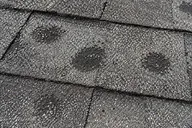 How do you know if hail damaged your roof?Quarter-size (1 inch) hail can start to damage older 3-tab shingles, laminated ones at 1.25 inches. How to spot real damage and when to call your insurer.