
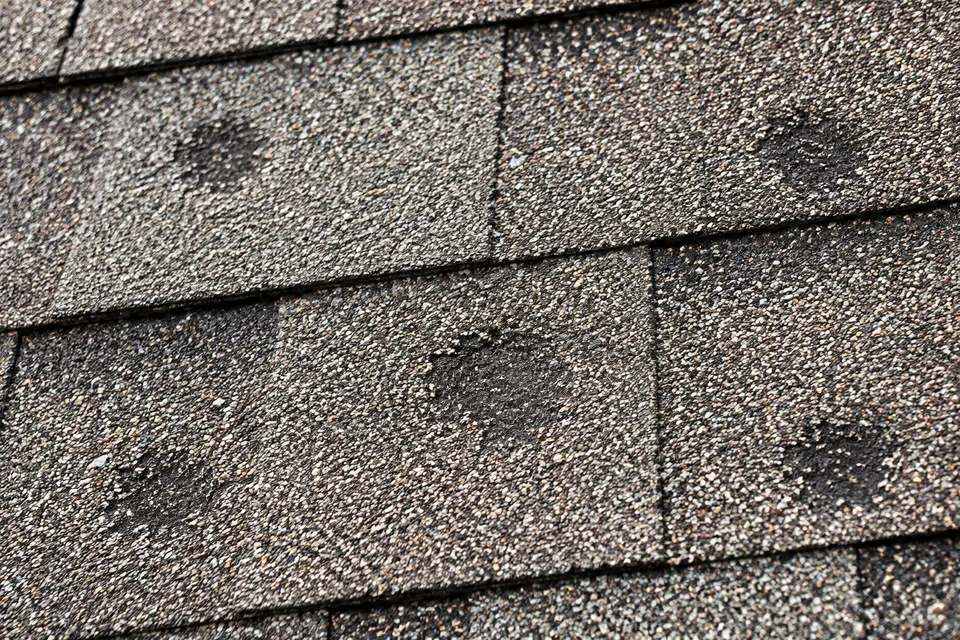
Hail and blisters can both leave dark, round spots on asphalt shingles, but they are made in opposite ways. A hailstone pushes the shingle in from above: it leaves a shallow dent with gently sloped sides, often a soft "bruise" where the mat underneath has cracked, scattered at random across the roof, and matching dents or marks on soft metal such as vents and air conditioner fins. A blister pushes out from inside: gas in the asphalt raises a small bubble, usually 1/4 inch across or less according to engineers at Haag Engineering, and when it pops it leaves a steep-sided pit with the granules gone, often down to the mat. The difference matters because homeowners insurance generally covers hail, while blisters, wear and defects in the shingles are a matter for the shingle warranty, maintenance or your own pocket. This page is general information, not insurance advice.
Five quick tells
| Question | Points to hail | Points to blistering |
|---|---|---|
| Which way was the surface pushed? | Inward: a shallow dent with gently sloped sides | Outward: a raised bubble, or a pit left where one burst |
| What happened to the granules? | Knocked loose, but many pressed into the dent | Shed with the cap of the bubble, so the pit is bare |
| How big and how deep? | Varies with the hail; a bruise feels soft like a bruised apple | Usually 1/4 inch or less, steep sides, often down to the mat |
| Where on the roof? | Random, heaviest on the slopes that faced the storm | Wherever the shingles run hot; InterNACHI links most blisters to poorly ventilated roofs |
| Anything else hit? | Dents in vents and air conditioner fins, spatter marks on metal, scuffs on fences | Nothing: a blister forms inside the shingle, so metal and nearby objects are unmarked |
No single tell settles it. Inspectors look at all of them together, and at the roof as a whole rather than one shingle.
What hail damage looks like
Haag Engineering, a forensic engineering firm whose researchers have published widely on hail, defines functional hail damage to asphalt shingles as punctures, tears, or fractures in the shingle mat. The fracture is the "bruise": an indentation that feels soft to the fingertips, usually with granules knocked off so the dark asphalt shows. Haag's 2006 white paper adds that a hail fracture starts on the underside of the shingle, so it can always be confirmed from the back.
InterNACHI, the home inspectors' association, describes hail strikes as very shallow indentations with lightly sloped sides, reflecting the round stone that made them, and notes that hail tends to embed granules in the dent rather than strip them all away.
Where the marks fall is just as telling. Haag's researchers found that hail leaves a random pattern, with the most direct hits on the slope that faced the storm and fewer, glancing ones on the far side. Shingles with little support underneath, along ridges, rakes, eaves and valleys, and the edges of shingles are the most easily damaged. Fresh hail damage shows black, unweathered asphalt; Haag notes that after several months exposed asphalt oxidizes to a grey film, which helps tell a recent storm from an old one.
Our guide to how to know if hail damaged your roof covers the hail sizes that start to cause damage and the difference between cosmetic and functional damage.
What blistering looks like
A blister starts as a small bubble where part of the granule surface is raised. Haag describes the bubbles bursting in time and leaving steep-sided voids that often reach the mat, usually 1/4 inch across or less, and says they are not caused by hail. InterNACHI describes the same result as pockmarks with visible mat, and says blisters typically appear within the first year after the shingles go on.
The two sources describe the cause a little differently:
- Heat and ventilation. InterNACHI says blisters today usually form when volatile compounds flash out of the asphalt in newly installed shingles because a poorly ventilated roof runs too hot. It notes that older, hand-mixed manufacturing once caused blisters but automated production has made that rare.
- Asphalt quality. Haag attributes blisters to poor-quality asphalt combined with heat, and lists blistering among the conditions that come with aging shingles.
How much it matters depends on how much of the roof is affected. InterNACHI says isolated blisters may be negligible, while widespread blistering can shorten the roof's life and may mean replacing it early. If ventilation is the likely cause, our guide to roof ventilation explains how attics are vented.
Other marks that get mistaken for hail
Haag's researchers wrote that inspectors frequently mistake other marks for hail, and that many of them are found only after a storm even though the storm did not cause them.
| What made the mark | What it looks like | Where you find it | How it differs from hail |
|---|---|---|---|
| Hail | Shallow round dents, soft bruises, torn or chipped edges | Random, heaviest on slopes facing the storm; edges and ridges | Matching dents and marks on soft metal and objects around the house |
| Blisters | Raised bubbles, then small steep-sided pits, usually 1/4 inch or less | Across the shingle surface, often within the first year | Granules shed, not pressed in; nothing else on the property marked |
| Age and weathering | Thinning granules, cracking, curling, crazing, flaking | Across the whole roof; Haag says color, pitch, slope direction and ventilation affect how fast shingles age | Gradual and general, not scattered dents; InterNACHI says aging loosens the granule bond |
| Manufacturing defects | Bands, lines or spots missing asphalt or granules | On the shingles that left the factory with the flaw | Haag says quality control varies and such defects are not unusual to find |
| Foot traffic | Scuffs where asphalt and granules were pushed aside, with a ridge along the edge; worn shingle edges | Where people walked on the roof | Haag says it happens when people walk on hot, soft shingles |
| Dropped tools and equipment | Screwdriver marks, knife cuts and gouges | Around air conditioners, satellite dishes and solar panels | Cuts and grooves rather than round dents, grouped where the work was done |
| Deliberate damage | Marks in lines or groups, in the middle of shingles | Upper parts of each slope, away from edges, on every slope alike | Haag says hail is random and does not favor the centers of shingles |
| Adhesive spots | Round dark spots, or round patches of missing granules where stuck shingles pulled apart | Where sealant dripped or bonded during installation | Haag says their round shape is what gets them mistaken for hail |
A new roof also sheds loose granules for a while. InterNACHI calls them "hitchhikers": granules that were never fully embedded and fall off during shipping, installation and the first storms. Finding them in the gutters is not hail damage.
Why the difference matters for an insurance claim
A homeowners policy generally pays for sudden damage from a covered peril, and hail is one of them. Triple-I, the insurance industry's information group, says a standard policy pays to repair damage from hail and other listed disasters but not routine wear and tear.
The sample standard homeowners form that Triple-I publishes (the 2000 edition of the common HO-3 form) spells out what it leaves out. Among its exclusions:
- Wear and tear, marring and deterioration.
- Latent defects, and any quality in the property that causes it to damage itself.
- Faulty, inadequate or defective design, workmanship, materials or maintenance.
So a roof marked by hail and a roof marked by blisters, age or a bad batch of shingles can look alike from the yard and be treated very differently. The same roof can also have both: Haag's white paper points out that even small hail can break the crusts off existing blisters, and takes the view that damage to shingles that were already defective or worn out is not functional hail damage. Your insurer's adjuster decides what the policy covers on your roof, and your policy's wording decides where the line falls. Some policies also exclude hail damage that is only cosmetic; our guide to how a roof insurance claim works covers that, deductibles and the claim process. Read your own policy, and treat this as general information, not insurance advice.
What an inspector checks
A careful inspection, as Haag's researchers describe it, looks at the whole property before deciding what made the marks on the roof.
- The weather. NRCA, the roofing contractors' association, says statements and weather reports can help show whether hail fell at your address, and that inspections usually happen several days to several months after the storm.
- Soft metal and objects around the house. NRCA says inspecting thin aluminum fixtures helps verify hail. Haag lists spatter marks on faded metal such as air conditioners, electrical boxes and window frames, dents in air conditioner fins, and scuffs on wooden fences, and says they give a good estimate of the hail's size and direction, which should match the marks on the roof.
- Every slope, in sample areas. Haag describes counting damaged shingles in marked test squares on each slope facing a different direction, and examining the whole roof because edges, ridges and valleys are weakest.
- The pattern. Plotting the marks on a roof diagram shows whether they are random, as hail would be, or grouped, lined up or missing from slopes that should have been hit.
- Each mark up close. The inspector feels for soft bruises, checks whether granules are pressed in or shed, looks at the shape of the pit, and notes whether the exposed asphalt is black and fresh or grey and old.
- The age and condition of the roof. Aging, splitting, curling and blistering are recorded separately from any storm damage.
A roofer you hire and the insurer's adjuster may not agree. Our roof insurance claim guide explains reinspections and what to do if you disagree, and what a roof inspection costs covers paying for an independent one.
If it is blistering: the warranty route
Blisters caused by a defect in the shingles are a question for the shingle maker's warranty, not your insurer. Two published 2026 warranties show how that route works and where it narrows:
- What is covered. Both warrant the shingles against manufacturing defects. Owens Corning's covers defects that materially affect performance in its full-coverage period and, after that, defects that cause leaks. CertainTeed's pays to repair, replace or clean shingles it decides are defective.
- Ventilation. Owens Corning excludes damage caused by improper or inadequate ventilation or unvented attics. CertainTeed limits the coverage on inadequately ventilated decks unless it decides the damage came only from a defect unrelated to ventilation. If your blisters trace to a hot, poorly vented attic, the warranty may pay little or nothing.
- Hail and foot traffic. Both exclude hail. Owens Corning also excludes foot traffic and falling objects.
- Deadlines and evidence. Both require notice within 30 days of finding the problem. Both may ask for photographs or shingle samples to test, and Owens Corning says a claim may be denied if you repair or replace the shingles before it decides.
Find the warranty for the product on your invoice, not a brochure. Our guide to what a roof warranty covers explains prorating, the contractor's workmanship warranty and what voids coverage.
What to do next
- Stay on the ground. Photograph the roof from the yard, the gutters and downspouts, vent caps, the air conditioner and any dents in metal, with the date.
- Note the storm. Write down the date and the size of any hail you saw, and keep weather reports for your address.
- Do not pop blisters or patch spots. NRCA says puncturing a blister or spreading roof cement covers up evidence a roofer needs. A tarp over an opening is fine.
- Get an inspection that covers the whole property, not only the roof, and ask for the findings in writing with photographs.
- If it looks like hail, call your insurer promptly and follow our roof insurance claim guide.
- If it looks like blistering or a defect, find your warranty and invoice and notify the shingle maker within its deadline. Have the attic ventilation checked too.
- Be careful who you hire. Our guide to what to check before you hire a home improvement contractor walks through licenses and insurance, and storm damage to your roof covers the rest of the cleanup.
Frequently asked questions
Can I tell hail from blisters from the ground?
Not reliably. From the yard you can see dents in gutters, vents and air conditioner fins, which point to hail. Bruises have to be felt and pits looked at up close, which is a job for a roofer or an adjuster.
Are blisters covered by homeowners insurance?
Generally not. The sample standard form Triple-I publishes excludes wear and tear, deterioration, latent defects and defective materials. Blisters from a manufacturing defect may fall under the shingle warranty instead. Your policy decides.
Can hail make blisters worse?
Haag's white paper says even small hail can break the crusts off existing blisters and expose the asphalt, and takes the view that this is not functional hail damage on shingles that were already defective. How your insurer treats it depends on your policy and the adjuster's findings.
How soon after installation do blisters appear?
InterNACHI says blisters typically appear within the first year. That timing is one more reason to keep your invoice and warranty papers where you can find them.
Is granule loss in the gutters a sign of hail?
Not on its own. A new roof sheds loose "hitchhiker" granules, and old shingles shed granules as they age. A heavy wash of fresh granules right after a hailstorm, with dents on soft metal, is a reason to have the roof inspected.
How we got these numbers
HomeAnvil does not publish inspection or claim data of its own. Each fact on this page comes from the source named beside it, all read on September 27, 2026. Manufacturers are named only as examples of how warranties are written, not as recommendations.
- Timothy P. Marshall, Richard F. Herzog and Scott J. Morrison, Haag Engineering Co., Hail damage to asphalt roof shingles, a paper presented at the American Meteorological Society annual meeting, 2004: the definition of functional hail damage and bruises, blister size and cause, aging, manufacturing and installation marks, foot traffic, deliberate damage, random hail patterns, test squares, roof diagrams, fresh and oxidized asphalt, and collateral marks on metal and fences. Haag is an engineering firm that investigates property claims.
- Haag Engineering Co., A white paper: hail damage to composition shingles, April 2006: hail fractures starting on the underside, bruises, and small hail breaking the crusts of existing blisters.
- InterNACHI, Mastering roof inspections: asphalt composition shingles, part 35: what blisters look like, their causes, the first-year timing and how much they matter.
- InterNACHI, Mastering roof inspections: asphalt composition shingles, part 46: aging and the granule bond, and "hitchhiker" granules.
- InterNACHI, Mastering roof inspections: asphalt composition shingles, part 47: the shape of hail strikes compared with blisters.
- InterNACHI, Mastering roof inspections: asphalt composition shingles, part 49: hail embedding granules, blisters shedding them, and damage from tools and equipment.
- NRCA, Roof repair after a hailstorm: inspection timing, weather reports, thin aluminum fixtures as evidence, and not puncturing blisters.
- Triple-I (Insurance Information Institute), What is covered by standard homeowners insurance?: hail covered, routine wear and tear not.
- Triple-I, Sample homeowners 3 special form, HO 00 03 10 00: the exclusions for wear and tear, marring, deterioration, latent defects and faulty workmanship, materials and maintenance. This is a sample form; your policy may differ.
- Owens Corning, Standard product limited lifetime warranty on roofing shingles and components, publication dated January 2026, read from the copy hosted by BuildSite: defect coverage, the ventilation, hail and foot traffic exclusions, the 30-day notice, photographs and samples, and repairs before a decision.
- CertainTeed, Asphalt shingle residential products 2026 limited warranty, read from the copy hosted by BuildSite: defect coverage, inadequately ventilated decks, the hail exclusion, the 30-day notice and samples.
Insurance policies and warranties vary. When this page and your policy or warranty differ, the document decides. We will update this page when these sources change, and the date above will say when.
Related guides
 How do you know if hail damaged your roof?Quarter-size (1 inch) hail can start to damage older 3-tab shingles, laminated ones at 1.25 inches. How to spot real damage and when to call your insurer.
 How does a roof insurance claim work after a storm?Insurance usually pays for sudden wind or hail damage, not wear. Wind/hail deductibles often run 1% to 5% of your home's insured value. How a claim works.
 What does a roof warranty actually cover?A shingle warranty covers manufacturing defects, a contractor's warranty covers installation. How prorating, wind, algae, transfers and voiding work.
 How much attic ventilation does a roof need?Code calls for 1 square foot of net free vent area per 150 square feet of attic, split between intake and exhaust. How vents work, warning signs and costs.
 Storm damage to your roof: how to tell and what to doWind damage usually starts at a roof's edges. How to spot lifted, creased and missing shingles and debris damage, and what to do in the first 72 hours.
 How much does a roof inspection cost?A roof inspection typically costs $125 to $383, about $252 on average. Drone inspections run $150 to $400 and infrared $400 to $600. What each one checks.