
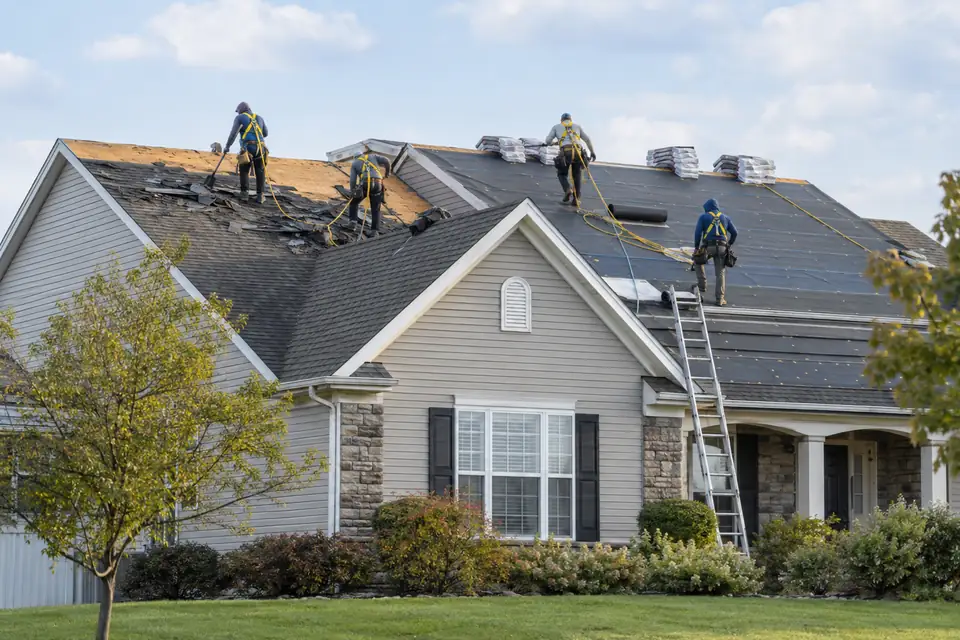
A roof replacement has three parts: the paperwork and preparation before the crew arrives, the work on the roof itself, and the inspection and warranty papers after. The work on the roof is the short part. GAF, a shingle maker, says an asphalt shingle roof on an average-sized home can often be replaced in one to two days, and Angi puts a standard asphalt roof at one to three days. On those days the crew strips the old roof to the wood deck, repairs any rotten decking, lays underlayment and an ice barrier where needed, fits drip edge and flashing, nails down the new shingles and sets the vents, then cleans up.
The steps at a glance
| Step | What happens | How long, where a source says |
|---|---|---|
| Estimate | The roofer measures the roof, looks at its condition and goes over materials with you | Within a few hours or by the next day when the roof is measured from aerial images (GAF) |
| Contract and permit | You sign a written scope; a permit is pulled where your local code requires one | Not published |
| Delivery and preparation | Shingles and a dumpster arrive; the yard and driveway are cleared | Not published |
| Tear-off | The old roof comes off down to the deck | Usually a few hours (GAF) |
| Deck repair | Rotten or damaged sheathing is replaced | A few hours to an extra day (GAF) |
| Underlayment to ridge | Ice barrier, underlayment, drip edge, flashing, shingles, vents | The whole roof, tear-off included: one to two days (GAF) or one to three days (Angi) for asphalt |
| Cleanup and final inspection | Debris and nails are collected; the building department inspects where a permit was issued | Not published |
Weather moves every number in that table. GAF notes that a crew may finish only part of a roof if rain is forecast for the afternoon, and may start later on a frosty morning. A steep roof, which GAF describes as generally steeper than 8 in 12, needs extra safety equipment and goes more slowly, and a roof with many valleys, dormers and penetrations takes longer because more shingles have to be cut.
Before work starts: estimate, contract and permit
The first visit is an inspection and a measurement. Ask whether the roofer will also check the attic for ventilation and signs of old leaks.
Before you sign, get the scope in writing. The National Roofing Contractors Association (NRCA) recommends a written proposal with a complete description of the work and the materials, start and completion dates, and payment terms. It also suggests asking for copies of the contractor's liability insurance and workers' compensation certificates, checking that both stay in force for the length of your job, and asking who will supervise the work and how many people will be on the crew. Our guide to what a roof replacement costs lists what a complete estimate should name.
Ask who pulls the permit. Whether you need one, and what the building department inspects, depends on where you live, so check with your local building department or ask the roofer to show you the permit before work begins.
If your house is old, ask about asbestos. The EPA says the only way to know whether a material such as a shingle contains asbestos is to have it tested by a qualified laboratory, and it recommends testing when you plan a renovation that would disturb a suspect material, with samples taken by a trained and accredited inspector.
Delivery and getting the house ready
When the shingles are delivered, Owens Corning's installation instructions for its Duration shingles say bundles should be laid flat on the roof and never bent over the ridge, and stored flat in a covered, ventilated place no hotter than 110°F. The same instructions warn against mixing bundles with different lot numbers, which are printed on the side of each bundle.
You can make the first morning faster. GAF points out that ladders, dumpsters and material staging need room, and that moving things out of the way after the crew arrives adds hours. Before the start date:
- Move cars out of the driveway and out from under the eaves.
- Take down anything hanging on exterior walls, and move patio furniture, grills and planters away from the house.
- Mark sprinkler heads, septic lids and anything else in the yard a dumpster or ladder could damage.
- Keep children and pets away from the work area while old material is coming off the roof.
- Ask the roofer whether you should cover anything stored in the attic.
Angi notes that you can stay home during the work but that it is very loud, and that roofers generally do not need to come inside unless they are checking ventilation, a leak or the structure.
Tear-off and the deck
The crew strips the old shingles, underlayment and worn flashing down to the wood deck. GAF says this usually takes a few hours. Workers six feet or more above a lower level must be protected from falls under OSHA's rules for residential construction, typically by guardrails, safety nets or a personal fall arrest system of harness, lanyard and anchor.
Whether the old roof must come off at all is set by code. The 2021 International Residential Code does not allow a new covering over the old one when the existing roof is water-soaked or too deteriorated to serve as a base, when it is slate, clay, cement or asbestos-cement tile, or when it already has two or more layers of any covering. Your local code may be stricter.
With the deck exposed, the roofer can see water damage for the first time. Owens Corning's instructions call for a deck of at least 3/8-inch plywood, 7/16-inch OSB or boards at least 6 inches wide, installed to the standards of APA, the Engineered Wood Association, and kept dry before, during and after installation. Rotten or soft sheets are cut out and replaced; GAF says this adds anywhere from a few hours to an extra day. This is the one cost no one can see in advance, which is why a price per sheet in the contract matters.
Ice barrier, underlayment and drip edge
These layers sit under the shingles and do much of the waterproofing.
- Ice barrier. Where roofs have a history of water backing up behind ice dams, Owens Corning calls for a self-adhered ice and water barrier from the eave edge up to at least 24 inches inside the interior wall line, measured horizontally, and says most roofs will need two courses of it to get there. Whether it is required on your roof is set by your local code.
- Drip edge. A metal edge along the eaves and rakes. At the eaves the underlayment laps over the drip edge; at the rakes it goes under, according to Owens Corning's instructions. IKO, another shingle maker, explains that drip edge carries water off the roof edge and into the gutter instead of letting it run down the fascia.
- Underlayment. On roofs of 4 in 12 or steeper, Owens Corning calls for one layer of synthetic underlayment meeting ASTM D8257. On lower slopes, from 2 in 12 up to 4 in 12, it calls for two layers, each lapped over at least half the one below plus 2 inches, or a fully self-adhered membrane instead.
Flashing and shingles
Flashing is the metal that seals the joints where the roof meets something else. Owens Corning calls for corrosion-resistant step flashing, each piece at least 4 by 4 by 8 inches, wherever the roof meets a sidewall or a chimney. Valleys get a liner, such as a 36-inch-wide strip of self-adhered underlayment, before the shingles cross them.
Then the shingles go on, from the eaves up:
- A starter course along the eaves and rakes, fastened with 5 nails per starter shingle and overhanging the drip edge by 1/4 to 3/4 inch.
- The field shingles, course by course, each offset from the one below so the joints never line up. Owens Corning's Duration shingles are laid with a 5 5/8-inch exposure and a 6 1/2-inch offset.
- Nails in the right place. Owens Corning requires nails, not staples, of at least 12 gauge with a 3/8-inch head, driven into the marked nailing strip and long enough to go at least 3/4 inch into the deck or through it by at least 1/4 inch. It gives both a standard pattern and a six-nail pattern, and requires six nails and dabs of roof cement per shingle on slopes steeper than 60 degrees.
- Hip and ridge caps last, from a matching cap shingle.
Cold weather changes the method. Below 40°F, Owens Corning calls for small gaps at shingle joints and for hand-sealing the shingles around the edges of the roof with roof cement, because the factory adhesive may not seal until the weather warms.
Ventilation
If the attic is poorly ventilated, the roofer can correct it during the replacement; GAF notes that doing so adds time to the job. The 2021 International Residential Code sets the minimum net free vent area of a vented attic at 1/150 of the area of the vented space. It allows 1/300 when 40 to 50 percent of the vent area sits high in the attic, within 3 feet of the ridge, with the rest low, and, in the coldest climate zones, when a vapor retarder is installed on the warm side of the ceiling as well. Ask the roofer how your existing vents measure against that and what they will change.
Cleanup, final inspection and warranty paperwork
At the end of the job the crew should remove the dumpster, the torn-off material and the stray nails. Ask how they will sweep the yard and driveway for nails, and walk the property with the foreman before they leave. The EPA counts asphalt from roofing shingles among the construction and demolition materials that can be kept out of landfills and put to new use; ask your roofer where your old roof is going.
Where a permit was issued, the building department inspects the finished roof. A homeowner guide to re-roofing published by SAFEbuilt, a building department services company, advises not making the final payment until the final inspection has passed.
Then collect the warranty papers. GAF describes three kinds of roof warranty:
- The manufacturer's standard warranty covers defects in the materials, not mistakes in installation. GAF says its base shingle warranties need no registration, only proof of purchase such as your contract.
- The contractor's workmanship warranty covers installation errors. Its terms are set by each contractor, so get it in writing.
- An enhanced manufacturer's warranty adds workmanship coverage and usually costs extra. GAF says it generally requires an installer in the manufacturer's certification program and a minimum set of the manufacturer's own accessories, and the contractor registers it.
Keep the contract, the invoice, the permit sign-off and any warranty certificate together. NRCA advises reading a warranty for the provisions that would void it, and GAF notes that warranties set a time limit for transferring coverage when a house is sold.
Frequently asked questions
How long does the whole process take, from first call to finished roof?
The sources that give a time cover the work on the roof: one to two days according to GAF, one to three days according to Angi, for asphalt shingles on an ordinary home. None of the sources publishes a figure for the time before that, from estimates through the permit, which depends on where you live and how busy roofers are. Ask each roofer for a start date and a finish date in writing.
Do I need to be home during the replacement?
No, but be reachable, in case the roofer finds more damaged decking than expected and needs your go-ahead. Angi notes the work is loud enough that many people prefer to be out.
What if it rains in the middle of the job?
GAF says a crew facing afternoon rain may finish only part of the roof and return the next day to complete it. Ask your roofer what their plan is for keeping the house dry if weather turns mid-job.
Can new shingles go over the old roof instead?
Sometimes, but not when the roof already has two or more layers, is water-soaked or badly deteriorated, or is slate, clay, cement or asbestos-cement tile, under the 2021 International Residential Code. A layover also hides the deck from inspection. Your local code has the final word.
How long do other roofing materials take?
Angi reports longer installations for other materials: six to seven days for slate, six to 12 for tile, and seven to 14 for metal. Our metal roof and shingle comparison covers the other differences.
How we got these numbers
HomeAnvil does not yet publish data of its own on roofing jobs. Every time and specification on this page comes from a published source, read on September 26, 2026:
- GAF, How long does it take to replace a roof?, December 22, 2024: the one-to-two-day figure, tear-off and deck repair times, estimate turnaround, weather and pitch.
- Angi, How long does it take to replace a roof?, updated July 8, 2026: install times by material, staying home, roofers coming inside.
- Owens Corning, Duration series shingles installation instructions, January 2026: deck, storage, ice barrier, underlayment, drip edge, flashing, starter course, nailing and cold-weather rules. Other manufacturers publish their own instructions, and your roofer should follow the ones for the shingle on your roof.
- IKO, guide to drip edges for shingle roofs, August 15, 2023.
- 2021 International Residential Code, read on UpCodes: section R908.3.1.1, when a roof recover is not allowed, and section R806.2, minimum vent area. Building codes are adopted, and often amended, place by place.
- OSHA, fall protection in residential construction.
- EPA, how to know whether there is asbestos in your home, and sustainable management of construction and demolition materials.
- NRCA, selecting a contractor.
- GAF, what to know about roof warranties, and registering a GAF warranty.
- SAFEbuilt, homeowner guide to residential re-roofing, January 1, 2026, as published by a local building department.
We will update this page when these sources change, and the date above will say when.
Related guides
 How much does a roof replacement cost?A roof replacement typically costs $5,900 to $13,400, or $400 to $1,100 per square installed. How to measure your roof, what moves the price and how to compare estimates.
 What are the signs you need a new roof?The signs a roof needs replacing, outside and in: age past 20 to 30 years for shingles, bald or curling shingles, repeat leaks, a sagging line. What each means.
 Should you repair or replace your roof?Most roof repairs cost $395 to $1,967; a replacement typically costs $5,900 to $13,400. How age, damage, layers and repair history decide which one you need.
 Is a metal roof worth it over asphalt shingles?A standing-seam metal roof costs about 1.6 times as much as asphalt shingles ($51,865 against $31,871) but is rated to last 40 to 80 years instead of 20 to 30.
 How does a roof insurance claim work after a storm?Insurance usually pays for sudden wind or hail damage, not wear. Wind/hail deductibles often run 1% to 5% of your home's insured value. How a claim works.
 Should you replace gutters with a new roof?Often, if they are old or sagging. New gutters cost about $3 to $45 a linear foot by material, and guards $6 to $45. Sizing, fascia, and when to keep yours.
 How long does a roof last?Architectural shingles last about 30 years, 3-tab about 20, metal 40 to 80, slate 60 to 150. What shortens a roof's life, and why a warranty isn't a lifespan.
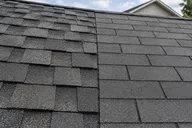 Are architectural shingles worth it over 3-tab shingles?Architectural shingles start near $3.50 a square foot against $1.50 for 3-tab, last about 30 years instead of 20, and carry longer warranties.