
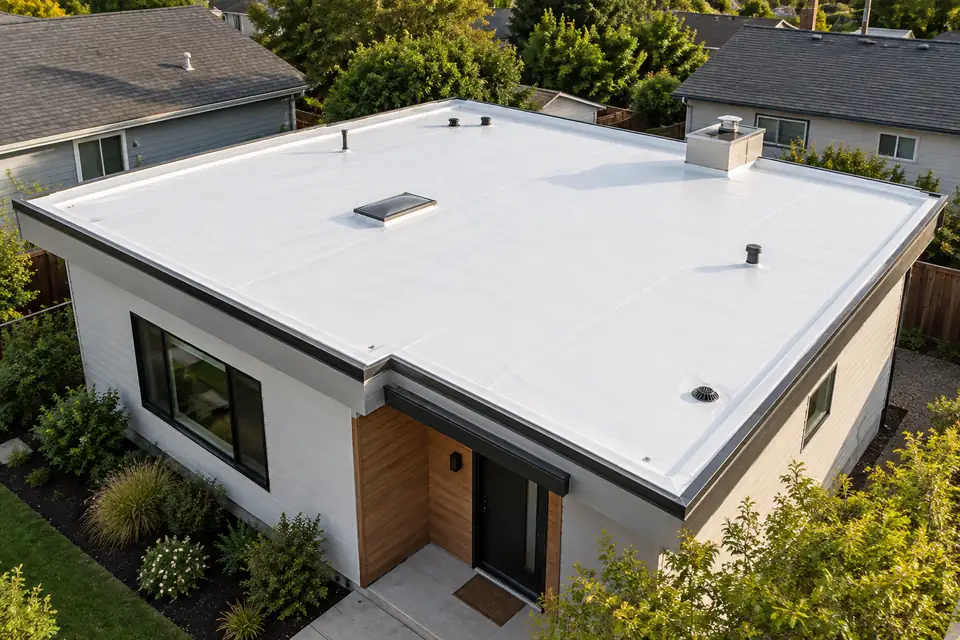
Replacing a flat or low-slope roof on a home typically costs $3,331 to $11,558, with an average of $7,433, according to HomeAdvisor's survey of its customers. HomeAdvisor puts the installed price at $4 to $35 a square foot, and Fixr gives an average of $8,000 with a typical range of $4,000 to $21,000. Most of the difference between one flat roof and another comes down to its size, the membrane you choose, what has to come off first, and whether the roof drains properly.
This guide is about the flat and low-slope roofs on homes: over a porch, a garage, a rear addition, a dormer or the whole of a modern house. The prices below are for residential jobs, not commercial buildings.
What national sources say it costs
| Source | Typical total | Average | Per square foot |
|---|---|---|---|
| HomeAdvisor, updated June 20, 2026 | $3,331 to $11,558 | $7,433 | $4 to $35 |
| Fixr, updated January 27, 2026 | $4,000 to $21,000 | $8,000 | $4 to $16 for the membrane types below |
| This Old House, updated March 16, 2026 | $11,311 to $37,709 or more | $24,510 | $7 to $13 for the membrane types below |
The first two are close. This Old House is much higher, and it prices a larger roof: its per-material totals are for 2,000 square feet, and it says its figures come from the Homewyse cost database and a survey of 1,000 homeowners. A 300 square foot porch roof will land far below any of these averages; a whole flat-roofed house can land above them. The fairest way to compare your own estimates is by the square foot, or by the square (100 square feet), once you know how big the roof is.
HomeAdvisor also breaks out a few costs that appear on most estimates: tearing off the old roof at $1 to $5 a square foot ($1,000 to $1,500 on average), labor at $3 to $7 a square foot, and a permit and inspection at $250 to $600.
The membranes, and what each costs
A flat roof is covered with a continuous waterproof membrane rather than overlapping pieces. These are the main types on homes.
- EPDM is a synthetic rubber sheet. The EPDM Roofing Association says it comes in black, gray and white, in thicknesses of 45, 60 and 90 mils, and is fully glued down, mechanically fastened or held down with ballast. Its seams are joined with tape or liquid adhesive.
- TPO and PVC are thermoplastic sheets, mostly white. SPRI, the single-ply roofing industry's trade group, explains that their seams are made by melting the two sheets together with a hot-air welder, so a finished seam is the same plastic as the sheet. SPRI notes that PVC resists rooftop chemicals such as oils and greases.
- Modified bitumen is asphalt blended with a polymer, known as SBS or APP, and usually laid as a base sheet with a cap sheet on top. The Asphalt Roofing Manufacturers Association (ARMA) lists heat welding, cold adhesive, self-adhering sheets and mechanical fastening as ways to apply it.
- Built-up roofing, the old "tar and gravel" roof, alternates layers of asphalt with ply sheets, typically three or four, and is finished with gravel, a mineral cap sheet or a coating, according to ARMA.
| Membrane | HomeAdvisor, per sq ft | Fixr, per sq ft | This Old House, per sq ft |
|---|---|---|---|
| Modified bitumen | $4 to $8 | $4 to $8 | $7 to $9 |
| Built-up | $4 to $10 | $4 to $10 | $7 to $9 |
| EPDM rubber | $5 to $13 | $4 to $13 | $9 to $13 |
| TPO | $4 to $14 | $4 to $14 | $8 to $11 |
| PVC | not given | $5 to $16 | not given |
All three sources put the membranes in an overlapping band, so the membrane alone rarely decides the price. Insulation, tear-off, the number of edges and penetrations, and how the roof drains usually move it more.
How long each membrane lasts
The sources disagree, sometimes by a decade. Treat these as ranges to ask about, not promises.
| Membrane | InterNACHI life expectancy chart | Fixr |
|---|---|---|
| EPDM | 15 to 25 years | about 30 years |
| TPO | 7 to 20 years | 20 to 30 years |
| PVC | not listed | 20 to 30 years |
| Modified bitumen | 20 years | about 20 years |
| Built-up | 30 years | 15 to 30 years |
ARMA says it is not rare to find modified bitumen or built-up roofs still in excellent condition after 20, 30 or 40 years. How long yours lasts depends heavily on whether water drains off it, which is the next section. For how other roofing materials compare, see how long a roof lasts.
Drainage and ponding
A "flat" roof should not be truly flat. ARMA recommends a slope of at least 1/4 inch per foot and says model building codes require that much for new construction, and positive drainage when a roof is re-covered. ARMA defines ponding as water that is still on the roof 48 hours or more after it stops raining.
Standing water shortens a membrane's life. ARMA lists the harm it does: the weight can deform the deck, ice can damage the membrane, dirt and plant growth collect in it, the membrane breaks down faster, and insulation under it loses some of its value.
A replacement is the best time to fix drainage. ARMA names the usual remedies: tapered insulation that builds slope into a roof whose deck has none, drains and scuppers, and small crickets or saddles that steer water around obstacles and toward the outlets. If your roof holds water after a storm, ask each roofer how their estimate will stop that, and ask to see it in writing.
Why asphalt shingles can't go on a flat roof
Shingles depend on slope: each course overlaps the one below, and the roof has to be steep enough for water to run off across those laps. ARMA's rule is plain: never apply asphalt shingles on a roof with less than 2 inches of rise per foot (2:12). Between 2:12 and 4:12 shingles are allowed only with extra underlayment, such as a double layer or a self-adhering sheet, following the manufacturer's low-slope instructions.
So a porch or addition roof that is flatter than 2:12 needs a membrane, or another covering rated for low slopes, not shingles. If a roofer offers to shingle a roof that flat, ask which manufacturer's installation instructions allow it.
Skylights and other openings in a flat roof
Every pipe, vent and skylight is a hole in the membrane, and each needs its own flashing. VELUX, a skylight maker, says its deck-mounted skylights are not suitable for low slopes, and that a flat or low-slope roof takes a curb-mounted or self-flashed unit instead. Our guide to skylight and chimney flashing explains how flashing works and what goes wrong with it.
Repair or replace
A flat roof repair is usually far cheaper than a new roof. HomeAdvisor gives an average flat roof repair of $400, Fixr an average of about $700, and This Old House a range of $379 to $1,755. A split seam, a puncture or one failed flashing is a repair.
Replacement makes more sense when the membrane is near the end of the ranges above, when leaks keep returning in different places, when the insulation or deck below is wet, or when the roof holds water and cannot be fixed without adding slope. Fixr's guidance is similar: repair is almost always cheaper, and replacement wins when the roof is near the end of its life or damaged across the whole surface. Our guide to repairing or replacing a roof walks through the decision for any roof.
What to ask before you sign
- The size of the roof in square feet and the price per square foot.
- The membrane by brand, product and thickness, and how it will be attached.
- Whether every existing layer comes off, and the price for any wet insulation or rotten deck found underneath.
- How the new roof will drain: slope, tapered insulation, drains or scuppers.
- How each skylight, pipe, vent and wall edge will be flashed.
- Who pulls the permit, and the written warranties on the membrane and on the labor.
Check the contractor as well as the estimate: our guide to what to check before you hire a contractor covers licenses, insurance and references.
Frequently asked questions
Which flat roof membrane is cheapest?
The three national sources put modified bitumen, built-up, EPDM and TPO in overlapping price bands, starting around $4 a square foot. PVC starts a little higher in Fixr's figures. Compare full estimates rather than material prices alone.
Can I put shingles on a low-slope porch roof?
Only if the slope is at least 2 inches of rise per foot, and between 2:12 and 4:12 only with the extra underlayment ARMA describes. Below 2:12, the roof needs a low-slope covering such as a membrane.
How much water on a flat roof is too much?
ARMA treats water that remains 48 hours or more after rain as ponding. A few damp spots that dry within a day or two are normal; water that stays longer is worth raising with a roofer.
Can a new membrane go over the old one?
Sometimes, but a roofer has to confirm the old roof and insulation are dry and sound, and ARMA notes that model codes require positive drainage when a roof is re-covered. Ask each roofer whether their estimate is for a tear-off or a re-cover, and why.
How long does a flat roof last?
It depends on the membrane and on drainage. InterNACHI's chart runs from 7 to 20 years for TPO up to 30 years for built-up roofing, and Fixr gives 20 to 30 years for most membranes.
How we got these numbers
HomeAnvil does not yet publish price data of its own. Every figure on this page comes from a published source, read on September 26, 2026:
- HomeAdvisor, flat roof replacement cost, updated June 20, 2026: the typical and average total, the price per square foot overall and by material, tear-off, labor, permit and average repair costs. HomeAdvisor says its figures come from a survey of its customers paired with other published research.
- Fixr, flat roof replacement cost, updated January 27, 2026: the average and typical total, the price per square foot and lifespan by material, the average repair cost and its repair-or-replace guidance.
- This Old House, flat roof replacement cost, updated March 16, 2026: the average and range, the price per square foot by material and the repair range. It says its data come from Homewyse and a survey of 1,000 homeowners.
- InterNACHI, standard estimated life expectancy chart for homes: the low-slope membrane lifespans.
- EPDM Roofing Association, what is EPDM: EPDM colors, thicknesses, attachment and seams.
- SPRI, single-ply roofing 101, January 9, 2019: how EPDM, TPO and PVC seams are made, and PVC's chemical resistance.
- Asphalt Roofing Manufacturers Association, multilayer asphalt roofing, April 30, 2018: what built-up and modified bitumen roofs are, how they are applied and how long they can last.
- Asphalt Roofing Manufacturers Association, ponding water basics, January 29, 2019: the definition of ponding, the recommended slope, what ponding does and how it is fixed.
- Asphalt Roofing Manufacturers Association, installing asphalt shingles on lower sloped roofs: the 2:12 minimum and the extra underlayment between 2:12 and 4:12.
- VELUX, mounting and flashing: which skylights suit a low-slope roof.
We will update this page when these sources publish new figures, and the date above will say when.
Related guides
 How much does a roof replacement cost?A roof replacement typically costs $5,900 to $13,400, or $400 to $1,100 per square installed. How to measure your roof, what moves the price and how to compare estimates.
 Should you repair or replace your roof?Most roof repairs cost $395 to $1,967; a replacement typically costs $5,900 to $13,400. How age, damage, layers and repair history decide which one you need.
 How long does a roof last?Architectural shingles last about 30 years, 3-tab about 20, metal 40 to 80, slate 60 to 150. What shortens a roof's life, and why a warranty isn't a lifespan.
 What are the signs you need a new roof?The signs a roof needs replacing, outside and in: age past 20 to 30 years for shingles, bald or curling shingles, repeat leaks, a sagging line. What each means.
 What to check before you hire a contractorFive things to ask for before you sign with a roofing, siding, window, bath or HVAC contractor, wherever you live in the United States.