
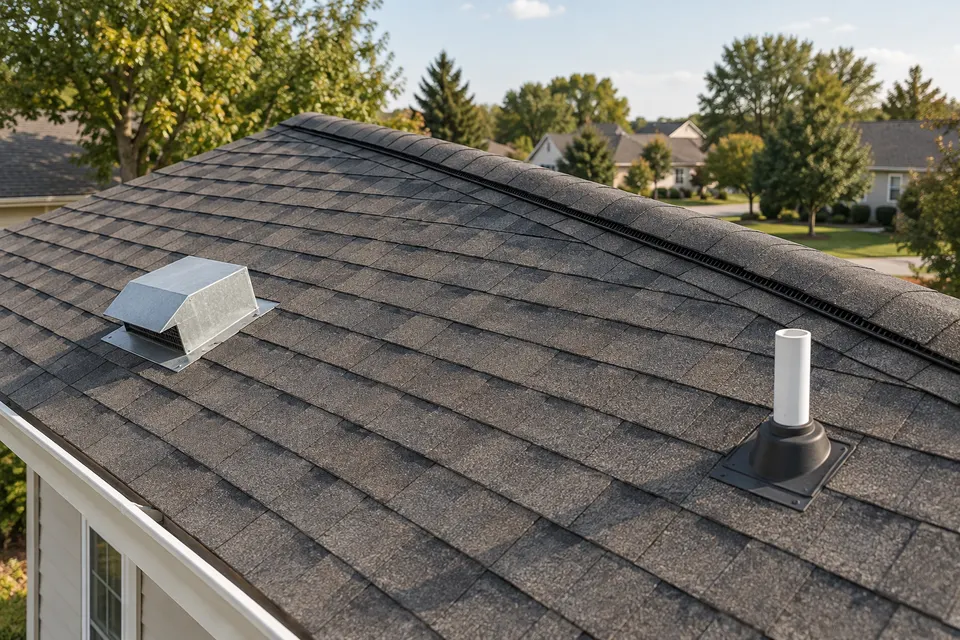
Installing or replacing a roof vent typically costs $382 to $1,388, according to Thumbtack, with simple jobs from about $150 and large ones up to $3,554. The type of vent sets most of the price: HomeAdvisor puts a turbine at $65 to $250, a ridge vent $300 to $650, and a powered attic fan $369 to $914 in most cases. Replacing a cracked rubber boot around a plumbing pipe is a smaller repair at $75 to $250, according to Fixr. This page is about what each vent costs to replace and how to tell one is failing. For why an attic needs ventilation and how much it needs, see our guide to attic ventilation.
Replacement cost by vent type
HomeAdvisor and Fixr price vents differently: HomeAdvisor gives a total per job, Fixr a cost to install per vent or per foot. Both are shown.
| Vent | Job | HomeAdvisor, per job | Fixr, cost to install |
|---|---|---|---|
| Ridge vent | Exhaust along the peak | $300 to $650, $500 average | $7 to $13 per linear foot |
| Box, static or roof louver | Exhaust near the peak | about $500 | $41 to $87 each |
| Off-ridge vent | Exhaust, for roofs with little ridge | not given | $113 to $206 each |
| Turbine | Wind-driven exhaust | $65 to $250 | $95 to $201 each |
| Powered attic fan | Electric or solar exhaust | $369 to $914, $626 average | see below |
| Soffit vent | Intake under the eaves | $315 to $465 | $35 to $64 each |
| Drip edge vent | Intake at the roof edge | not given | $2 to $4 per linear foot |
| Gable vent | Wall louver at the attic ends | $60 to $150 | $45 to $320 each |
| Pipe boot | Seal around a plumbing vent pipe | not given | $75 to $250 to repair or replace |
HomeAdvisor's ridge vent figures were updated June 19, 2026, and its attic fan figures June 20, 2026. Fixr's vent prices come from an article dated September 12, 2024, and its pipe boot price from its roof repair guide, updated January 21, 2026. The two are not directly comparable: a per-job figure covers a whole visit, while a per-vent or per-foot figure prices one unit, so multiply it by how many vents or feet your roof needs.
Ridge vents
A ridge vent runs along the peak under the ridge cap shingles. Fixr's price of $7 to $13 per linear foot means a 40-foot ridge would come to about $280 to $520, which is our own arithmetic and lines up with HomeAdvisor's $300 to $650 per job. HomeAdvisor puts the labor at $100 to $400 of that.
Because the vent sits under the ridge cap shingles, ask whether the price includes new cap shingles. If only a short piece is cracked or blown loose, ask whether that section alone can be replaced.
Box vents and turbines
Box vents are small fixed hoods set into the roof near the peak. Turbines are the round caps that spin in the wind; IKO, a shingle maker, says they work best where winds average at least 5 mph. On both, most of what you pay is labor on the roof: the old vent comes out, the new one goes in, and the shingles around it are sealed back down.
If you are replacing box vents or a turbine, it is a good moment to ask whether that type should stay at all. Paul Scelsi, writing in Roofing magazine, says that two types of exhaust vent should not be mixed over one shared attic, because one type can start pulling air in and let snow and rain into the attic. Swapping a failed box vent for a turbine next to other box vents is exactly that mix.
Powered attic fans
HomeAdvisor's customers pay $626 on average to install an attic fan, most between $369 and $914. Its breakdown:
| Fan | Cost (HomeAdvisor) |
|---|---|
| Passive | $75 to $100 |
| Electric | $100 to $450 |
| Solar | $300 to $1,000 |
| Dual power | $300 to $1,000 |
| Roofer's labor | $45 to $85 an hour, about 2 hours |
| Electrician's labor | $65 to $85 an hour, 1 hour minimum |
Fixr's older guide, updated August 26, 2022, puts the average at $450 and adds the parts that control a fan: a thermostat at $150 to $400 and a humidistat at $50 to $100. Fixr says most fans last about 15 years with cleaning, lubrication and inspection.
When a fan stops working, before paying for a new one, ask whether the attic needs a fan at all; our guide to attic ventilation covers the cautions about powered fans.
Soffit intake vents
Soffit vents are the slotted or perforated panels under the eaves. HomeAdvisor gives $315 to $465 for the job, and Fixr $35 to $64 per vent. If the soffit boards around them are rotten, the vent job becomes a soffit repair; our guide to soffit and fascia repair cost covers that. For houses with little or no soffit, Fixr prices a drip edge vent, an intake built into the metal roof edge, at $2 to $4 per linear foot.
Pipe boots around plumbing vents
Plumbing vent pipes are not attic vents, but they come through the roof the same way. Each pipe has a flashing with a rubber collar, the boot, sealed around it. ARMA's manual lays the flashing so the shingles at its sides and above overlap it, which is why a new boot means lifting and resealing those shingles.
| Job | Cost | Source |
|---|---|---|
| Repair or replace a vent boot | $75 to $250 | Fixr, roof repair, updated January 21, 2026 |
| Leak traced to a damaged vent boot | $100 to $600 | Fixr, roof leak repair, updated January 27, 2026 |
| Parts for a do-it-yourself fix | $10 to $20 | This Old House, updated May 27, 2026 |
Fixr says most of the price is labor, and that a metal roof, where panels may have to come off, costs more. ARMA, the asphalt roofing manufacturers' association, says in its residential manual that the boot's flange should be inspected once a year for cracks. Our guide to roof leak repair covers how boot leaks show up inside the house.
Signs a vent is failing or leaking
| What you see | Where to look | What it may mean |
|---|---|---|
| Cracked or split rubber around a pipe, stains on the ceiling below it | Pipe boots on the roof, the ceiling underneath | The boot has failed; This Old House also lists damp attic insulation, dripping in rain and musty smells |
| Dents in metal vents after a storm | Box vents, turbines, ridge vent ends | Hail; NRCA says thin aluminum fixtures help confirm hail hit the roof |
| Snow or rain inside the attic near a vent | Under exhaust vents, on insulation | Mixed exhaust types drawing weather in, or a vent flange that has lifted |
| A turbine that never turns | From the ground on a breezy day | Not moving air; ask whether it should be replaced or capped |
| A powered fan that never runs on a hot afternoon | The fan and its thermostat | A failed motor, thermostat or wiring |
| Frost, mold or damp insulation across the attic | The underside of the roof deck | A ventilation problem rather than one vent; see our attic ventilation guide |
If the vents were hit in a storm, photograph them before anything is replaced and see our guide to hail damage and roof insurance claims. This is general information, not insurance advice.
Replace vents during a new roof
The cheapest time to replace any vent is when the roof is being replaced anyway. ARMA's manual tells roofers reroofing a house to examine the flashing around pipes and to remove and replace any that has deteriorated. Ask each roofer to name, in writing, which vents and boots they will replace, which they will reuse, and which they will close off. Our guide to roof replacement cost explains how to compare the rest of the estimate.
Frequently asked questions
Can I replace a roof vent myself?
The parts are cheap, but the work is on the roof and involves lifting and resealing shingles. NRCA advises homeowners to leave roof repairs to a professional in all but extreme situations.
Should I replace box vents with a ridge vent?
A new roof is the easiest time to decide, because the ridge is open. If a ridge vent goes in, ask the roofer to close off the old box vents, because the ventilation task force article warns against mixing exhaust types over one attic.
How often should a pipe boot be checked?
ARMA's manual calls for checking the flange for cracks once a year. This Old House suggests looking at the roof and vent pipes at least twice a year.
How much does a solar attic fan cost?
HomeAdvisor puts a solar attic fan at $300 to $1,000 installed, the same range as a dual-power fan.
Does a new vent need a permit?
It depends on your building department and the size of the job. Check your local rules, or ask the roofer who pulls any permit.
How we got these numbers
HomeAnvil does not yet publish price data of its own. Every figure and claim on this page comes from a published source, read on September 27, 2026:
- Thumbtack, cost to install a roof vent, reviewed June 30, 2026: the typical range and the low and high ends.
- HomeAdvisor, roof ridge vent installation cost, updated June 19, 2026: ridge, box, turbine, soffit and gable vent prices and ridge vent labor.
- HomeAdvisor, attic fan installation cost, updated June 20, 2026: fan prices by type and labor rates.
- Fixr, types of roof vents, September 12, 2024: costs to install each vent type.
- Fixr, attic fan installation cost, updated August 26, 2022: average fan cost, thermostat and humidistat, fan life.
- Fixr, roof repair cost, updated January 21, 2026: vent boot repair. Fixr, roof leak repair cost, updated January 27, 2026: leaks from a damaged vent boot.
- This Old House, how to fix a leaking rooftop vent pipe, updated May 27, 2026: parts cost and the signs of a failing boot.
- IKO, Roof Vents 101, October 25, 2023: vent types and the turbine wind threshold.
- Paul Scelsi, Roofing magazine, do not mix attic exhaust vents, March 31, 2025.
- ARMA, Residential Asphalt Roofing Manual, 2014 edition: pipe flashing, yearly inspection and replacing flashing when reroofing.
- NRCA, roof repair after a hailstorm and roof repair after strong winds: aluminum fixtures as evidence of hail, and leaving repairs to a professional.
- The 40-foot ridge example is our own arithmetic from Fixr's per-foot price.
We will update this page when these sources publish new figures, and the date above will say when.
Related guides
 How much attic ventilation does a roof need?Code calls for 1 square foot of net free vent area per 150 square feet of attic, split between intake and exhaust. How vents work, warning signs and costs.
 How to find and fix a roof leak, and what it costsA roof leak repair typically costs $350 to $1,500, about $800 on average. How to trace a leak from the attic, what to do first and what each fix costs.
 How much does a roof repair cost?Most roof repairs cost $395 to $1,967, about $1,173 on average. Prices by problem: shingles, flashing, leaks, decking, vents, fascia and sagging.
 How much does soffit and fascia repair cost?Soffit and fascia repair typically costs $1,050 to $3,300, or $6 to $20 a linear foot. Signs of rot and pests, costs by material, and doing it with a new roof.
 How do you know if hail damaged your roof?Quarter-size (1 inch) hail can start to damage older 3-tab shingles, laminated ones at 1.25 inches. How to spot real damage and when to call your insurer.
 What causes ice dams, and how do you stop them?Ice dams form when attic heat melts roof snow that refreezes at the eaves. How to remove one safely, what not to do, and how to stop them coming back.