
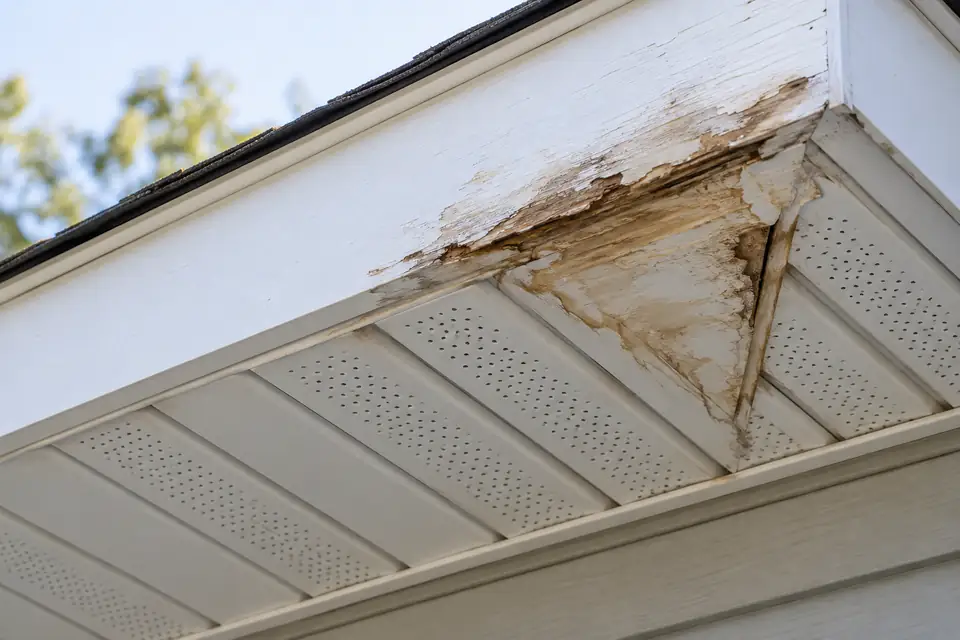
Repairing or replacing soffit and fascia typically costs $1,050 to $3,300, with an average of $2,500, according to HomeAdvisor's survey of its customers. HomeAdvisor prices the work at $6 to $20 per linear foot. Thumbtack's national range is lower, $525 to $2,338. A few feet of rotted board over one gutter sits at the bottom of those ranges; new soffit and fascia around a whole house sits near the top.
What soffit and fascia are
Both sit at the edge of the roof, where it overhangs the walls.
- Fascia is the board that runs along the roof edge, across the ends of the rafters. HomeAdvisor describes it as the trim that covers the rafter tails. IKO, a shingle maker, notes that it closes off the attic and is what the gutters are fastened to.
- Soffit is the underside of the overhang, the surface you see when you stand below the eaves and look up. HomeAdvisor calls it the exposed siding beneath the overhang. IKO notes that soffit vents, set into it, are one of the most common ways to let outside air into the attic.
HomeAdvisor says both protect the house against moisture and pests. When either fails, water and animals have a way in.
Signs of damage
- Rot and soft wood. IKO says roof leaks and clogged gutters can keep the fascia wet, and that bare, unsealed wood is the most likely to rot.
- Peeling paint, cracks or dark streaks. Modernize, a home improvement site, lists cracking, peeling or blistering paint and water streaks along the roofline as visible signs.
- Sagging, bowing or warped boards. IKO treats a bowed fascia as a sign of a structural problem.
- Holes, gaps or chewed edges. IKO lists chewing and pest infestation, and holes that let water into the attic. Modernize lists holes or gaps along the roofline and animal or insect activity near it.
- Mold, algae or a musty attic. IKO lists growth from constant wetness, and Modernize lists a musty or moldy attic smell among the less obvious signs.
- Gutters pulling away. A gutter that sags or leans away from the house often means the board it is screwed into has gone soft.
Why gutters are often the first sign
The gutters hang on the fascia. Modernize says gutters installed on damaged or rotting fascia can sag, drain poorly and fail early, and that a full gutter puts real weight on the board. IKO notes that there is no way to replace a fascia board without taking the gutters down first.
So a gutter that keeps pulling loose is often a fascia problem wearing a gutter's symptoms. Before you pay for new hangers or new gutters, ask whoever comes out to press on the board behind them. Our guide to new gutters with a new roof covers when the gutters themselves need replacing.
What it costs
| Source | Typical range | Average | Full range |
|---|---|---|---|
| HomeAdvisor, updated June 17, 2026 | $1,050 to $3,300 | $2,500 | $300 to $6,000 |
| Thumbtack, updated July 8, 2026 | $525 to $2,338 | not given | $184 to $7,018 |
| Fixr, roof repair guide, updated January 21, 2026 | $500 to $6,000 | not given | not given |
| This Old House, roof repair guide, updated March 5, 2026 | $600 to $6,000 | not given | not given |
Most of the spread is length. A soffit and fascia job is priced by the linear foot of roof edge, so a small repair over a porch and a whole house of new trim are not the same job.
HomeAdvisor also prices the work by the kind of damage:
| Kind of damage | HomeAdvisor's price |
|---|---|
| Water damage | $10 to $23 per linear foot |
| Insect or animal damage | $75 to $2,000 |
| Dry rot | $500 to $4,000 |
Extra costs HomeAdvisor lists: painting at $2.50 to $6.50 per linear foot, new drip edge at $1 to $2 per linear foot, and 7% to 15% more for areas that are hard to reach, such as a second story.
Costs by material
HomeAdvisor gives these prices per linear foot by material, and labor separately at $6 to $20 per linear foot. It does not say whether the material figures include installation, so read them as a way to compare materials rather than a full price.
| Material | HomeAdvisor, per linear foot |
|---|---|
| Wood or cedar | $1 to $3 |
| Fiber cement | $1 to $5 |
| Composite | $1 to $8 |
| PVC and other plastics | $3 to $7 |
| Vinyl | $5 to $9 |
| Aluminum | $8 to $20 |
HomeAdvisor's roof repair guide prices soffit panels separately at $1.50 to $4.50 per square foot, and Bob Vila puts fascia board replacement at $15 to $30 per linear foot.
How long each lasts is less settled. InterNACHI's life expectancy chart gives aluminum soffit and fascia 20 to 40 years or more. Thumbtack gives vinyl and aluminum 10 to 20 years, and fiber cement and steel 30 years or more. Thumbtack also notes that wood needs regular painting and sealing to keep rot out.
Repair or replace
Thumbtack's guidance is plain: a small damaged section is usually cheapest to repair, and damage that is widespread, keeps coming back, or runs along much of the roofline is better value to replace. Replacing a board also gives you the choice of a material that needs less upkeep than painted wood.
Whatever you choose, fix the cause. IKO names roof leaks and clogged gutters as what keeps fascia wet, and Fixr adds too few downspouts and a drip edge that is not doing its job. New fascia over the same problem is exposed to the same water.
Doing it during a roof replacement
A roof replacement is the natural time to deal with the roof edge. The old drip edge comes off, the gutters often come down, and rot along the eaves is in plain sight. IKO says that when fascia is replaced during roof work, the new shingles go on first and the fascia board follows. Bob Vila suggests raising soffit and fascia with the roofer you are already hiring, and notes that problems at the roof edge can point to problems with the roof structure itself.
Ask for a price per linear foot of fascia and soffit in the roofing contract, the same way you would ask for a price per sheet of decking, so rot found during the tear-off has a known cost. If you are replacing the roof anyway, our guide to roof replacement cost covers the rest of the estimate.
Soffit vents and the attic
IKO explains that roofers usually put intake vents low, near the eaves, and exhaust vents near the peak, so that cooler air coming in at the bottom pushes warm air out at the top. Soffit vents are one of the most common intakes. ENERGY STAR warns never to lay insulation over soffit vents, because it blocks that air. If new soffit is going up, ask whether it will be vented, and whether the insulation behind it will be kept clear. Our guide to roof ventilation explains how intake and exhaust work together, and blocked soffits are one of the causes covered in our guide to ice dams.
Who does the work
Bob Vila lists roofers and general contractors, and gutter installers, as the trades that usually repair soffit and fascia. If animals, bees or wasps are nesting in the eaves, or you see termite damage, it says to bring in pest control first, so the new boards do not close a nest inside. Check the contractor as well as the estimate: our guide to what to check before you hire a contractor covers licenses, insurance and references.
Frequently asked questions
What is the difference between soffit and fascia?
Fascia is the vertical board along the roof edge that the gutters hang on. Soffit is the horizontal underside of the overhang, between the fascia and the wall.
Can fascia be repaired, or does it have to be replaced?
A short rotted section can be cut out and replaced. Thumbtack suggests replacement when the damage is widespread or keeps coming back.
Do the gutters have to come off?
To replace the fascia, yes. IKO says the fascia cannot be replaced without taking the gutters down, and in good condition they can usually go back up on the new board.
Is vinyl or aluminum better?
The sources do not settle it. HomeAdvisor prices vinyl at $5 to $9 a linear foot and aluminum at $8 to $20. For lifespan, InterNACHI gives aluminum 20 to 40 years or more, while Thumbtack gives both 10 to 20 years.
Will insurance cover rotted fascia?
Homeowners insurance generally covers sudden damage, such as a storm, not rot or wear. Your policy decides; this is not insurance advice. See our guide to roof insurance claims.
How we got these numbers
HomeAnvil does not yet publish price data of its own. Every figure on this page comes from a published source, read on September 26, 2026:
- HomeAdvisor, fascia and soffit repair cost, updated June 17, 2026: the typical, average and full range, the price per linear foot, material and labor prices, costs by damage type, painting, drip edge and access, and definitions. HomeAdvisor says its figures come from surveys of its customers and other published research.
- HomeAdvisor, roof repair cost, updated June 19, 2026: soffit panels per square foot.
- Thumbtack, soffit and fascia repair cost, updated July 8, 2026: its national range, material lifespans and repair-or-replace guidance. Thumbtack says its figures come from its pros' data and additional research.
- Fixr, roof repair cost, updated January 21, 2026: its soffit and fascia range.
- This Old House, cost of roof repair, updated March 5, 2026: its soffit and fascia range.
- Bob Vila, who repairs soffit and fascia, updated May 8, 2024: who does the work, pest control first, the fascia price per foot and raising it with a roofer.
- IKO, replacing or repairing roof fascia, November 22, 2023: what fascia does, signs of damage, causes of rot, gutters and fascia, and the order of work during a reroof.
- Modernize, should soffit and fascia be repaired during gutter replacement, updated August 12, 2026: signs of damage and gutters on rotting fascia.
- InterNACHI, standard estimated life expectancy chart for homes: aluminum soffit and fascia lifespan.
- Fixr, fascia board replacement guide, updated February 16, 2022: causes of fascia damage.
- IKO, Roof Vents 101, October 25, 2023: soffit vents as intake and how intake and exhaust work.
- ENERGY STAR, attic insulation project: keeping insulation off soffit vents.
We will update this page when these sources publish new figures, and the date above will say when.
Related guides
 Should you replace gutters with a new roof?Often, if they are old or sagging. New gutters cost about $3 to $45 a linear foot by material, and guards $6 to $45. Sizing, fascia, and when to keep yours.
 How much does a roof repair cost?Most roof repairs cost $395 to $1,967, about $1,173 on average. Prices by problem: shingles, flashing, leaks, decking, vents, fascia and sagging.
 How much attic ventilation does a roof need?Code calls for 1 square foot of net free vent area per 150 square feet of attic, split between intake and exhaust. How vents work, warning signs and costs.
 How much does a roof replacement cost?A roof replacement typically costs $5,900 to $13,400, or $400 to $1,100 per square installed. How to measure your roof, what moves the price and how to compare estimates.
 What causes ice dams, and how do you stop them?Ice dams form when attic heat melts roof snow that refreezes at the eaves. How to remove one safely, what not to do, and how to stop them coming back.
 What does a sagging roof mean, and how serious is it?A sagging roof points to water damage, rot, too much weight or undersized framing. Repairs typically cost $750 to $3,000; when to call a structural engineer.