
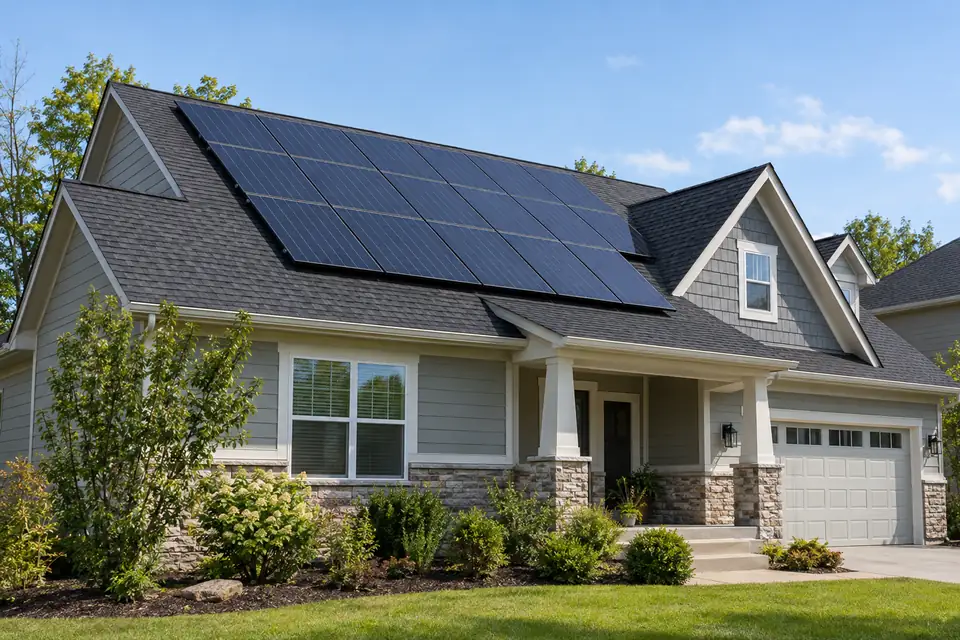
To replace a roof under solar panels, a solar professional disconnects and removes the panels and their mounts, the roofer replaces the roof, and the panels are reinstalled and checked. The Department of Energy says the panels and mounting system have to come off for a roof replacement. Fixr puts removing and reinstalling a typical home system at $2,800 to $4,800; HomeAdvisor's figures run higher. If you are only planning solar, the cheaper path is to deal with an aging roof first, before the panels go up.
Replace the roof first if it is near the end of its life
A solar array is meant to stay put for decades. The Department of Energy says residential panels usually last 20 to 25 years, and that most keep at least 80% of their original output for at least 25 years. A roof that will need replacing partway through that time means paying to take the system down and put it back.
That is why the Department of Energy tells homeowners to consider the age of the roof, and how long until it will need replacing, before going solar, and to have it evaluated. Its guide to choosing an installer says checking the roof's condition should be one of the first things an installer does, and that you should ask whether the roof needs repair before installation. If you do not know how old your roof is, the Department of Energy notes that your local government should have a record of the building permit.
Our guides to how long a roof lasts and the signs you need a new roof can help you judge how much life your roof has left.
Doing both at once
The Department of Energy said in 2021 that adding solar at the same time as a roof replacement can save money, partly because roofers and solar installers often work together. Using the averages it gave then, about $10,000 for a roof and $19,000 for a solar array, it put the two done together at about $25,000, an average saving of about $4,000. The $29,000 for two separate projects is our own arithmetic on its figures. Prices have changed since 2021, so treat the saving as a sign of the direction, not today's number.
If you are weighing a solar roof instead of panels on a new roof, see solar shingles vs solar panels.
What removing and reinstalling panels costs
The industry calls this job a detach and reset, or a remove and reinstall. The two national cost guides we found disagree by a wide margin.
| Source | What the figure covers | Cost |
|---|---|---|
| Fixr, updated January 31, 2025 | Disconnecting, removing and reinstalling 14 to 16 panels, with inspection | $2,800 to $4,800; $3,800 on average |
| Fixr | The same work, per panel | $200 to $300 |
| HomeAdvisor, updated June 19, 2026 | Removal only | $3,000 to $12,500; $5,000 on average; $200 to $500 per panel |
| HomeAdvisor | Reinstallation after roof work | $2,000 to $2,500; $50 to $100 per panel |
HomeAdvisor's range for removal alone is wider and higher than Fixr's range for the whole job, so ask every solar company to price removal and reinstallation separately and to say how many panels the price covers. Fixr's per-panel figure scales with system size: its table puts 30 panels at $6,000 to $9,000.
This is on top of the roof. See our guide to roof replacement cost for that part of the budget.
What moves the price of a detach and reset
HomeAdvisor lists these, with its own figures where it gives them:
- The number of panels, the biggest factor.
- Labor, at $50 to $200 an hour.
- The roof's design and how easy it is to reach.
- The age of the system and the condition of its mounting hardware. Old or brittle parts may need replacing.
- Disconnecting from the grid, $400 to $600.
- Permits, $150 to $1,000.
- Removing the mounting system, $30 to $50 per panel.
HomeAdvisor says most removals take one to two days. Fixr notes the price can include small replacement parts such as fasteners and connectors.
Who does what: the roofer and the solar installer
Two trades share the roof, and the job goes best when each knows the other's schedule.
- The solar company disconnects and removes the system. Fixr says only certified solar professionals should remove or reinstall a system, and HomeAdvisor says a solar professional makes sure the electrical disconnection is done safely.
- The panels are stored safely on site or at the installer's shop until the roof is done. Ask who is responsible for them while they are off the roof.
- The roofer replaces the roof, including the areas under the array. Our roof replacement process guide covers each step.
- The solar company reinstalls the mounts and panels, reconnects the system and tests it.
- Permits and inspections may be needed for the roofing and for the solar work. Ask each contractor which permits it pulls; our guide to roofing permits explains the roofing side.
If your panels are leased or covered by a power purchase agreement, the company that owns them has to be involved. The Federal Trade Commission advises asking, before you sign, what happens if you need to repair your roof after the system is installed. Read your contract for who arranges and pays for removal.
Warranties on the roof and on the panels
A roof under solar carries two sets of warranties, and each can be put at risk by the other trade's work.
- Shingle warranties exclude solar work. Owens Corning's 2026 shingle warranty excludes damage from solar panel installation after the roof is finished, and says it will not pay to remove and replace solar panels or other rooftop equipment during a warranty repair. Read your own shingle warranty for the same terms.
- Solar warranties can be voided by the wrong hands. HomeAdvisor warns that improper removal can void warranties, and Fixr says amateur work may void the warranty. Ask your solar company whether a detach and reset by another company affects its warranty.
- Ask who owns a leak. The Department of Energy advises asking a solar installer who is responsible if the roof is damaged or a leak develops. Fixr says many solar companies warrant the roof where the panels sit, for at least 10 years, varying by company.
Get each warranty in writing before work starts. Our guide to roofing warranties explains manufacturer and workmanship coverage.
Roof penetrations and mounting
Most rooftop systems are bolted through the roof into the structure, so every mount is a hole that has to stay sealed. Fixr notes that when mounting hardware comes off, the exposed openings must be patched to keep the roof from leaking. On a replacement, those holes are made again when the mounts go back on the new roof, so ask how each mount will be flashed and sealed.
The Department of Energy suggests asking whether roof repairs, or moving vent pipes to low-profile openings that fit under the panels, should be part of the solar proposal. Things mounted on a roof are a common source of leaks; our guide to roof leak repair explains how to trace one.
Tax credits and the roof
The federal residential clean energy credit is no longer available for new systems: the IRS says it does not apply to property placed in service after December 31, 2025. Even when it applied, the IRS says, ordinary roofing did not qualify; solar shingles and solar roofing tiles did, because they generate electricity. Check current federal rules and your state's rules before counting on any credit or rebate. This is general information, not tax advice.
Frequently asked questions
Can a roofer remove solar panels?
Fixr says only certified solar professionals should remove or reinstall a system, and removing it the wrong way can void warranties. Most roofers work alongside a solar company for this part of the job.
How long does it take to remove and reinstall solar panels?
HomeAdvisor says removal usually takes one to two days. Add the roof replacement itself and the reinstall, and allow time for any permits and inspections.
Should I replace my roof before installing solar panels?
If the roof is likely to need replacing within the life of the panels, doing it first avoids paying for a detach and reset later. The Department of Energy says residential panels usually last 20 to 25 years.
Do solar panels void my roof warranty?
They can affect it. Owens Corning's shingle warranty excludes damage from solar panel installation and will not pay to remove and replace panels. Read the exclusions in your own warranty and ask your solar company what it covers.
Can I replace only the part of the roof under the panels?
Ask your roofer. Matching new shingles to an older roof, and the age of the rest of the roof, both bear on whether a partial replacement makes sense.
How we got these numbers
HomeAnvil does not yet publish price data of its own. Every source was read on September 26, 2026:
- Fixr, cost to remove solar panels to replace a roof, updated January 31, 2025: the $2,800 to $4,800 range for 14 to 16 panels, the per-panel figure, the 30-panel row, what the price includes, who may do the work, patching mount holes and roof warranties from solar companies.
- HomeAdvisor, solar panel removal cost, updated June 19, 2026: removal and reinstallation ranges, per-panel costs, labor, grid disconnection, permits, mounting removal, time on site and the warning about warranties.
- U.S. Department of Energy, should I replace my rooftop solar system, June 25, 2024: removal of panels and mounts for a roof replacement, and output after 25 years.
- U.S. Department of Energy, replacing your roof? it's a great time to add solar, July 28, 2021: the combined-project figures.
- U.S. Department of Energy, homeowner's guide to going solar: roof age before going solar. The page carries no date.
- U.S. Department of Energy, a step-by-step guide for consumers going solar, August 4, 2021: roof evaluation and permit records of roof age.
- U.S. Department of Energy, choosing a solar installer, August 31, 2021: roof checks, responsibility for leaks and vent relocation.
- U.S. Department of Energy, a consumer's guide to buying a house with solar panels: panel lifespan. The page carries no date.
- Federal Trade Commission, solar power for your home, April 2022: roof repair after installation and lease terms.
- IRS, residential clean energy credit: the end date and which roofing qualified.
- Owens Corning, standard product limited lifetime warranty on roofing shingles and components, January 2026, read from the copy hosted by BuildSite: the solar exclusions.
We could not read the Solar Energy Industries Association's consumer guide, which blocked our request, so nothing here comes from it. We will update this page when either cost guide publishes new figures.
Related guides
 How much does a roof replacement cost?A roof replacement typically costs $5,900 to $13,400, or $400 to $1,100 per square installed. How to measure your roof, what moves the price and how to compare estimates.
 How long does a roof last?Architectural shingles last about 30 years, 3-tab about 20, metal 40 to 80, slate 60 to 150. What shortens a roof's life, and why a warranty isn't a lifespan.
 What does a roof warranty actually cover?A shingle warranty covers manufacturing defects, a contractor's warranty covers installation. How prorating, wind, algae, transfers and voiding work.
 How to find and fix a roof leak, and what it costsA roof leak repair typically costs $350 to $1,500, about $800 on average. How to trace a leak from the attic, what to do first and what each fix costs.
 What happens during a roof replacement, step by step?An asphalt shingle roof usually goes on in one to three days. What happens before, during and after, from tear-off and deck repair to flashing and cleanup.
 Do you need a permit to replace a roof?Usually yes, where your local code requires one. A roofing permit costs about $100 to $500, and up to $1,400 in some places. Who pulls it and what gets inspected.