
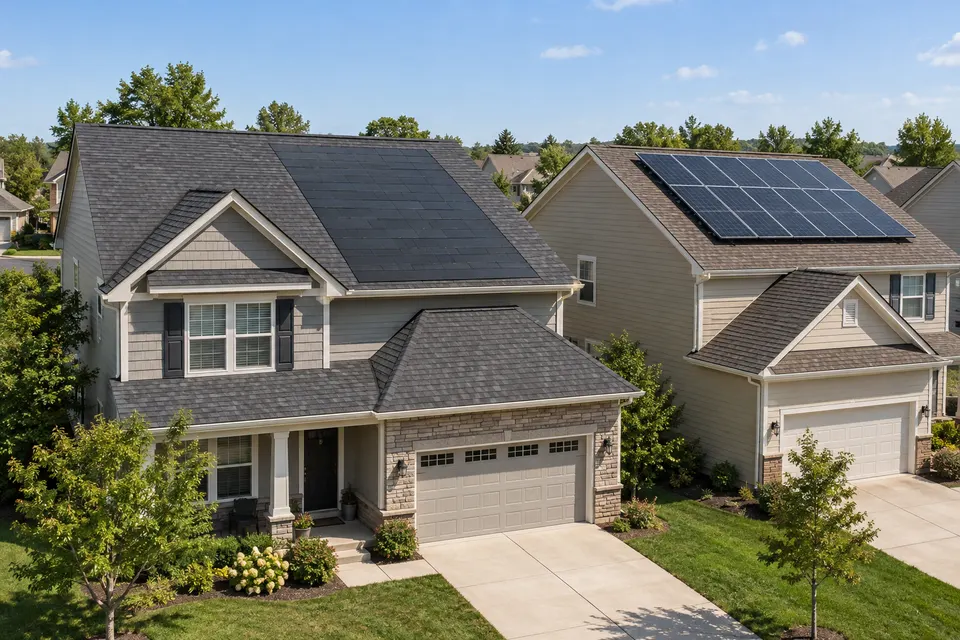
For most homeowners replacing a roof, a new conventional roof with solar panels racked on top makes more electricity for less money. Fixr puts solar shingles at $3.50 to $8 per watt installed; HomeAdvisor puts panels at $2.50 to $3.50 per watt. Panels also make more power from each square foot of roof. Solar shingles make sense when appearance matters most to you and you are replacing the roof anyway, because they become part of the roof instead of sitting on it. Either way, the federal residential clean energy credit no longer applies to systems placed in service after December 31, 2025, according to the IRS.
The two at a glance
| Solar shingles | Solar panels on a new roof | |
|---|---|---|
| Installed cost per watt | $3.50 to $8 (Fixr) | $2.50 to $3.50 (HomeAdvisor) |
| Typical system cost | $27,600 to $60,000, about $46,000 on average (Fixr) | $18,297 to $36,409, about $27,129 on average (HomeAdvisor); $19,000 to $23,800 (Fixr) |
| Efficiency | 15% to 20% (Fixr) | Up to 19% to 22% (Fixr) |
| Power per square foot | Up to about 16 watts (EnergySage) | Over 20 watts for the best panels (EnergySage) |
| How it meets the roof | Is the roof, or part of it | Racked on mounts bolted through a separate roof |
| Expected life | 25 to 30 years, with 25-year warranties common (Fixr) | 25 to 30 years (HomeAdvisor); most keep at least 80% of their output for at least 25 years (Department of Energy) |
| Needs a new roof underneath | Replaces the roofing where it goes | Yes, if the roof will not outlast the panels |
The panel costs above are for the solar system only. Put a new roof under them and you pay for that too; our guide to roof replacement cost covers that part of the budget. Solar shingles replace some of the roofing they cover, so part of their price is doing a roof's job.
Installed cost
The national cost guides we could read agree that solar shingles cost more for the same power.
- Fixr, updated January 30, 2026, puts a solar shingle installation at $27,600 to $60,000, about $46,000 on average, or $21 to $25 per square foot of shingles. It says labor is around 60% of the total. It puts a traditional panel system for the average home at $19,000 to $23,800.
- HomeAdvisor, updated June 19, 2026, puts professional panel installation at $18,297 to $36,409, with most homeowners spending about $27,129, and $2.50 to $3.50 per watt.
- EnergySage, in a page updated December 4, 2024, said solar shingles cost roughly 60% to 190% more than panels for the same power output.
Price per watt is the fair comparison, because it prices the electricity-making part of each system. An example, with our own arithmetic on those ranges: an 8,000-watt (8 kW) system would be about $28,000 to $64,000 in solar shingles and about $20,000 to $28,000 in panels, before the roof under the panels.
Two national guides we tried, Angi and HomeGuide, blocked our requests, so nothing here comes from them.
Output and efficiency per square foot
Efficiency is the share of the sunlight hitting a surface that becomes electricity. Fixr gives traditional panels up to 19% to 22% and solar shingles 15% to 20%. EnergySage said the best panels produce over 20 watts per square foot, while the solar shingles it compared topped out at about 16 watts per square foot. The Department of Energy's guide for homebuilders says building-integrated solar, the category solar shingles belong to, typically comes at a higher cost and makes less power for the same area.
What that means on your roof, in our own arithmetic: an 8 kW system needs about 500 square feet of sun-facing roof at 16 watts per square foot, and about 400 square feet at 20 watts per square foot. If your good, unshaded roof area is small, panels can fit more power on it.
Fixr says individual solar shingles range from 13 to 100 watts each, with most common models at 18 to 22 watts. Ask for the rated watts of each piece and the total system size in writing, so two proposals can be compared.
How each ties into the roof
Solar shingles are integrated. Fixr says they either act as the roof or fit into conventional roofing such as asphalt shingles, so part of the roof is solar and the rest is ordinary shingles. The solar pieces shed water as the roof does, and there is no separate rack. EnergySage said they work mainly with asphalt shingle roofs, not with materials such as flat roofs or clay tile. They are installed with the roof, so they fit a reroof or new construction, not an existing roof you are keeping.
Solar panels are racked. Panels sit on rails fixed to mounts that are fastened through the roofing into the structure. Each mount is a hole that has to be flashed and sealed, and the whole array has to come off when the roof under it is replaced. The Department of Energy says the panels and mounting system need to be removed for a roof replacement. Our guide to replacing a roof with solar panels covers that job and its cost.
Roof warranty and leaks
With either choice, the question is who answers for a leak.
- With panels, you have a roofing warranty and a solar warranty on the same surface, and each can be affected by the other trade's work. Shingle warranties can exclude damage from solar installation; our solar panels and roof replacement guide describes one such exclusion, and our guide to roofing warranties explains manufacturer and workmanship coverage.
- With solar shingles, the solar product is the roof covering, so its warranty has to cover weathertightness as well as power. Fixr says manufacturers commonly give 25-year warranties covering performance and durability. EnergySage reported that some manufacturers guarantee 85% of rated output at year 25. Terms differ by product, so read the actual warranty.
- More trades on one roof. The Department of Energy's summary of industry comments on building-integrated solar notes that it adds a solar contractor to the job, must comply with both construction and solar codes, and that water getting in is one of the things such systems should be monitored for.
The Department of Energy advises asking a solar installer who is responsible if the roof is damaged or a leak develops. Get the answer in writing, for the roofing and for the solar, before work starts.
Lifespan and repairs
Lifespan. Fixr says solar shingles typically last 25 to 30 years. HomeAdvisor says most panels produce electricity for 25 to 30 years. The Department of Energy says most systems keep at least 80% of their original output for at least 25 years, and lose only about 1% a year. Compare that with how long the rest of your roof will last; our guide to how long a roof lasts gives the figures by material. A roof that wears out long before the solar does means paying to work around the system.
Repairs. A panel can be taken off its rack and replaced. A solar shingle is part of the roof. The Department of Energy's building-integrated solar summary notes that it is more challenging to replace a failed component that is built into the building and also doing a building's job. Fixr notes that a repair under warranty may cost only the labor. Ask who stocks replacement pieces, who is trained to fit them, and whether a roofer can repair the ordinary shingles around them without affecting the solar warranty.
The federal tax credit
The IRS says the residential clean energy credit equals 30% of the cost of qualifying clean energy property, and that it is not available for any property placed in service after December 31, 2025. While it applied, the IRS said solar shingles and solar roofing tiles qualified because they generate electricity, and traditional shingles that support solar panels did not. Fixr likewise says systems placed in service in 2026 or later are not eligible.
Some older Department of Energy pages, written in 2022, still describe a 30% credit running through 2032. The IRS page, last updated July 4, 2026, is the current word; check it for the year you file. State and utility programs are separate; check your state's rules and your utility's programs. This is general information, not tax advice, and tax rules change. Ask a tax professional about your own return. Our guide on whether a new roof is tax deductible covers how a roof affects your home's basis.
When to reroof before solar
The Department of Energy tells homeowners to consider the age of their roof and how long until it will need replacing before they go solar. It also advises asking an installer whether the roof needs repair before installation. Its 2021 figures put a roof and a solar array done together at about $25,000 on average, saving about $4,000 over doing them separately; prices have changed since.
- Roof near the end of its life: replace it first, or choose solar shingles as part of the new roof. Either avoids paying to remove and reinstall panels partway through their life.
- Roof with many good years left: panels on the existing roof are usually the cheaper path; solar shingles would mean tearing off a sound roof.
- Roof you are replacing now: price both. Get the new roof with panels on it and the roof with solar shingles as two complete proposals, each with the total system size in watts.
Our guides to the signs you need a new roof and roofing materials can help with the first decision.
What to ask
- What is the total system size in watts, and the expected yearly output? The Federal Trade Commission says a bid should state the system's size and how much power it is expected to deliver, and the full cost including permit fees.
- What is the price per watt, and for panels, what does the roof under them cost?
- For solar shingles, how much of the roof is solar and how much is ordinary roofing, and which product covers each part?
- Who is responsible for a leak, for the roofing and for the solar, and for how long?
- What warranties cover the equipment and the installation workmanship? The FTC suggests asking about both.
- What happens if the roof needs repair after the system is installed? The FTC suggests asking this too.
- Is the installer licensed, bonded and insured for solar work where you live? The Department of Energy suggests checking, and names NABCEP certification as a credential to look for.
- If the system is leased or under a power purchase agreement, who arranges and pays for roof work later?
Before you sign, check the contractor as well as the proposal: see what to check before you hire a home improvement contractor. To price the roof itself, try the roof cost calculator.
Frequently asked questions
Are solar shingles cheaper than solar panels?
No, not for the same power. Fixr puts solar shingles at $3.50 to $8 per watt and HomeAdvisor puts panels at $2.50 to $3.50 per watt. Solar shingles also stand in for some roofing, but even so the national guides we read put them above panels.
Do solar shingles make as much electricity as panels?
Not per square foot. Fixr gives shingles 15% to 20% efficiency and panels up to 19% to 22%, and EnergySage said the best panels produce over 20 watts per square foot against about 16 for solar shingles.
Can I put solar shingles on my existing roof?
No. Fixr says solar shingles replace the roofing material instead of mounting on top, so they go on during a roof replacement or new construction.
Do solar shingles still qualify for the federal tax credit?
Not for systems placed in service after December 31, 2025, the IRS says. Before then they qualified because they generate electricity. This is not tax advice.
Do solar panels on a new roof cause leaks?
They can if a mount is not flashed and sealed properly, because each mount goes through the roof. Ask how each one will be sealed and who answers for a leak.
How we got these numbers
HomeAnvil does not yet publish price data of its own. Every source below was read on September 27, 2026:
- Fixr, how much do solar shingles cost, updated January 30, 2026: solar shingle and panel system costs, per watt and per square foot, labor share, efficiency, watts per shingle, lifespan, warranties, repairs, installation and the tax credit end.
- HomeAdvisor, cost to install solar panels, updated June 19, 2026: panel installation cost, price per watt and panel lifespan.
- EnergySage, solar shingles, updated December 4, 2024: the 60% to 190% cost gap, watts per square foot, output guarantees and compatible roofs. It is older than the other cost sources; we use it for comparisons the others do not give.
- U.S. Department of Energy, solar energy guide for homebuilders: building-integrated solar's higher cost and lower output for the same area. The page carries no date.
- U.S. Department of Energy, summary of the building-integrated photovoltaics RFI, March 7, 2022: extra trades, codes, water ingress and replacing integrated components.
- U.S. Department of Energy, should I replace my rooftop solar system, June 25, 2024: output after 25 years, yearly decline, and removal for a roof replacement.
- U.S. Department of Energy, homeowner's guide to going solar: roof age before going solar. The page carries no date, and its tax credit section is out of date, so we do not use it for the credit.
- U.S. Department of Energy, replacing your roof? it's a great time to add solar, July 28, 2021: the combined-project figures.
- U.S. Department of Energy, choosing a solar installer, August 31, 2021: roof repair, leak responsibility, licensing and NABCEP.
- U.S. Department of Energy, solar investment tax credit: what changed, September 8, 2022: the 2022 description of a credit through 2032.
- IRS, residential clean energy credit, last updated July 4, 2026: the 30% rate, the end date and which roofing qualified.
- Federal Trade Commission, solar power for your home, April 2022: what a bid should state and what to ask about warranties and roof repair.
- The 8 kW cost and roof-area examples are our own arithmetic on the figures above.
Angi, HomeGuide and Lawrence Berkeley National Laboratory's installed-price data blocked our requests, so nothing here comes from them. We will update this page when these sources publish new figures, and the date above will say when.
Related guides
 How do you replace a roof that has solar panels?The panels come off, the roof is replaced, and the panels go back on. Removing and reinstalling them costs about $2,800 to $4,800 by one estimate, more by another.
 Is a new roof tax deductible?A new roof on your own home is not deductible but adds to your cost basis. Home office and rental rules differ; federal home energy credits ended after 2025.
 What does a roof warranty actually cover?A shingle warranty covers manufacturing defects, a contractor's warranty covers installation. How prorating, wind, algae, transfers and voiding work.
 How long does a roof last?Architectural shingles last about 30 years, 3-tab about 20, metal 40 to 80, slate 60 to 150. What shortens a roof's life, and why a warranty isn't a lifespan.
 How much does a roof replacement cost?A roof replacement typically costs $5,900 to $13,400, or $400 to $1,100 per square installed. How to measure your roof, what moves the price and how to compare estimates.
 Types of roofing materials, and how they compareRoofing materials compared: asphalt costs $3 to $7 a square foot installed and lasts 20 to 30 years; slate $15 to $30 and 60 to 150 years.