
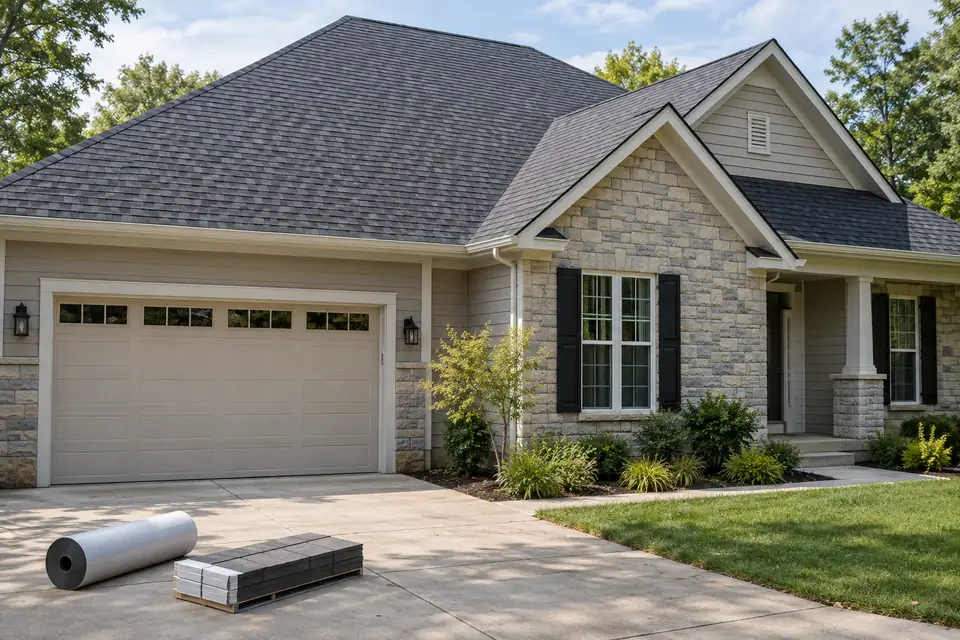
A new shingle roof usually comes with two separate promises. The shingle maker's warranty covers defects in the shingles. In two 2026 warranties for lifetime shingles, it pays in full, labor included, only for the first 10 years; after that it pays a shrinking share of the shingle cost and no labor. The roofer's own warranty covers mistakes in the installation, and its length is whatever the contractor offers: NRCA, the roofing contractors' association, says many offer one or two years and that there is no industry standard. A third kind, an enhanced or system warranty, adds installation coverage from the manufacturer but only when a certified contractor installs a full set of that maker's products. The shingle warranties exclude hail, wind above their rated speed and ordinary wear, which are matters for homeowners insurance and maintenance.
The three kinds of roof warranty
| Warranty | Who stands behind it | What it covers | What it usually leaves out |
|---|---|---|---|
| Manufacturer's standard material warranty | The shingle maker | Manufacturing defects in its own shingles and, sometimes, its matching accessories | Installation errors, other companies' parts such as flashing and decking, hail and storms, and usually tear-off and disposal |
| Contractor's workmanship warranty | The roofing company that installed the roof | Leaks and failures caused by how the roof was put on | Whatever the contractor writes out of it, and everything if the company closes |
| Enhanced or system warranty | The shingle maker, sold through contractors it has credentialed | Material defects for longer at full value, and in some programs the workmanship as well | Roofs that miss any of the program's conditions, which are strict |
The manufacturer's warranty comes with the shingles. The workmanship warranty is part of your contract with the roofer, so it says only what that contract says. An enhanced warranty depends on who installs the roof and which products go on it.
Non-prorated years, prorated years and what "lifetime" means
Every shingle warranty has two phases. In the first, called the non-prorated period, the maker pays the full covered cost of a defect. After it, the warranty is prorated: the maker pays a share of the shingle cost that shrinks with each year of use, and labor stops being covered. Two published 2026 warranties show how this is written.
| Term | Owens Corning standard warranty, lifetime shingles | CertainTeed 2026 warranty, lifetime shingles |
|---|---|---|
| Full-coverage period | 10 years (it calls this TRU PROtection) | 10 years (it calls this SureStart) |
| Paid during that period | Replacement shingles and the labor directly needed to fix them; not tear-off, disposal or other makers' metal and flashing | Comparable shingles and labor; tear-off, metal work, flashing and disposal only for some lifetime lines |
| After that period | A prorated share of the shingle cost, no labor | The shingle cost reduced by 1/600 for every month since installation, no labor |
| What "lifetime" means | As long as you own the home, on a single-family detached house you live in | As long as the original individual owner owns the property |
| On a rental, condominium or company-owned building | 40 years, with 5 years of full coverage | 50 or 40 years, depending on the line |
| Deadline to report a problem | Within 30 days of discovering it | Within 30 days of discovering it |
To see what prorating is worth, run the numbers. Owens Corning's own example is a claim in the fifteenth year: it pays 72% of the shingle cost and nothing for labor. Under CertainTeed's formula, a defect found 20 years after installation is 240 months in, so the reduction is 240/600, or 40%, and the most CertainTeed would contribute is 60% of the cost of comparable shingles, again with no labor or tear-off. Because labor is not covered, a late-life claim pays for far less than a new roof. Our guide to how long a roof lasts explains why a warranty's length is not a prediction of the roof's life.
NRCA makes the same point from the other side: it says a warranty's length should not be the main reason to choose a roofing product, because a long warranty does not show that the roof will perform, and a warranty is only worth something while its issuer is in business and able to pay.
Wind and algae coverage
Wind and algae are covered separately from defects, on their own clocks.
Wind. Shingles are held down by strips of asphalt sealant that need several days of warm sun to bond. Owens Corning treats blow-offs before the strips have sealed, for example after a cold-weather install, as the nature of the product rather than a defect. CertainTeed will supply replacement shingles in that case, but not the labor to put them on. After sealing, wind coverage for lifetime shingles runs 15 years from installation, and only up to a stated wind speed, gusts included. The speed depends on how the roof is nailed and finished:
- One Owens Corning lifetime line is rated at 110 mph with four nails per shingle and 130 mph only with six nails and the maker's starter shingles along the eaves and rakes.
- CertainTeed's lifetime lines start at 110 mph and rise to 130 or 160 mph for the first 15 years only if the maker's matching hip and ridge caps and starter shingles are installed and the shingles are not laid over an old roof.
- CertainTeed caps what it pays for wind at the reasonable cost of hand-sealing all the shingles on the roof. Owens Corning's standard warranty pays to replace blown-off shingles and hand-seal the rest. Neither covers winds above the rated speed.
Ask your roofer which nailing pattern and starter product the estimate includes, since the higher rating depends on them.
Algae. The dark streaks on many roofs are a blue-green algae, which both makers name as Gloeocapsa magma. Only shingles sold as algae-resistant, usually marked AR, are covered against it. Owens Corning covers staining on AR shingles for 25 years, the first 10 at full cost including labor, but only if its own hip and ridge shingles are used; otherwise the coverage drops to 10 years with 1 year at full cost. CertainTeed's AR coverage runs 25 or 30 years by product line with its AR hip and ridge accessories, and 10 years without them. Neither covers lichen, mold or other growth. Both also note that in some coastal and dry areas the copper in algae-resistant granules can corrode aluminum gutters, and neither will pay for that damage.
Enhanced and system warranties
Shingle makers sell longer warranties through contractors they have trained or approved. Two published examples show what they add and what they demand.
Owens Corning's Platinum Protection warranty, for shingles bought after August 1, 2026, extends full material coverage on lifetime shingles to 50 years on a single-family home you own and live in, with tear-off and disposal included when a repair needs them. It also covers workmanship: installation errors that cause leaks are covered in full for the first 25 years and prorated after that for as long as you own the home, and the installing contractor is responsible for fixing errors found in the first two years. To qualify:
- An Owens Corning Platinum Preferred contractor must install the whole roof and register the warranty within 60 days of installation.
- The old roof must come off to a clean deck, with rotten decking and loose chimney mortar repaired.
- Its shingles must go on with its underlayment and hip and ridge shingles, plus at least two of its ice and water barrier, starter or ventilation products.
- New metal flashing and drip edge must be installed, and the roof must be over a ventilated deck.
CertainTeed describes an extended SureStart PLUS warranty, available when one of its credentialed contractors installs its full roof system, that extends full coverage up to 50 years depending on the level chosen, with tear-off and disposal among the added benefits.
If an estimate includes an enhanced warranty, ask for the warranty's name and level, confirm with the manufacturer that the contractor holds the credential it requires, and ask to see the registration confirmation after the job.
The contractor's workmanship warranty
The standard manufacturer's warranty excludes installation errors, so the contractor's workmanship warranty is usually the only thing that covers them. Because there is no industry standard, read it as closely as the manufacturer's:
- How long it lasts, counted from which date.
- What it covers: leaks only, or also flashing, vents and details such as chimneys and skylights.
- What the contractor will do: repair the problem, and whether that includes interior damage the leak caused.
- What voids it: other trades working on the roof, satellite dishes or solar panels added later, or missed maintenance.
- Whether it transfers to a buyer if you sell.
Get it in writing and signed, as part of the contract. The Better Business Bureau advises that a roofing contract state the length of the warranty and what it covers, workmanship included. A workmanship warranty is only as good as the company behind it, which is one reason to check a contractor before you hire.
Registration, and transferring when you sell
Registration. Some warranties need it and some do not. CertainTeed says registering its standard warranty is optional and that not registering does not void it, but without proof of purchase it may use the shingles' manufacturing date to calculate a claim. Owens Corning's Platinum Protection warranty must be registered by the contractor within 60 days. Whatever your warranty says, keep the contract, the invoice showing the product and installation date, any registration confirmation and the warranty document itself.
Transfer. A shingle warranty usually passes to the next owner once, and it often shrinks when it does:
- Both makers allow one transfer, from the original owner to the next buyer. CertainTeed counts a foreclosure or a change of names on the deed as a transfer.
- A transfer during the full-coverage years gives the buyer the rest of that coverage, though CertainTeed turns a lifetime warranty into a 50- or 40-year one for the new owner. A transfer after them cuts the warranty to two years from the date of the sale, in both documents.
- Owens Corning requires the new owner to submit proof of purchase, the installation date and the ownership history within 60 days of the sale, and its Platinum warranty adds a $100 fee. Its wind and algae coverage transfer in full for the rest of their terms.
- Owens Corning's Platinum workmanship coverage becomes 25 years from installation for a buyer who takes over in the first 20 years, and ends if the sale comes later.
If you are selling, find your warranty papers before you list the house and give copies to the buyer. If you are buying, ask for them, check the installation date and put the transfer deadline in your calendar.
What voids or shrinks a warranty
The exclusions in a warranty are where claims fail. These are the ones that come up most with shingle roofs:
- Poor ventilation. Owens Corning excludes damage from inadequate ventilation and unvented attics. CertainTeed limits shingles on an inadequately ventilated deck to a 10-year warranty with no full-coverage period, and reduces what it pays by 1/120 for every month since installation, so after five years it would contribute at most half the shingle cost. NRCA advises checking a shingle maker's minimum ventilation requirements, since coverage can depend on them.
- Installation that ignores the instructions. Both makers exclude damage from installation that does not follow their written instructions, and Owens Corning adds the local building code.
- Layering over an old roof. CertainTeed's higher wind ratings do not apply to shingles installed over existing shingles, and Owens Corning's Platinum warranty requires a full tear-off. Building codes also limit re-covering: NRCA says codes allow no more than one re-cover before a full replacement.
- Changes after the roof is finished. Owens Corning lists solar panels and other equipment, structural changes, power washing, painting, coatings and cleaning products it has not approved. CertainTeed lists added equipment and structural changes.
- Other companies' parts and nearby problems. Flashing, metal work, pipe boots and nails from other makers, cracked chimney mortar and badly built gutters are excluded.
- Storms and impact. Hail, winds above the rated speed, falling branches and foot traffic are not defects. Those are for your homeowners insurance; see our guide to roof insurance claims.
- Fixing it before the maker looks. Owens Corning says a claim may be denied if you repair or replace the shingles before it has decided on the claim, and it pays no cost it has not approved in advance.
How to read a roof warranty
Ask for the actual warranty document for the product named on your estimate, not a brochure, and read it before you sign the roofing contract. The FTC's advice on any written warranty applies here too: find out who offers it, how long it lasts, exactly what is and is not covered, whether the company repairs, replaces or refunds, and what you have to do to make a claim.
- Find the version and date. Warranties change: both 2026 documents here apply only to shingles bought or installed in a stated period.
- Find the full-coverage period and what it pays for: shingles only, or labor, tear-off and disposal too.
- Read the proration terms and work out what a claim in year 15 or year 25 would pay.
- Check who qualifies. "Lifetime" often applies only to an owner-occupied single-family home.
- Check the wind speed and the conditions attached to it, such as nail count, starter shingles and matching ridge caps.
- Check algae coverage and whether your shingles are labeled algae-resistant.
- Read the exclusions, especially ventilation, installation and re-covering.
- Note the deadlines: 30 days to report a problem in both documents here, 60 days to transfer or register where required.
- Read the dispute terms. Owens Corning's warranty requires individual arbitration and bars disputes brought more than one year after the cause arose.
- Keep a copy with your contract and invoice, as the FTC advises for any warranty.
Frequently asked questions
Does a lifetime shingle warranty mean the roof is covered for life?
No. In the two 2026 warranties described here, lifetime means as long as the original owner owns the home, full coverage lasts 10 years, and after that the maker pays a shrinking share of the shingle cost and no labor. It covers manufacturing defects, not storms, wear or installation errors.
Does the manufacturer's warranty cover a leak caused by bad installation?
Not a standard material warranty: both makers exclude installation that does not follow their instructions. Installation errors fall under the contractor's workmanship warranty or, where you bought one, an enhanced warranty that includes workmanship.
Can I transfer my roof warranty when I sell my house?
Usually once. Transfer it during the full-coverage years and the buyer gets the rest of that coverage; transfer it later and both documents here cut it to two years from the sale. Owens Corning requires the buyer to apply within 60 days.
Do I have to register my shingle warranty?
It depends on the warranty. CertainTeed says its standard warranty is valid without registration. Owens Corning's Platinum Protection warranty must be registered by the contractor within 60 days of installation. Ask your roofer which applies and keep proof of purchase either way.
Is a longer warranty a sign of a better roof?
Not by itself. NRCA advises choosing a roof on the product's proven qualities and fit for your house, not on the warranty's length, and notes that a warranty is only as good as the company that issued it.
Where this information comes from
HomeAnvil does not publish warranty data of its own. Each fact on this page comes from the source named beside it, all read on September 26, 2026. Manufacturers are named only as examples of how warranties are written, not as recommendations.
- Owens Corning, Standard product limited lifetime warranty on roofing shingles and components, publication dated January 2026, for shingles purchased after January 1, 2026, read from the copy hosted by BuildSite: full-coverage and prorated periods, the year-15 example, the meaning of lifetime, coverage on other buildings, wind and algae terms, transfer, exclusions, the 30-day claim deadline, arbitration and the one-year limit.
- Owens Corning, Platinum Protection limited lifetime warranty, publication dated August 2026, for shingles purchased after August 1, 2026: eligibility, contractor registration within 60 days, workmanship coverage, the 50-year full-coverage period, transfer terms and the $100 fee.
- CertainTeed, Asphalt shingle residential products 2026 limited warranty, for shingles installed in 2026, read from the copy hosted by BuildSite: SureStart coverage, the monthly reduction figures, the meaning of lifetime, wind and algae terms, ventilation, transfer, optional registration and the 30-day notice.
- CertainTeed, Why credentialing matters: the SureStart PLUS extended warranty for credentialed contractors.
- NRCA (National Roofing Contractors Association), Resources for consumers: manufacturer and workmanship warranties, the one-to-two-year workmanship norm, ventilation requirements and the limit on re-covering.
- NRCA, Consumer advisory bulletin: roof system warranties, no date shown: why a warranty's length should not decide the choice of roof.
- NRCA, Selecting a contractor: reading a warranty for the provisions that void it.
- FTC Consumer Advice, Warranties, July 2023: what to check in any written warranty and keeping your records.
- Better Business Bureau, Hire a trusted roofing contractor, updated May 28, 2025: putting the warranty's length and coverage in the contract.
- The prorating examples for 20 years and for an inadequately ventilated deck are arithmetic on CertainTeed's published reduction figures.
Warranty terms change from year to year and between product lines. When this page and your warranty differ, your warranty decides. We will update this page when these documents change, and the date above will say when.
Related guides
 How long does a roof last?Architectural shingles last about 30 years, 3-tab about 20, metal 40 to 80, slate 60 to 150. What shortens a roof's life, and why a warranty isn't a lifespan.
 Are architectural shingles worth it over 3-tab shingles?Architectural shingles start near $3.50 a square foot against $1.50 for 3-tab, last about 30 years instead of 20, and carry longer warranties.
 What happens during a roof replacement, step by step?An asphalt shingle roof usually goes on in one to three days. What happens before, during and after, from tear-off and deck repair to flashing and cleanup.
 What questions should you ask a roofer before you sign?The roofing questions to ask before you sign: tear-off, decking, ice barrier, ventilation, permit, crew, cleanup, payment and warranty papers, plus red flags.
 How does a roof insurance claim work after a storm?Insurance usually pays for sudden wind or hail damage, not wear. Wind/hail deductibles often run 1% to 5% of your home's insured value. How a claim works.
 How much does a roof replacement cost?A roof replacement typically costs $5,900 to $13,400, or $400 to $1,100 per square installed. How to measure your roof, what moves the price and how to compare estimates.