
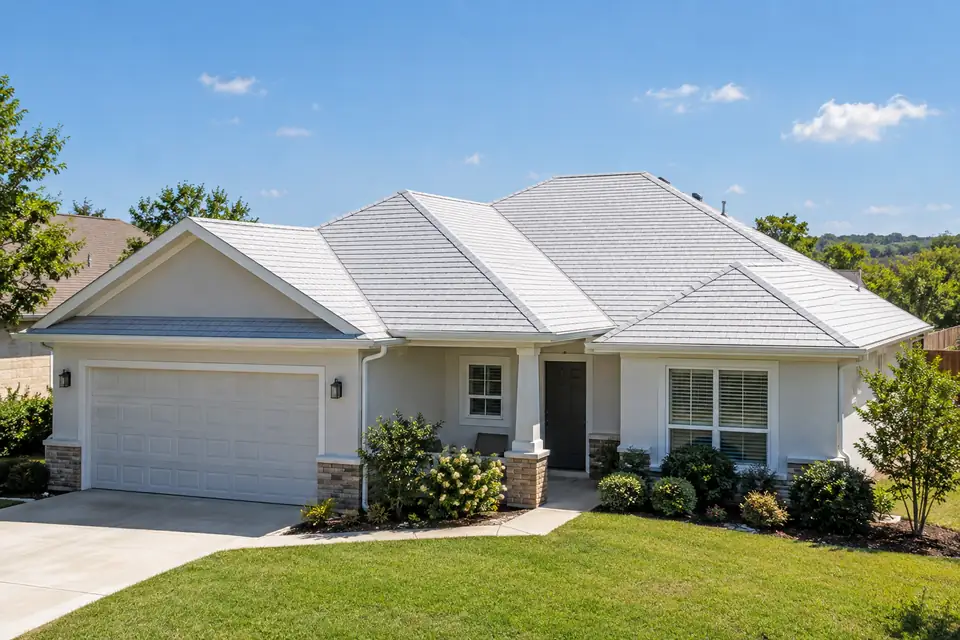
A cool roof can lower your cooling bill, and it pays best in a hot, sunny climate on a house with little attic insulation. The U.S. Department of Energy (DOE) says a cool roof can cut the cooling part of a home's energy bill by at least 5 to 20%, with the largest savings in hot and warm climates. In a cold climate the savings shrink and the roof can add a little to your heating bill. Two things have changed that older advice still repeats: the ENERGY STAR label for roof products ended on June 1, 2022, and the federal energy efficient home improvement credit is not available for work placed in service after December 31, 2025.
What makes a roof "cool"
Two measured properties decide how hot a roof gets in the sun. Both are scored from 0 to 1, and higher is cooler.
- Solar reflectance is the share of sunlight the surface bounces away. A roof that reflects 55% of sunlight has a solar reflectance of 0.55. DOE's selection guide says most dark roofing reflects 5 to 20% of sunlight, and light-colored roofing typically 55 to 90%.
- Thermal emittance is how well the surface sheds the heat it did absorb. DOE says nearly all non-metal roofing scores between 0.80 and 0.95. Bare, shiny metal scores low, so it can stay warmer than a white surface that reflects the same amount of sun.
A third number, the Solar Reflectance Index (SRI), combines the two. In DOE's examples a clean black roof scores about 0 and a clean white roof about 100; dark roofs usually score under 20.
A cool roof does not have to be white. The Cool Roof Rating Council (CRRC) explains that many "cool color" products use pigments that reflect strongly in the near-infrared part of sunlight, which the eye cannot see. For steep roofs, DOE lists cool versions of asphalt shingles, clay and concrete tile, and metal. Cool asphalt shingles use specially coated granules; DOE adds that coating existing asphalt shingles to make them cool is not normally recommended or approved by shingle manufacturers.
How much cooler, and what it saves
- DOE says a conventional roof can pass 150°F on a sunny summer afternoon.
- ENERGY STAR, citing a national laboratory's heat island research group, says a clean white roof that reflects 80% of sunlight stays about 50°F cooler than a grey roof that reflects 20%.
- DOE's consumer guide says that in warm or hot climates a cool roof can cut the yearly air conditioning energy of a single-story building by up to 15%, and trim at least 5 to 20% off the cooling portion of a home's bill.
Those are ranges, not promises. DOE names climate, insulation levels, the efficiency of your cooling equipment and your utility rates as the things that set your actual result. It also says it is rarely economical to replace a sound roof only to make it more reflective. The time to choose a cool shingle is when the roof is being replaced anyway.
The ENERGY STAR roof label ended in 2022
Many articles still tell you to look for an ENERGY STAR roof. You can no longer buy one. In a letter dated May 28, 2019, the U.S. Environmental Protection Agency finalized the end of the ENERGY STAR specification for roof products, effective June 1, 2022. Certification of new roof products stopped on June 1, 2021, and from June 1, 2022 brand owners had to stop using the ENERGY STAR name and mark on any roof product. EPA's reasons included the difficulty of applying a pass or fail label to the complicated question of what is cost-effective on the top of a particular house.
What to look for now is a CRRC rating. The CRRC measures a product's solar reflectance and thermal emittance when new and again after three years of outdoor weathering, and prints both on a product label and in its online Rated Roof Products Directory. ENERGY STAR's own cool roofs page now points homeowners to that directory. Two cautions from the CRRC itself: it rates products but does not endorse them, and a listing in the directory does not by itself mean a product counts as "cool" under any particular code or program.
The aged number matters most. DOE notes that shingles lose some of their reflectance over time, so savings should be judged on long-term values. One example in DOE's guide shows a product falling from 0.87 to 0.77 after three years.
What counts as cool for a shingle roof
Different programs draw the line in different places, and the bar is lower for steep roofs than for low-slope ones. These are the thresholds DOE's 2010 selection guide lists:
| Definition | Low-slope roof (2 in 12 or less) | Steep roof (steeper than 2 in 12) |
|---|---|---|
| Typical code minimum cited by DOE, first test | Aged solar reflectance 0.55 and emittance 0.75 | Aged solar reflectance 0.20 and emittance 0.75 |
| Typical code minimum cited by DOE, alternative | Aged SRI 64 | Aged SRI 16 |
| LEED green building program | SRI 78 | SRI 29 |
| DOE's rule for its own buildings | Same as the typical code minimum | Aged SRI 29 or higher |
| Former ENERGY STAR roof label (ended 2022) | Solar reflectance 0.65 new, 0.50 aged | Solar reflectance 0.25 new, 0.15 aged |
A roof can meet the typical code minimum either by clearing both the reflectance and emittance numbers or by clearing the SRI number alone. If your town requires cool roofs on re-roofing, its code sets the threshold that applies to you, so ask your roofer or building department, and check your state's rules.
Hot climates and cold climates
Where summers are long and hot, a cool roof does the most. ENERGY STAR says cool roofs save the most energy in hot, sunny climates on buildings with low levels of roof insulation. DOE's consumer guide says savings are greatest in hot and warm climates.
Where winters are long and cold, the trade-off is closer. A cool roof reflects winter sun too, so it can raise heating use. DOE says that even in mixed climates the winter penalty can be smaller than the summer savings, and that snow on the roof can reduce the penalty. DOE's 2010 guide put rough figures on it: cooling savings of $0.00 to $0.13 per square foot of roof per year, against a heating penalty of $0.00 to $0.03. On a 2,000 square foot roof that works out to anywhere from nothing to about $260 a year saved on cooling, and from nothing to about $60 a year added to heating; that is our arithmetic on 2010 figures, and your climate and prices will differ.
DOE also flags moisture. Roofs in cold climates can gather moisture from condensation, and DOE says it is possible, though not proven, that cool roofs are more prone to it than dark roofs of the same design; good design avoids it. In warm, damp places DOE says cool surfaces can grow more algae, which looks bad and lowers reflectance. Our guide to roof moss and algae covers cleaning and algae-resistant shingles.
Insulation, air sealing and ventilation come first
A reflective surface changes how much sun heat reaches the attic. It does not stop heat moving through the ceiling in either direction. DOE's guide is direct: cool roofs are never a substitute for enough thermal insulation, because insulation cuts heat loss and heat gain in ways a reflective surface cannot.
ENERGY STAR estimates that sealing air leaks and adding insulation saves homeowners an average of 15% on heating and cooling costs, or 11% of total energy costs. Its recommended attic insulation levels by climate zone:
| Climate zone | Attic with no insulation | Attic with 3 to 4 inches already |
|---|---|---|
| 1 | R30 | R25 |
| 2 and 3 | R49 | R38 |
| 4A, 4B, 4C, 5, 6, 7 and 8 | R60 | R49 |
The order of work matters, and so does the roof's ventilation. DOE's Building America checklist for attic air sealing and insulation says to:
- Check the attic ventilation first, such as ridge and soffit vents, and fix any problems before sealing or insulating.
- Seal every gap and penetration between the living space and the attic. Fluffy insulation does not stop air.
- Install baffles at the eaves where there are soffit vents, reaching at least 6 inches above the finished insulation, so air can still flow from the soffits to the ridge.
If you are replacing the roof, that is a natural moment to have the attic checked, because the ventilation is part of the roofing job. Our guide to attic ventilation explains how much venting a roof needs, and ice dams shows what happens in winter when heat leaks into a cold attic.
What cool shingles cost
The two DOE sources give different pictures:
| DOE source | What it says about cost |
|---|---|
| Consumer Guide to Cool Roofs (posted August 2021) | Cool asphalt shingles cost about the same as conventional asphalt shingles |
| Guidelines for Selecting Cool Roofs (July 2010) | Shingles with cool-colored granules carried an approximate premium of $0.35 to $0.75 per square foot; shingles with white granules, none |
The 2010 figures are more than fifteen years old and came from conversations with contractors, manufacturers and wholesalers plus a cost database. Treat them as history, not a price. The simplest test today is to ask your roofer to price the cool version of the same shingle line as a separate line on the estimate. For what a full replacement costs, see how much a roof replacement costs, and for a naturally reflective option, metal roofing compared with shingles.
Federal tax credits in 2026
The energy efficient home improvement credit has ended. The IRS says you can claim it for improvements made through December 31, 2025, and its August 2025 guidance on the 2025 tax law says the credit is not allowed for property placed in service after that date. Even while it ran, from 2023 through 2025, roofs were not on the IRS's list of qualifying improvements. Insulation and air sealing materials were, at 30% of the cost within a $1,200 yearly limit.
The residential clean energy credit has ended too. The IRS says it is not available for property placed in service after December 31, 2025. While it ran, the IRS said ordinary shingles and roof trusses that support solar panels did not qualify, while solar shingles and solar roofing tiles did because they generate electricity. Our guide to a new roof under solar panels covers that case.
Older government guides you may find still mention a federal credit for cool asphalt and metal roofing. That credit belonged to earlier versions of the law and does not apply to a roof installed now. Some utilities and local agencies do offer cool roof rebates, which ENERGY STAR and DOE both mention, so ask your electric utility. This is general information, not tax advice; check with a tax professional about your own return.
Frequently asked questions
Do cool shingles have to be white?
No. Cool-colored shingles use granules with pigments that reflect the invisible near-infrared part of sunlight. They reflect less than white, which is why the steep-roof thresholds are lower. Compare the aged solar reflectance on the product's CRRC rating.
Is a cool roof worth it in a cold climate?
It can be, but the case is weaker. Savings on cooling are smaller, a cool roof can add a little to heating, and DOE says snow cover reduces that penalty. Insulation and air sealing usually matter more, and the online calculator that DOE's consumer guide points to, roofcalc.com, estimates both effects.
Can I make my existing shingles reflective with a coating?
DOE says coating existing asphalt shingles to make them cool is not normally recommended or approved by shingle manufacturers. Ask the manufacturer before doing it, since it may affect your warranty.
Does a cool roof last longer?
ENERGY STAR and the CRRC both say a cooler roof surface can slow the aging of roofing materials. Neither gives a number of years, so treat it as a possible bonus rather than a reason to buy.
Is there still an ENERGY STAR roof to look for?
No. The ENERGY STAR roof label ended on June 1, 2022. Look for the product's CRRC rating, and use the three-year aged values.
Where this information comes from
Every figure on this page comes from a published source, each read on September 26, 2026:
- U.S. Department of Energy, Consumer Guide to Cool Roofs, DOE/EE-2478, posted August 2021: cooling savings of at least 5 to 20%, up to 15% of yearly air conditioning energy, cost of cool asphalt shingles, winter heating penalty, cool options for steep roofs.
- U.S. Department of Energy Building Technologies Program, Guidelines for Selecting Cool Roofs, July 2010, version 1.2: definitions of reflectance, emittance and SRI; the cool roof thresholds in the table; roof temperatures; insulation; moisture and algae; cost premiums and yearly savings and penalties per square foot.
- ENERGY STAR, cool roofs: the 50°F comparison, best fit in hot climates with low roof insulation, the CRRC directory, local incentives.
- U.S. Environmental Protection Agency, ENERGY STAR roof products sunset letter, May 28, 2019: the end of the roof label on June 1, 2022, and its milestones.
- ENERGY STAR, recommended home insulation R-values, and methodology for estimated energy savings: attic R-values and the 15% and 11% savings estimates.
- U.S. Department of Energy Building America Solution Center, attic air sealing and insulation checklist: ventilation check, air sealing and baffles.
- Cool Roof Rating Council, what is a cool roof and roof rating program: cool colors, three-year aged ratings, the label and the directory, and its statement that a listing is not an endorsement.
- Internal Revenue Service, energy efficient home improvement credit, last updated April 28, 2026; FAQs on the 2025 changes to sections 25C and 25D, August 21, 2025; and residential clean energy credit, last updated July 4, 2026.
- The dollar figures for a 2,000 square foot roof are our own arithmetic on DOE's 2010 per-square-foot ranges.
We will update this page when these sources change, and the date above will say when.
Related guides
 How much attic ventilation does a roof need?Code calls for 1 square foot of net free vent area per 150 square feet of attic, split between intake and exhaust. How vents work, warning signs and costs.
 What causes ice dams, and how do you stop them?Ice dams form when attic heat melts roof snow that refreezes at the eaves. How to remove one safely, what not to do, and how to stop them coming back.
 Is a metal roof worth it over asphalt shingles?A standing-seam metal roof costs about 1.6 times as much as asphalt shingles ($51,865 against $31,871) but is rated to last 40 to 80 years instead of 20 to 30.
 How do you replace a roof that has solar panels?The panels come off, the roof is replaced, and the panels go back on. Removing and reinstalling them costs about $2,800 to $4,800 by one estimate, more by another.
 Are black streaks and moss bad for your roof?Black roof streaks are algae and mostly cosmetic; moss can lift shingles. Never pressure wash. Pro cleaning costs about $300 to $1,050 for a typical roof.
 How much does a roof replacement cost?A roof replacement typically costs $5,900 to $13,400, or $400 to $1,100 per square installed. How to measure your roof, what moves the price and how to compare estimates.