
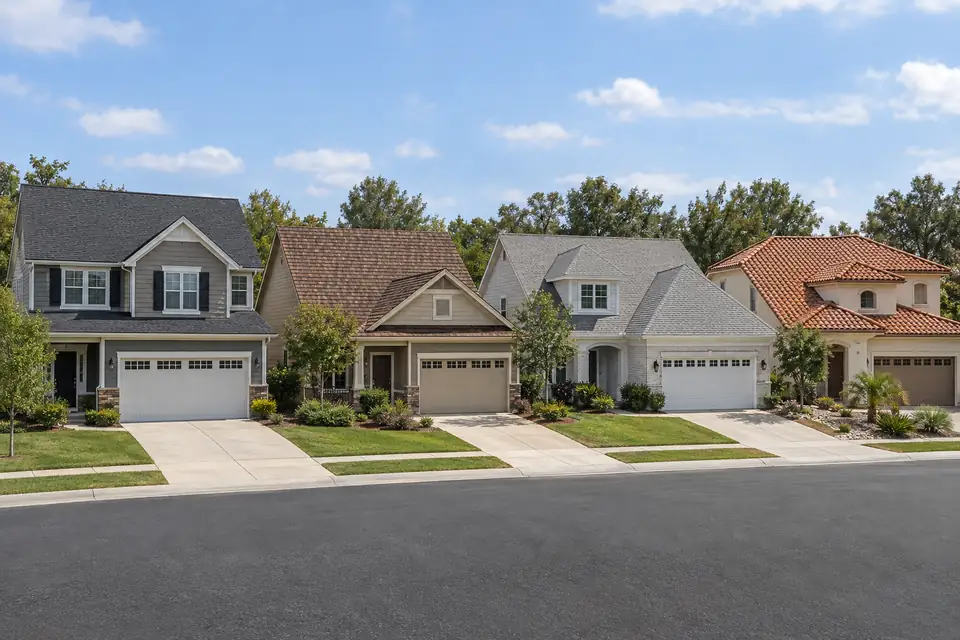
Choose a roof color in this order: what your climate asks of it, what your neighborhood rules allow, and then what looks right with your siding, trim and brick. Color changes how hot a roof gets. A clean white roof that reflects 80% of sunlight stays about 50°F to 55°F cooler on a summer afternoon than a grey roof that reflects 20%, according to ENERGY STAR and Lawrence Berkeley National Laboratory. The Cool Roof Rating Council puts the typical saving from a cool roof at 7% to 15% of cooling costs. In a cold climate, the choice matters less and looks can lead.
How color changes the heat on your roof
Two properties decide how hot a roof gets in the sun, and ENERGY STAR describes both:
- Solar reflectance is the share of sunlight the surface reflects instead of absorbing.
- Thermal emittance is how readily the surface gives off the heat it has absorbed.
A roof that is high in both stays coolest. Color drives the first. Lawrence Berkeley National Laboratory's Heat Island Group, which studies cool roofs, notes that about half the sun's energy arrives as near-infrared light, which the eye cannot see. A traditional dark roof absorbs it. A cool-colored dark roof is made to reflect it, so it can look the same as a traditional one and still run cooler.
| Roof surface | Share of sunlight reflected | How much cooler on a summer afternoon |
|---|---|---|
| Clean white roof, against a grey roof reflecting 20% | 80% | about 55°F (LBNL); about 50°F (ENERGY STAR, citing LBNL) |
| Cool-colored dark roof, against a traditional roof of the same color reflecting 10% | 35% | about 22°F (LBNL) |
ENERGY STAR adds that a cooler roof can extend the life of the roofing itself, because heat speeds up its breakdown.
Lawrence Berkeley National Laboratory says cool-colored asphalt shingles are among the products it and Oak Ridge National Laboratory helped manufacturers develop, so a darker shingle need not be the hottest choice. The Cool Roof Rating Council's directory, described below, lists rated shingles by color. Our guide to shingle brands compares the major product lines, and our guide to architectural and 3-tab shingles covers the types.
Where a cool roof pays off
ENERGY STAR says cool roofs save the most energy in hot, sunny climates and on buildings with little roof insulation. The Cool Roof Rating Council gives an average saving of 7% to 15% of total cooling costs, and adds that in homes without air conditioning a cool roof makes the inside feel cooler.
A reflective roof also means a little more heating in winter. Lawrence Berkeley National Laboratory says this winter penalty is usually small next to the summer saving across most of the United States, and larger only in the coldest northern areas, because winter sun is low, days are short and skies are often cloudy. It also points out that a roof under snow is white whatever its color.
The Department of Energy's Building America Solution Center gives a working target for a pitched roof in a hot climate: a Solar Reflectance Index of 29 or more (78 or more for a low-slope roof). ENERGY STAR's point about insulation is a reminder that the attic matters as much as the roof; our guide to roof ventilation covers the attic side.
ENERGY STAR and the Cool Roof Rating Council
ENERGY STAR no longer certifies roofing. The Environmental Protection Agency ended its roof products program on June 1, 2022, and since then no roofing product carries the ENERGY STAR label, according to the Cool Roof Rating Council. ENERGY STAR still publishes general guidance on cool roofs, but a roofing product described as ENERGY STAR today is not certified, so ask for its current rating instead.
That rating comes from the Cool Roof Rating Council (CRRC), an independent body that runs a public directory of rated roofing products. Its ratings show:
| Rating | What it measures | What to look for |
|---|---|---|
| Solar reflectance | The share of sunlight reflected | Higher is cooler |
| Thermal emittance | How well the surface sheds absorbed heat | Higher is cooler |
| Solar Reflectance Index (SRI) | A single score calculated from the two, roughly 0 for a black surface and 100 for a white one | Higher is cooler |
| Initial and aged values | The same properties when new and after weathering | The aged value is the better guide to the roof you will live with |
The CRRC says it measures both initial and aged performance, and that the Solar Reflectance Index is calculated rather than measured. Ask your roofer for the CRRC listing of the exact product and color you are considering; the directory can be searched by manufacturer, product type and color.
ENERGY STAR and the CRRC both note that some places require cool roofs on new buildings and replacement roofs, and that rebates or loans are offered in some areas. Check your local building department and your utility before you choose.
Siding, trim and brick
The roof has to work with everything below it. IKO, a shingle maker, publishes pairing advice, and its main principles are these:
- Aim for contrast between roof and walls. A roof and siding of the same value can look flat. A dark house often suits a lighter roof, and a light house can take either.
- Mind warm and cool tones. IKO suggests avoiding brown and tan roofs on light blue siding, where they can clash with its cool tone.
- Pick up the undertone of brick or stone. A multi-colored stone front often suits a blended shingle that repeats some of its colors.
- Look at full-size samples at your house. IKO suggests asking your contractor to bring several full-size shingles so you can see them against your siding and trim in daylight.
It helps to look at the samples in the morning and again in the afternoon, and, if you can, at a finished roof in the same color nearby.
Neighborhood rules and resale
If your home is in a homeowners association, read its covenants and design guidelines before you choose. The Community Associations Institute, the trade group for homeowners associations, says those rules typically include architectural guidelines, paint colors among them. Ask the association whether it keeps a list of approved roof colors and whether it needs to approve the work, and get any approval in writing before your roofer orders material.
Local rules can apply without an association. IKO notes that some building energy codes require reflective roofing. Ask your roofer and your local building department what applies to your address, including whether your home is in a historic district or under design review. This is not legal advice; for a dispute over an association's rules, read your governing documents and consider speaking with a lawyer.
On resale, we found no independent study that measures how roof color changes a home's sale price. IKO cites a survey of real estate professionals on color-coordinated exteriors but does not name it, so we do not rely on it. IKO's own resale advice is about condition rather than color: buyers are put off by leaks and damaged shingles. For what a new roof returns at sale, see our guide to whether a metal roof is worth it over shingles, which gives the Cost vs Value figures.
Metal roof colors and finishes
The Metal Roofing Alliance, the industry's trade group, says the choices are virtually limitless and describes three kinds of finish:
- Bare metal. Copper and zinc are often left unpainted and weather to a patina. The Alliance cautions that bare metal is not advisable for every metal.
- Paint. Protects the metal against rust and weather, and can carry cool pigments that reflect sunlight.
- Stone coating. Granules bonded to steel panels shaped like shingles, shake or tile.
For painted metal, the paint system matters as much as the color. Sheffield Metals, a supplier of painted metal coil, compares the two common systems:
| Paint system | What it is | How it holds color | Cost |
|---|---|---|---|
| PVDF, sold as Kynar 500 or Hylar 5000 | A resin of about 70% fluoropolymer | Resists chalking and fading best; recommended for bright, vivid colors | Higher |
| SMP, silicone-modified polyester | Polyester with silicone added | Chalks and fades more, especially in strong sun | Lower |
All painted metal chalks and fades to some degree; the warranty says how much is allowed and for how long. Sheffield's own PVDF and SMP warranties run the same length but allow less fading and chalking on PVDF, and its vivid red carries fade and chalk cover for only 10 years. Ask for the paint system by name and for the fade and chalk terms of the warranty on the color you choose.
Color also moves the price. HomeGuide says custom and high-demand colors add $1 or more per square foot on standing seam, and that PVDF finishes cost more than standard ones. HomeAdvisor suggests choosing from a manufacturer's in-stock colors to save money, and says lighter shades reflect more sunlight. HomeGuide also lists a drawback worth knowing before you choose an unusual color: repairs on metal can be hard to color-match. Our guides to metal roof cost and standing seam roofs cover the rest of the price.
A short checklist
- Check your association's covenants and any local rules, and get approval in writing if it is needed.
- Decide how much heat matters: in a hot, sunny climate with air conditioning, favor a light or cool-rated color.
- Narrow to a few colors that contrast with your siding and suit your trim, brick or stone.
- Look up each color's CRRC rating, and for metal, its paint system and fade warranty.
- See full-size samples at the house, at different times of day, before you sign.
Frequently asked questions
Does a dark roof make my house hotter?
A dark roof absorbs more sunlight and gets hotter, and some of that heat reaches the attic and rooms below. ENERGY STAR says the effect is largest in hot, sunny climates and on buildings with little roof insulation. Cool-colored dark products reflect more of the invisible part of sunlight and run cooler than traditional dark roofs of the same shade.
Can I still buy an ENERGY STAR roof?
No. The EPA ended ENERGY STAR certification for roofing on June 1, 2022. Look up the product's rating in the Cool Roof Rating Council's directory instead.
Is a light roof a bad idea in a cold climate?
Usually not a large one. Lawrence Berkeley National Laboratory says the extra winter heating from a reflective roof is small next to the summer saving across most of the country, though the balance tips in the coldest areas. Where summers are mild, choose on looks and rules.
Do metal roof colors fade?
All painted metal chalks and fades to some degree. PVDF paint systems hold color longer than SMP, especially for vivid colors, and the paint warranty sets how much fading is allowed.
Do I need approval to change my roof color?
If you live in a homeowners association, check its covenants and design guidelines, which often cover exterior colors. Some local energy codes also require reflective roofing. Ask before your roofer orders material.
Where this information comes from
Every fact on this page comes from a published source, read on September 26, 2026:
- ENERGY STAR, cool roofs: solar reflectance and thermal emittance, the white and grey roof comparison, where cool roofs save most, roof life, and local requirements and incentives.
- Lawrence Berkeley National Laboratory, Heat Island Group, cool roofs: near-infrared light, the white and cool-colored roof temperature comparisons, the winter heating penalty, snow and cool-colored shingles.
- Cool Roof Rating Council, resources for home and building owners: cooling cost savings, the product ratings, the Solar Reflectance Index and the rated products directory; and ENERGY STAR roofing program sunsets: the end of ENERGY STAR roofing certification on June 1, 2022.
- U.S. Department of Energy, Building America Solution Center, metal roofs: the Solar Reflectance Index targets for hot climates.
- IKO, how to pick roof shingle colors, April 22, 2025: a shingle maker's advice on contrast, undertones, brick and stone, full-size samples and energy codes.
- Community Associations Institute, first-time homebuyers guide to HOAs: what association rules typically cover.
- Metal Roofing Alliance, colors and coatings: bare, painted and stone-coated finishes.
- Sheffield Metals, PVDF vs. SMP paint systems, February 17, 2022: what each paint system is, chalking and fading, its own warranty terms and vivid colors.
- HomeGuide, standing seam metal roof cost, April 5, 2023, and metal roof cost, November 21, 2025: the cost of custom colors and PVDF finishes, and color-matching repairs.
- HomeAdvisor, standing seam metal roof cost, updated June 19, 2026: standard colors and lighter shades.
Naming a manufacturer or supplier here is not a recommendation; they are the sources whose published guidance we could read. We will update this page when these sources change, and the date above will say when.
Related guides
 Is a metal roof worth it over asphalt shingles?A standing-seam metal roof costs about 1.6 times as much as asphalt shingles ($51,865 against $31,871) but is rated to last 40 to 80 years instead of 20 to 30.
 Are architectural shingles worth it over 3-tab shingles?Architectural shingles start near $3.50 a square foot against $1.50 for 3-tab, last about 30 years instead of 20, and carry longer warranties.
 How do the major shingle brands compare?Shingle makers sell a standard warranty with every roof and longer system warranties only through credentialed roofers. How to compare lines on your estimate.
 How much attic ventilation does a roof need?Code calls for 1 square foot of net free vent area per 150 square feet of attic, split between intake and exhaust. How vents work, warning signs and costs.
 How much does a metal roof cost?A metal roof typically costs $6,045 to $18,341 installed, or $5 to $16 per square foot. Prices by metal and panel type, repair costs and lifespan.
 Standing seam vs exposed-fastener metal roofsStanding seam costs $9 to $16 per square foot installed against $5 to $12 for exposed-fastener panels. It hides its screws, needs less upkeep and lasts longer.