
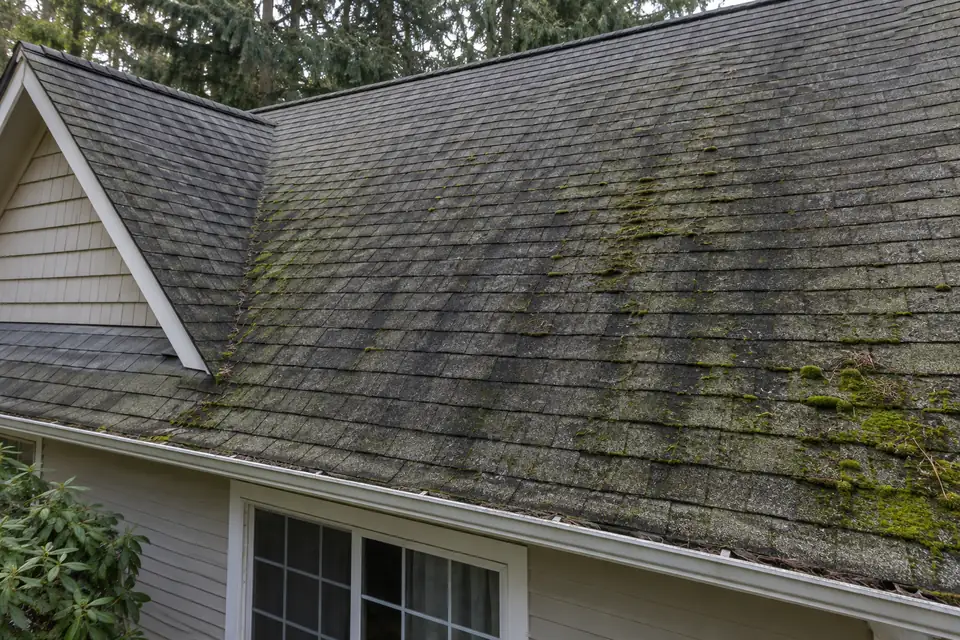
The dark brown or black streaks on many shingle roofs are algae, which the Asphalt Roofing Manufacturers Association (ARMA) says is often mistaken for soot, dirt or fungus. ARMA also says there is no scientific evidence that algae damages asphalt shingles; it is a problem of looks. Moss is different. ARMA says moss can lift or curl the lower edges of shingles, which raises the risk of them blowing off in a storm. Both can be cleaned off with a gentle bleach solution and a low-pressure rinse, never a pressure washer. Professional cleaning of a typical roof costs about $300 to $1,050, according to This Old House, or $450 to $700 according to Fixr.
Streaks and moss are different problems
| Algae | Moss | |
|---|---|---|
| What it looks like | Brown to black discoloration, even or in streaks | Usually a localized patch rather than a whole slope |
| What it needs | Moisture that lingers on the roof; coastal and humid climates suit it best | A moist environment; often north-facing planes, which stay damp longer |
| How it arrives | Carried through the air | Grows where the roof stays damp |
| Damage to shingles | No scientific evidence of damage | Can lift or curl shingle edges and raise the risk of wind blow-off |
Every entry in the table comes from ARMA.
ARMA's technical bulletin adds that algae staining is easy to mistake for soot, dirt, fungus, moss or tree droppings. Moss and tree droppings usually make only local stains. Algae is most visible on light-colored roofs and harder to see on dark ones.
What causes them
The streaks come mostly from a blue-green algae called Gloeocapsa magma, which ARMA calls probably the most common of several species involved. Spores travel on the air and settle on roofs and other outdoor surfaces. The algae make a dark pigment, which is why a light roof can gradually turn brown or black. ARMA says the staining shows up in all parts of the country to some degree, especially where it is warm and humid, and that almost every type of roofing can be affected.
Moss needs moisture to live, so it grows where a roof stays damp, and ARMA notes that planes getting less direct sun stay damp longer. ARMA says trimming branches back to let in more sunlight and cut down on debris makes a roof less inviting to both.
Does it damage the roof?
Algae: ARMA says there is no scientific evidence that algae damages asphalt shingles, though it clearly affects how the roof looks. Streaks alone are not a sign that you need a new roof. If a roofer tells you otherwise, ask to see the damage they mean.
Moss: ARMA says moss can harm the performance of asphalt shingles by lifting or curling their leading edges, which makes them more likely to blow off in high wind. After the moss is gone, have someone look at the shingles underneath. Curled, lifted or missing shingles are a repair, and widespread damage is one of the signs you need a new roof.
One more cost of algae: on a reflective roof, DOE's cool roof guidance says algae growth can make the roof look bad and lower how much sunlight it reflects. Our guide to cool roofs and energy explains why that matters.
How to clean a roof safely
ARMA's advice for asphalt shingles, in short:
- Use a bleach and water solution. ARMA's 2024 bulletin says mixing directions vary by shingle manufacturer and by how bad the staining is. An older ARMA article, from 2012, recommends a 50:50 mix of laundry-strength liquid chlorine bleach and water. Check your shingle maker's instructions first, and do not use other chemicals without its approval.
- Apply it gently with a sprayer, and protect plants and the rest of the house from runoff. Wear eye protection and rubber gloves.
- Leave it on for 15 to 20 minutes, then rinse gently with low-pressure water.
- Do not scrub. Friction can knock off the protective granules. ARMA says not to use a brush or broom at all.
- Let loosened moss go. ARMA's 2012 article says moss treated this way loosens over time and can then be cleared with a leaf blower.
Never use a pressure washer. ARMA says high-pressure washing is likely to damage asphalt roofing, causes granule loss, and very likely leads to early failure of the roof. That holds for algae, moss and any other stain. Some cleaning companies still list pressure washing as a service, so ask how a company will clean before you hire it.
Consider hiring it out. ARMA warns that the solution makes the roof slippery and dangerous, recommends that only trained professionals work on a roof, and suggests working from a ladder or walkboards rather than standing on the shingles. Cleaning is temporary, too: ARMA says the staining may come back.
What professional cleaning costs
Two national cost pages give similar but not identical figures:
| This Old House, updated March 31, 2026 | Fixr, updated January 31, 2025 | |
|---|---|---|
| Typical total | $675 average for a 1,500 square foot home; range $300 to $1,050 | $612 typical for a 1,500 square foot roof; range $450 to $700 |
| Per square foot, general cleaning | $0.20 to $0.70 | $0.10 to $0.60 |
| Moss removal, per square foot | $0.20 to $0.70 | $0.20 to $0.70 |
| Soft wash, per square foot | $0.30 to $0.75 | $0.30 to $0.75 |
| Blower cleaning, per square foot | $0.05 to $0.10 | $0.05 to $0.10 |
| Moss prevention treatment | $150 to $250 | $150 to $250 |
This Old House says labor makes up most of the price and that most companies charge by roof size. Fixr also lists pressure washing as a method; ARMA's warning above still applies. When you get an estimate, ask what solution the company uses, whether it rinses at low pressure, whether it walks on the roof, and how it protects your plants.
Algae-resistant shingles and their warranties
If your roof is due for replacement anyway, algae-resistant shingles are the longer-term answer to streaks. ARMA says they are designed to inhibit algae growth for extended periods. They work with copper: CertainTeed describes copper-containing granules that release copper gradually, and ARMA's 2012 article describes algae-resistant copper granules in general.
The algae warranty is separate from the main shingle warranty and has its own length and conditions:
- Owens Corning moved most of its laminate shingle lines from a 10-year to a 25-year algae resistance limited warranty in January 2023, according to Roofing Contractor. The 25 years apply only when approved Owens Corning hip and ridge shingles are installed with the roof; the coverage is against blue-green algae staining.
- CertainTeed's own pages give different lengths. One says its algae-resistant shingles carry a limited warranty against blue-green algae for the first 10 or 15 years, depending on the product, and that CertainTeed will pay, without proration, the reasonable cost to clean or replace the affected shingles. Another says coverage ranges from 25 to 30 years. Our guide to roofing warranties, drawn from CertainTeed's warranty document, notes that the longer terms need its algae-resistant hip and ridge accessories.
Ask for the warranty document for the exact shingle and accessories on your estimate. The algae warranties above name blue-green algae, so read what yours says about moss and other growth. Our guides to shingle brands compared and architectural and 3-tab shingles list algae terms by line.
Zinc and copper strips
ARMA lists zinc or copper strips as a way to prevent both algae and moss. This Old House explains that rain dissolves zinc from the strip and carries it down the roof, where it discourages moss, algae and other growth, and describes the strips installed near the ridge with about 1 inch left exposed.
ARMA's advice on timing matters most. It says strips can be used when a roof is replaced, but adding them to an existing roof is not recommended: they have to go on either with exposed nails, which can leak over time, or by breaking the seal between shingles to slide them underneath, which may lead to wind damage. If you already have a roof you like, cleaning and trimming trees is the safer route; plan for strips or algae-resistant shingles at the next replacement.
On price, Fixr's 2022 article on strips gives material costs of about $40 for a 50-foot roll of zinc and $50 to $75 for a 20-foot roll of copper. That works out to about $0.80 per foot for zinc and $2.50 to $3.75 per foot for copper; that is our arithmetic, for material only, on figures from 2022. Neither Fixr nor This Old House gives an installed price.
Keeping it from coming back
ARMA's prevention advice comes down to three steps:
- Trim back branches so more sunlight reaches the roof and less debris collects on it.
- Clean moss off before it can lift the shingles, using the gentle method above.
- At replacement time, choose algae-resistant shingles, and decide then whether you want zinc or copper strips installed as part of the job.
Frequently asked questions
Do black streaks mean my roof needs replacing?
Not by themselves. ARMA says there is no scientific evidence that algae damages asphalt shingles. Replacement depends on the shingles' condition, not the stain.
Can I pressure wash my roof?
No. ARMA says a pressure washer is likely to damage asphalt shingles, causes granule loss, and very likely leads to early failure of the roof. Use a gentle bleach solution and a low-pressure rinse.
Is moss worse than algae?
Yes. ARMA says moss can lift or curl shingle edges and raise the risk of wind blow-off, while it has found no scientific evidence that algae damages shingles.
How long does a roof cleaning last?
ARMA says the effect of cleaning algae is only temporary and the staining may return. Trimming trees and, at replacement, algae-resistant shingles do more to keep it away.
Does my shingle warranty cover algae?
Usually only if the shingles are sold as algae-resistant, and then under a separate algae warranty with its own length and conditions, such as matching hip and ridge shingles. Read the document for your exact product. This is general information, not legal advice.
How we got these numbers
HomeAnvil does not yet publish price data of its own. Every figure and claim on this page comes from a published source, each read on September 26, 2026:
- Asphalt Roofing Manufacturers Association, Algae Discoloration of Roofs technical bulletin, revised June 2024, hosted by a member manufacturer: causes of algae staining, bleach cleaning, dwell time, no scrubbing and no power washing, safety, algae-resistant shingles.
- Asphalt Roofing Manufacturers Association, Algae and moss prevention and cleaning for asphalt roofing systems, February 22, 2012: algae and moss conditions, moss damage, the 50:50 solution, pressure washing, zinc and copper strips, tree trimming.
- This Old House, roof cleaning cost, updated March 31, 2026; and preventing roof moss with zinc strips, updated May 28, 2026.
- Fixr, roof cleaning cost, updated January 31, 2025; and are zinc roof strips worth buying, January 13, 2022.
- Roofing Contractor, Owens Corning announces expanded algae resistance warranty coverage, January 5, 2023.
- CertainTeed, algae resistant shingles and StreakFighter algae resistance.
- U.S. Department of Energy, Guidelines for Selecting Cool Roofs, July 2010: algae on cool roofs and reflectance.
- The per-foot strip prices are our own arithmetic on Fixr's roll prices.
We will update this page when these sources publish new figures, and the date above will say when.
Related guides
 What does a roof warranty actually cover?A shingle warranty covers manufacturing defects, a contractor's warranty covers installation. How prorating, wind, algae, transfers and voiding work.
 Are architectural shingles worth it over 3-tab shingles?Architectural shingles start near $3.50 a square foot against $1.50 for 3-tab, last about 30 years instead of 20, and carry longer warranties.
 How do the major shingle brands compare?Shingle makers sell a standard warranty with every roof and longer system warranties only through credentialed roofers. How to compare lines on your estimate.
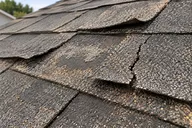 What are the signs you need a new roof?The signs a roof needs replacing, outside and in: age past 20 to 30 years for shingles, bald or curling shingles, repeat leaks, a sagging line. What each means.
 Is a cool roof worth it, and does it lower energy bills?A cool roof reflects sun and can cut cooling costs, most in hot climates. The ENERGY STAR roof label ended in 2022; the federal credit ended after 2025.
 How much does a roof repair cost?Most roof repairs cost $395 to $1,967, about $1,173 on average. Prices by problem: shingles, flashing, leaks, decking, vents, fascia and sagging.