
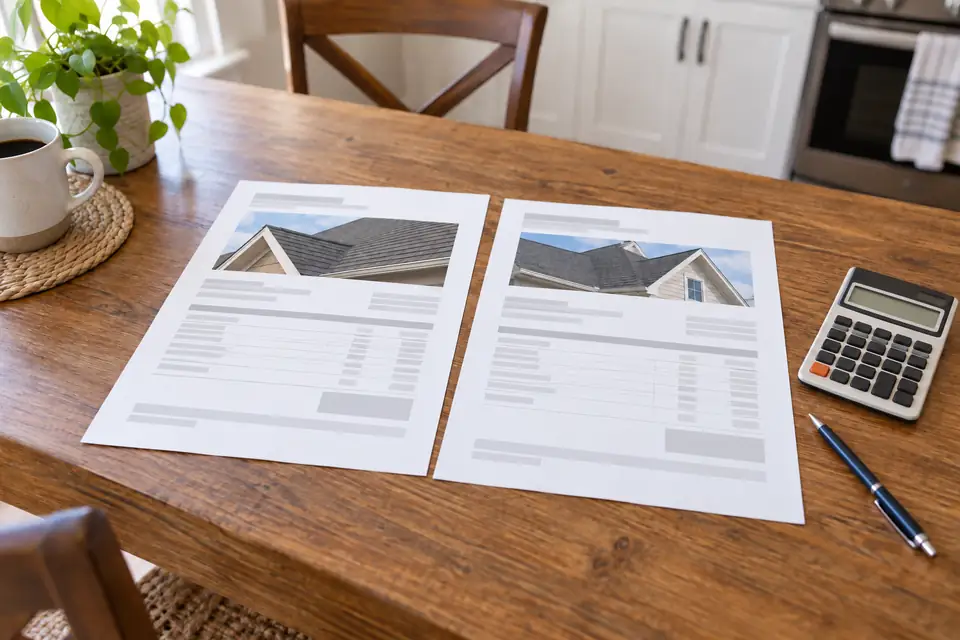
To compare roofing estimates, first make sure they price the same job. Put them side by side and check each line: how many squares of roof each one measured, the shingle by maker and product line, whether every old layer comes off, the price per sheet of replacement decking, the underlayment, flashing and ventilation, who pulls the permit, the cleanup, the warranties and when each payment is due. Then divide each total by its squares to get a price per square. Two estimates that differ by thousands of dollars often describe two different roofs. Once the scope lines up, you are comparing prices and not guesses.
Start with what the job is
Before you look at any total, write down the job you are asking for. Say whether the old roof comes off, which kind of shingle you want and whether gutters, skylights or chimney flashing are part of it. Each roofer who looks at the roof should be pricing that same list.
NRCA, the roofing contractors' trade association, tells homeowners to insist on a written proposal with a complete description of the work and its specifications, the approximate start and finish dates and how payment works. HUD's own advice on paying for home improvements says the same thing more briefly: get more than one estimate, and remember that the cheapest is not always the best fit. NRCA adds that price is only one test, and that a bid that seems too good to be true probably is.
Measure it the same way: squares and price per square
Roofers measure a roof in squares. One square is 100 square feet of roof surface. Every estimate should say how many squares it covers.
- Check the squares first. If one estimate measured 22 squares and another 26, ask each roofer how they measured. A steeper roof, dormers and valleys all add surface. Our roof replacement cost guide shows how to work out the squares on your own roof before anyone climbs a ladder.
- Ask about waste. Roofers order extra shingles for the cuts at edges, hips and valleys. An estimate should say whether its squares include that allowance.
- Divide the total by the squares. This gives a price per square you can put side by side. HomeAdvisor reports that roof replacement runs $4 to $11 per square foot of roof, which works out to $400 to $1,100 per square (our arithmetic: 100 square feet in a square).
An example, using round numbers of our own: an estimate of $14,000 for 20 squares is $700 per square, and one of $15,600 for 24 squares is $650 per square. The second total is higher, but it measured more roof. Find out which measurement is right before you decide which price is lower.
The line items, one at a time
| Line item | What a complete estimate says | Why it matters |
|---|---|---|
| Squares | The number of squares, and whether waste is included | Every other price depends on it |
| Shingles | Maker, product line and color | Different product lines are different roofs |
| Tear-off | How many existing layers come off | A layer left in place hides the deck |
| Disposal | Dumpster, hauling and fees | HomeAdvisor puts hauling and disposal at $500 to $1,500 |
| Decking | A price per sheet for any rotten or damaged deck found | Damage is found only after tear-off |
| Underlayment | The type, and where ice barrier goes if it is used | It is the layer under the shingles |
| Flashing | Chimney, wall, skylight and valley flashing, new or reused | It seals the joints where the roof meets something else |
| Drip edge | Named at eaves and rakes | It guides water off the edge |
| Ventilation | Intake and exhaust vents, and how many | NRCA calls for balanced intake at the eaves and exhaust near the ridge |
| Permit | Who pulls it and whether its fee is included | HomeAdvisor puts roofing permits at $100 to $1,400 |
| Cleanup | Removing debris and sweeping for nails | Stray nails end up in the yard and driveway |
| Warranties | The shingle warranty and the contractor's workmanship warranty, in writing | They cover different things |
| Payment | Deposit, schedule and final payment | Protects you if the job stalls |
Materials by product line
Ask each estimate to name the shingle by manufacturer and product line, not only "architectural shingles". NRCA's guidance on a detailed proposal includes the type of roof covering, its manufacturer and its color. Two estimates that name different product lines are pricing different roofs, so ask each roofer to price the other's choice too. Our guide to architectural and 3-tab shingles explains the main difference.
Tear-off and decking allowance
HomeAdvisor reports that removing an old roof adds $1,000 to $3,000, plus $500 to $1,500 for hauling and disposal. An estimate with no tear-off line may be assuming new shingles go over old ones, so ask; our guide to roofing over existing shingles covers when that is allowed.
No one can see the deck until the old roof is off. So a good estimate names a price per sheet for replacing rotten or damaged decking, and some also include a few sheets in the base price. Compare the per-sheet prices, not only the totals, because this line has no fixed quantity until the job starts.
Underlayment, flashing and ventilation
These are the parts under and around the shingles, and they are easy to leave vague. Look for each one by name: the underlayment, any ice barrier and where it goes, new flashing at walls, chimneys, skylights and valleys, drip edge, and the vents. NRCA describes a balanced ventilation system as one with about the same vent area at the eaves or soffits as at or near the ridge. See our guides to roof ventilation and skylight and chimney flashing for what each does.
Permit and cleanup
Ask who pulls the permit and whether its fee is included. HomeAdvisor gives $100 to $1,400 for roofing permits, depending on the area and the project. Cleanup should name debris removal and a sweep for nails, in the yard and the driveway.
Warranties
A new roof usually carries two warranties: the shingle maker's, for defects in the shingles, and the roofer's own, for mistakes in the installation. NRCA advises reading any warranty closely and watching for terms that would void it. Compare the length of each contractor's workmanship warranty and what it covers. Our roof warranty guide explains prorating and system warranties.
Payment terms
The FTC advises against paying for a whole project up front and warns against contractors who will take only cash. Check how much each estimate asks as a deposit, when each later payment is due and what has to be finished before the last one. Some states limit how large a deposit can be, so check your state's rules. If an estimate comes with financing, compare it on its own terms; see our guide to paying for a new roof.
A worksheet for your estimates
Copy this table onto paper or a spreadsheet and fill in one column per estimate. A blank cell is a question to ask that roofer.
| Line | Estimate A | Estimate B | Estimate C |
|---|---|---|---|
| Total price | |||
| Squares measured (waste included?) | |||
| Price per square (total ÷ squares) | |||
| Shingle maker, product line, color | |||
| Layers torn off | |||
| Disposal included? | |||
| Decking: sheets included, price per extra sheet | |||
| Underlayment type | |||
| Ice barrier, and where | |||
| Flashing: new or reused, which areas | |||
| Drip edge included? | |||
| Vents: intake and exhaust | |||
| Permit: who pulls it, fee included? | |||
| Cleanup and nail sweep | |||
| Shingle warranty | |||
| Workmanship warranty (years, what it covers) | |||
| Deposit and payment schedule | |||
| Start date and expected length of job |
Red flags in an estimate
- A single total with no lines. You cannot compare what you cannot see.
- No price per sheet for decking. The bill can grow with no limit you agreed to.
- No tear-off line. Ask whether the new roof goes over the old one.
- Pressure to sign today. The FTC advises not letting anyone pressure you into signing, and never signing a document with blank spaces.
- Cash only, or the full price up front. The FTC names both as warning signs.
- Financing arranged by the contractor that you have not compared. The FTC advises shopping for loan terms before you agree to any.
Once the estimates line up, check the company as well as the price. Our guide to what to check before you hire a contractor covers licenses, insurance and references, and questions to ask a roofer covers the job itself.
Before you sign the contract
The contract should repeat everything the estimate promised. The FTC lists what a written home improvement contract should hold: the contractor's name, address, phone number and license number, estimated start and finish dates, and every promise made in conversation about the scope of work and the cost of labor and materials. NRCA adds that the contract should say who is responsible for any damage caused by the roofing work.
If you sign in your home, federal rules can give you three business days to cancel. The FTC's Cooling-Off Rule covers many sales made at your home, and its advice on home improvement says the contract should include a written statement of that right when it applies. The rule has exceptions, such as emergency repairs you asked for, so read the notice you are given. This page is general information, not legal advice.
Estimate terms, in plain words
- Square: 100 square feet of roof surface.
- Pitch: how steep the roof is, given as rise in inches per 12 inches across.
- Tear-off: removing the existing roof down to the deck.
- Deck, decking or sheathing: the boards or panels the roof is nailed to.
- Underlayment: the sheet laid on the deck under the shingles.
- Ice barrier: a self-adhering membrane used at eaves and valleys to stop water backing up.
- Flashing: metal pieces that seal joints at walls, chimneys, skylights and valleys.
- Drip edge: metal trim at the roof edges that directs water away from the fascia.
- Ridge vent: an exhaust vent along the peak of the roof.
- Waste factor: extra material ordered to allow for cuts.
- Workmanship warranty: the contractor's own promise about installation.
- Change order: a written change to the contract's scope or price once the job has started.
Frequently asked questions
How many roofing estimates should I get?
There is no set number. HUD's advice is to get more than one estimate, and NRCA's is to compare written proposals that describe the work in full. What matters most is that each one prices the same job.
Should I choose the lowest estimate?
Not on price alone. NRCA calls price one test among several and advises skepticism about a bid that seems too good to be true. Compare the lines first; a low total often leaves something out.
Why is decking priced per sheet instead of in the total?
The roofer cannot see how much of the deck is damaged until the old roof is off. A price per sheet in writing means any extra has a known cost.
Can I ask one roofer to match another's price?
You can ask, but make sure you are asking for the same scope. Show the line items you are comparing, not only the total, and get any change in writing.
What if the estimate does not list the permit?
Ask who pulls the permit and whether its fee is included, and settle both in writing before work begins. Permit rules are local, so check with your building department.
Where this information comes from
HomeAnvil does not publish estimate data of its own. Each fact on this page comes from the source named beside it, all read on September 26, 2026:
- HomeAdvisor, roof replacement cost, updated June 17, 2026: the square, the $4 to $11 per square foot range, the cost of tear-off and disposal, and the permit range.
- NRCA, Selecting a contractor and its consumer bulletin Selecting an NRCA professional roofing contractor (steep-slope residential): written proposals, the lowest bid and warranties.
- NRCA, Roofing guidelines and consumer resources: what a detailed proposal names, balanced ventilation, and responsibility for damage in the contract.
- HUD, Fixing up your home and how to finance it: get more than one estimate.
- FTC Consumer Advice, How to avoid a home improvement scam, July 2022: payment, contractor financing, blank documents and what a contract should include.
- FTC Consumer Advice, Buyer's remorse: the FTC's Cooling-Off Rule may help, September 2025: three business days to cancel and the exceptions.
- The price per square and the worked example are our own arithmetic.
We will update this page when these sources change, and the date above will say when.
Related guides
 How much does a roof replacement cost?A roof replacement typically costs $5,900 to $13,400, or $400 to $1,100 per square installed. How to measure your roof, what moves the price and how to compare estimates.
 What questions should you ask a roofer before you sign?The roofing questions to ask before you sign: tear-off, decking, ice barrier, ventilation, permit, crew, cleanup, payment and warranty papers, plus red flags.
 What does a roof warranty actually cover?A shingle warranty covers manufacturing defects, a contractor's warranty covers installation. How prorating, wind, algae, transfers and voiding work.
 What to check before you hire a contractorFive things to ask for before you sign with a roofing, siding, window, bath or HVAC contractor, wherever you live in the United States.
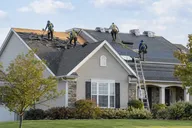 What happens during a roof replacement, step by step?An asphalt shingle roof usually goes on in one to three days. What happens before, during and after, from tear-off and deck repair to flashing and cleanup.
 How much attic ventilation does a roof need?Code calls for 1 square foot of net free vent area per 150 square feet of attic, split between intake and exhaust. How vents work, warning signs and costs.