
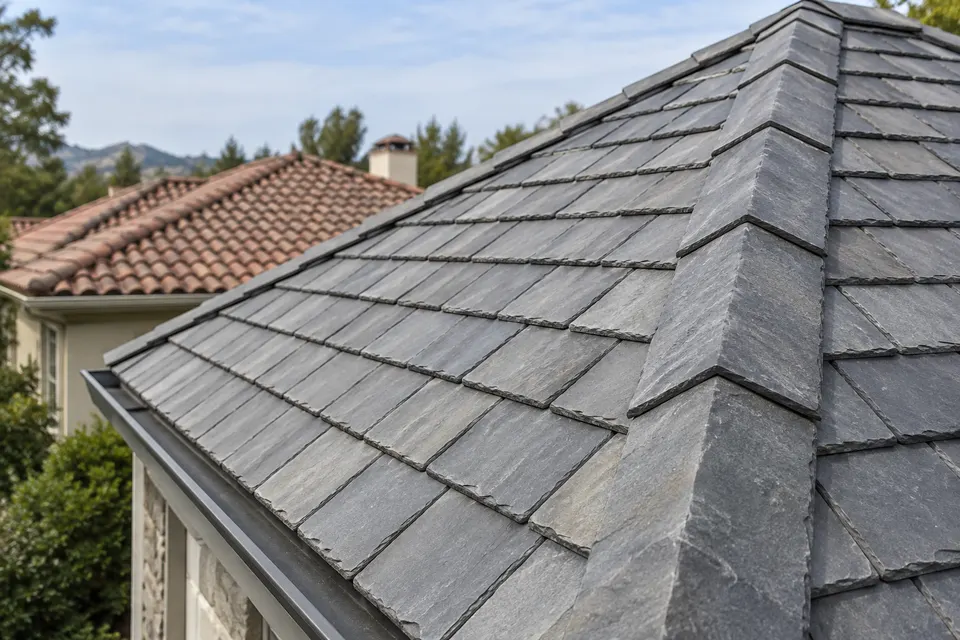
Natural slate usually costs more than tile. HomeAdvisor puts natural slate at $20 to $30 a square foot installed and tile at $7 to $25, with concrete tile at the low end and clay reaching the top. Both are heavy: common thicknesses of slate weigh roughly 935 to 1,405 pounds per square (100 square feet of roof), and concrete tile 900 to 2,000, against about 220 for an architectural asphalt shingle. Both can last a century or more when the material is good, but a low grade of slate, a concrete tile, and the underlayment beneath either one wear out much sooner. The house you have, and a roofer who knows the material, matter as much as the choice itself.
Slate and tile side by side
| Natural slate | Clay tile | Concrete tile | |
|---|---|---|---|
| Installed cost per square foot (HomeAdvisor) | $20 to $30 | $8 to $25 | $9 to $18 |
| Price per square foot (Fixr) | installed: $20 to $30 hard, $15 to $20 soft | material only $5 to $15 | material only $4 to $20 |
| Expected life (InterNACHI chart) | 60 to 150 years | more than 100 years | more than 100 years |
| Expected life (cost sites) | hard up to 200 years; soft 50 to 125 (HomeAdvisor) or 75 to 100 (Fixr) | about 100 years (Fixr) | 30 to 50 years (HomeAdvisor); about 50 (Fixr) |
| Weight per square | 935 to 1,405 pounds at the most common thicknesses (one quarry) | 900 pounds for one barrel profile; under 600 for two flat ones (one maker) | 900 to 2,000 pounds (InterNACHI) |
| Fire rating | Class A in a tested assembly (National Slate Association) | Class A (InterNACHI) | Class A (InterNACHI) |
| Hail rating, FM 4473 | Class 4 at 3/8 inch, Class 3 at 1/4 inch (National Slate Association) | many products tested to 2-inch hail (Tile Roofing Industry Alliance) | as for clay |
For whole jobs, HomeAdvisor's customer survey puts a slate roof at $4,389 to $22,377, averaging $13,348, but that range includes synthetic and other look-alike "slate". Fixr prices a natural slate roof at $20,000 to $60,000, averaging $40,000. For tile, HomeAdvisor gives $8,476 to $26,223, averaging $17,349, and Fixr $19,000 to $35,000, about $27,000 for a 1,500-square-foot roof.
An example, our own arithmetic. A 20-square roof (2,000 square feet) at HomeAdvisor's per-square-foot prices comes to $40,000 to $60,000 in natural slate and $14,000 to $50,000 in tile. The tile range is wide because it runs from plain concrete to premium clay; the slate range starts where most tile ends.
What else goes on the estimate:
- Labor. HomeAdvisor says labor is 40% to 50% of a slate roof and that one square of slate takes 10 to 12 hours to lay. For tile it splits the price into $2 to $10 a square foot for material and $5 to $18 for labor.
- Removing the old roof. HomeAdvisor gives $1,000 to $5,000 for slate, and $1 to $5 a square foot to tear off and dispose of a roof before tile.
- Strengthening the frame. HomeAdvisor and Fixr both put it at $1,000 to $10,000 for slate. The same work can apply to tile; see the next sections.
Our guides to slate roof cost and tile roof cost break each material down further, and the roof cost calculator prices your roof's squares in several materials.
How long each one lasts
Both materials can outlive the people who install them, but neither figure is a promise.
Slate depends on its grade. ASTM C406, the standard for roofing slate, sorts it into three grades by lab tests of water absorption, weather resistance and strength. InterNACHI, the home inspectors' association, gives grade S1 more than 75 years, S2 40 to 75 and S3 20 to 40, and says S1 slate may last 75 to 200 years or more. The National Park Service's guidance on slate roofs gives 60 to 125 years for a properly installed roof. A cheap slate can be a short-lived one, so ask for the grade in writing.
Tile depends on what it is made of. The sources agree that clay lasts a very long time: about 100 years according to Fixr, and possibly longer than the house itself according to HomeAdvisor. They disagree on concrete. HomeAdvisor gives 30 to 50 years and Fixr about 50, while InterNACHI's chart puts clay and concrete together at more than 100 years. Read any one figure as the middle of a range.
The layers underneath wear out first. InterNACHI notes that felt underlayment loses its oils and breaks down over time, which matters most under a covering that lasts decades longer. Fixr says many underlayments under tile last only about ten years. On slate, the National Park Service points to rusted nails and worn flashing as common causes of failure while the stone itself is still sound. On both roofs, replacing the underlayment means lifting the covering and relaying it.
Weight per square and your roof frame
Weight is where both materials part company with asphalt shingles, and where the house may decide for you.
| Roof covering | Pounds per square | Source |
|---|---|---|
| Architectural asphalt shingle, one product | 211 to 225 | CertainTeed data sheet |
| Flat clay tile, two profiles | under 600 | Ludowici |
| Natural slate, 3/16 inch | 700 | North Country Slate |
| Clay barrel tile, one profile | 900 | Ludowici |
| Natural slate, 1/4 inch | 935 | North Country Slate |
| Concrete tile | 900 to 2,000 | InterNACHI |
| Natural slate, 3/8 inch | 1,405 | North Country Slate |
| Natural slate, 1/2 inch | 1,870 | North Country Slate |
| Natural slate, 3/4 to 1 inch | 3,275 | North Country Slate |
The quarry's weights assume a 3-inch headlap, and it says 1/4 to 3/8 inch is the most common thickness. Fixr gives slate 1,000 to 2,000 pounds per square. So at common thicknesses, slate and concrete tile land in the same range; thicker slate is heavier than either, and the two flat clay profiles one maker lists are lighter than both.
What it means for your house:
- Have the framing checked before you choose. The National Slate Association says a licensed structural engineer should look at any house that has not carried slate before. InterNACHI suggests an engineer's review wherever tile replaces a lighter roof and the framing may not be adequate.
- Not every house needs work. A concrete tile maker says most well-built modern homes need little or no extra bracing. Only an assessment of yours will tell.
- Slate needs a thicker deck. InterNACHI says slate calls for sheathing at least 3/4 inch thick, and that the 1/2-inch sheathing on most roofs can lead to broken slates.
- Slope limits differ. InterNACHI says modern codes require at least a 4 in 12 slope for slate. For tile, it describes a double layer of underlayment on slopes from 2 in 12 to 4 in 12. Individual tile profiles can set their own minimum; one clay barrel tile lists 4 in 12.
Breakage and walking on the roof
Slate and tile both crack under a careless foot, so plan how anyone will reach the roof before a satellite dish, a chimney sweep or a painter needs to.
- Slate. The National Park Service advises keeping foot traffic off a slate roof, inspecting it from the ground or a lift, and having workers walk on a ladder hooked over the ridge. If someone must step on the slate, soft-soled shoes on the lower middle of each exposed slate are the least risky.
- Tile. The Park Service's guidance on clay tile says flat tiles can usually be crossed by a careful roofer, but high-profile curved tiles break easily. Roofers spread their weight on plywood, planks, sand-filled bags or a ladder hooked over the ridge. InterNACHI says any step on concrete tile risks breaking it; on flat tile the lower 3 inches is the best-supported spot, and the interlocking edges are the most fragile.
- A few breaks after installation are normal for slate. The National Slate Association says minor breakage in the first year or two does not by itself mean poor workmanship, because fine cracks made during installation can show up later.
Hail and falling branches break tile too, the Park Service notes. Our guide to hail damage covers what to look for after a storm.
Repairs and finding matching material
Both roofs are usually repaired one piece at a time. A broken slate or tile is cut or pulled free with a slate ripper and a new or salvaged piece is slid in, held with a single nail and a copper strip or with a hook or strap where nails cannot reach.
| Slate | Tile | |
|---|---|---|
| Typical repair cost | $785 to $3,252, averaging $2,015 (HomeAdvisor slate repair page); $300 to $1,600 (Fixr) | $900 to $2,300 (Fixr) |
| Per piece | $50 to $200 per slate (HomeAdvisor) | not given by the sources we read |
| When to consider replacing | about 20% or more of the slates broken, missing or sliding (National Park Service) | more than about 30% lost or broken and no match found, on historic roofs (National Park Service) |
HomeAdvisor's general roof repair page gives a lower slate average, $1,800; the figures above come from its page on slate repair alone. HomeAdvisor's slate repair page also puts the replace-or-repair line at 20% to 30% of the roof.
Finding a match is the harder part.
- Slate color can change. The Park Service explains that "fading" slates change shade after a few years in the weather, while "unfading" slates keep their color. With some green slates, 20% to 60% of the pieces turn brown, buff or gray. A replacement should match the old slate's size, shape, texture and weathered color, not its color when new.
- Source matters. The same guidance says imported slate often does not match the color and texture of slate quarried in this country, and suggests keeping it to new roofs. The National Slate Association says natural slate is still made in a wide range of colors and all standard sizes.
- Tile shapes drift. The Park Service warns that a tile sold under the same pattern name decades later may have changed in shape, size or thickness. New tile also weathers to a different shade, so place it where it shows least, and do not patch handmade clay tile with machine-made or concrete tile.
- Salvage and custom runs. For both materials, salvaged pieces are sold, and an old tile's original molds may still exist for a custom order large enough to justify it.
- Keep spares. Order extra for breakage and keep some from the job for future repairs.
Our roof repair cost guide compares repairs across materials, and repair or replace covers the decision for any roof.
Fire and hail ratings
Both materials reach the top fire class, and both have been tested against hail with a standard written for rigid roof coverings.
Fire. InterNACHI says concrete and clay tile are Class A fire-rated, and the Tile Roofing Industry Alliance, the tile trade group, says the same. The National Slate Association, working with the National Roofing Contractors Association, reports that a slate assembly achieved Class A under UL 790: 1/4-inch slate with a 3-inch headlap over 30-pound felt on a 1/2-inch plywood deck. A fire rating belongs to a tested assembly, so ask how your roof will be built. Our guide to fire-resistant roofing explains the classes.
Hail. The National Slate Association reports tests under FM 4473, a standard for rigid roofing materials hit by ice balls: 3/8-inch slate met Class 4, surviving 2-inch ice balls at 76 mph, and 1/4-inch slate met Class 3, surviving 1 3/4-inch ice balls at 69 mph. The Tile Roofing Industry Alliance says many tile products have been tested to resist 2-inch hail under the same standard. These are ratings for particular products and thicknesses; ask for the rating of yours in writing. Asphalt shingles are rated under a different test, UL 2218, so the classes do not compare one for one.
Wind. InterNACHI says properly installed tile can resist winds of over 125 mph, and the tile trade group says tile has been tested to 200 mph. We did not find a comparable published wind figure for slate.
Where synthetic slate fits
Synthetic slate is a molded plastic or rubber tile made to look like stone. It sits between asphalt and the real materials on price: $10 to $15 a square foot installed according to HomeAdvisor, and $9 to $15 according to Fixr. It weighs far less than slate or tile, which is its main case on a house framed for shingles. Its lifespan is the most disputed figure: InterNACHI gives simulated slate 10 to 35 years, HomeAdvisor 50 to 100 and Fixr about 50. Our guide to synthetic roofing compares products, ratings and warranties.
What to ask before you choose
- Can my roof frame and deck carry this material, and who will check them? What would strengthening cost?
- For slate: what is its ASTM C406 grade and thickness, and is it a fading or unfading slate?
- For tile: clay or concrete, which profile, what does it weigh per square, and what is its freeze-thaw grade where winters freeze hard?
- What underlayment, nails and flashing metal will you use, and how long is each expected to last?
- What are the product's fire class and hail rating, and do they depend on how the roof is built?
- How will your crew move on the roof without breaking it, and will you leave spare pieces for repairs?
- How many roofs in this material have you installed or repaired, and can I see some?
Check any roofer's license and insurance too: our guide to what to check before you hire a contractor covers the basics, and questions to ask a roofer has more.
Frequently asked questions
Is slate or tile cheaper?
Tile usually is. HomeAdvisor puts natural slate at $20 to $30 a square foot installed and tile at $7 to $25, with concrete tile at $9 to $18. Premium clay tile can cost as much as slate.
Which lasts longer, slate or tile?
Good slate and clay tile both commonly last a century or more. Grade S1 slate is rated for more than 75 years and InterNACHI's chart gives slate 60 to 150 years. Concrete tile has the shortest estimates, 30 to 50 years from HomeAdvisor, though InterNACHI's chart gives more than 100.
Which is heavier, slate or tile?
At common thicknesses they are close: one quarry lists 935 to 1,405 pounds per square for 1/4- to 3/8-inch slate, and InterNACHI gives concrete tile 900 to 2,000. Thick slate is heavier, and flat clay profiles can be under 600. Either may need a structural check.
Can I walk on a slate or tile roof?
Avoid it. Both break underfoot. Roofers spread their weight with ladders hooked over the ridge or with boards, and step only where the piece below supports it.
Is synthetic slate a good middle ground?
It costs less than natural slate and weighs far less, so it can suit a house framed for shingles. Its expected life ranges from 10 to 35 years (InterNACHI) to 50 to 100 (HomeAdvisor), so read the warranty closely.
How we got these numbers
HomeAnvil does not yet publish price data of its own. Every figure on this page comes from a published source, read on September 27, 2026. The per-square example and the comparisons between sources are our own arithmetic.
- HomeAdvisor, slate roof cost, updated June 19, 2026: slate totals, prices by slate type, labor, hours per square, removal, reinforcement and lifespans. HomeAdvisor says its figures come from a survey of its customers and other published research.
- HomeAdvisor, slate roof repair cost, updated June 19, 2026: repair range and average, cost per slate, and its repair-or-replace line.
- HomeAdvisor, roof repair cost, updated June 2026: the average slate repair across its general survey.
- HomeAdvisor, tile roof cost, updated June 19, 2026: tile totals, price by tile type, material and labor split, disposal and lifespans.
- Fixr, slate roof installation cost: natural slate totals, prices by type, weight, labor share, reinforcement, repairs and lifespans.
- Fixr, tile roof installation cost, updated January 31, 2025: tile totals, material prices, lifespans, repair range and underlayment life.
- InterNACHI, standard estimated life expectancy chart: slate, clay and concrete tile, and simulated slate.
- InterNACHI, Mastering Roof Inspections: Slate Roofs, part 2 (ASTM C406 grades and service life) and part 5 (weight, sheathing, slope and felt underlayment).
- InterNACHI, Mastering Roof Inspections: Tile Roofs, part 1 (fire class and wind), part 3 (underlayment and slope) and part 4 (concrete tile weight, structural review and walking on tile).
- National Park Service, Preservation Brief 29, The Repair, Replacement, and Maintenance of Historic Slate Roofs, by Jeffrey S. Levine: lifespan, fading and unfading slate, matching and imported slate, repair method, the 20% guideline and walking on slate.
- National Park Service, Preservation Brief 30, The Preservation and Repair of Historic Clay Tile Roofs, by Anne E. Grimmer and Paul K. Williams: weight and structure, walking on tile, hail, repair method, matching, salvage and custom tile, and the 30% guideline.
- National Slate Association, slate hail and fire test: FM 4473 hail classes and the UL 790 Class A assembly. National Slate Association, common myths about slate roofing: structural review, early breakage and availability. It is the slate trade group.
- Tile Roofing Industry Alliance, durability and longevity: fire class, hail testing under FM 4473, wind and freeze-thaw standards. It is the tile trade group.
- North Country Slate, thickness and weights: slate weight per square by thickness.
- Ludowici, frequently asked questions and Spanish 13 1/4" barrel tile data sheet: clay tile weights and one profile's minimum slope. Eagle Roofing, frequently asked questions: bracing for concrete tile.
- CertainTeed, Landmark shingle data sheet: the asphalt shingle weight used for comparison.
Manufacturers and quarries are named only because their data is published; naming them is not a recommendation. We will update this page when these sources publish new figures, and the date above will say when.
Related guides
 How much does a slate roof cost?A slate roof typically costs $4,389 to $22,377, and natural slate $20 to $30 a square foot installed. Lifespan by grade, weight, and repair vs replace.
 How much does a tile roof cost? Clay vs concreteA tile roof typically costs $8,476 to $26,223, or $7 to $25 a square foot installed. Clay vs concrete, weight, underlayment and repair costs compared.
 Is synthetic slate or shake roofing worth it?Synthetic slate costs $9 to $15 per square foot installed, against $10 to $30 for natural slate, and weighs about a third as much. Costs, lifespan and ratings.
 Types of roofing materials, and how they compareRoofing materials compared: asphalt costs $3 to $7 a square foot installed and lasts 20 to 30 years; slate $15 to $30 and 60 to 150 years.
 What makes a roof fire-resistant?Roofs are rated Class A, B or C for fire under ASTM E108 and UL 790. Asphalt shingles, tile, slate and metal can rate Class A. Why embers and vents matter.
 How do you know if hail damaged your roof?Quarter-size (1 inch) hail can start to damage older 3-tab shingles, laminated ones at 1.25 inches. How to spot real damage and when to call your insurer.