
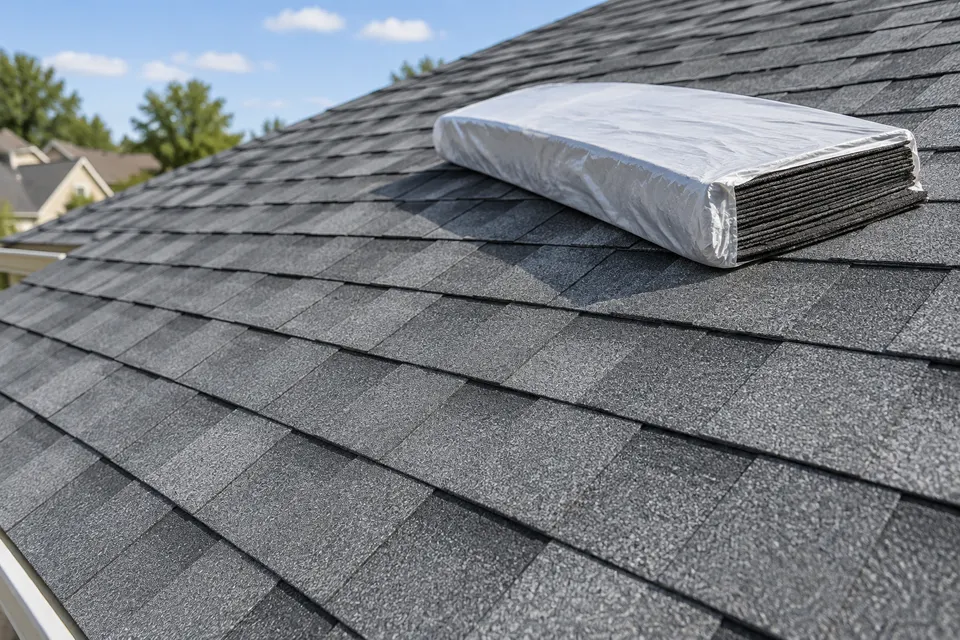
There is no real choice between the two: a fiberglass shingle is an asphalt shingle. Every asphalt shingle is built on a base mat that is soaked and coated in asphalt and topped with mineral granules, and today that mat is made of glass fibers. InterNACHI, the home inspectors' association, says all modern shingles made in North America use a fiberglass mat. The older alternative was an organic mat of felt made from paper and wood fibers. InterNACHI says organic shingles have not been made since about 2008, and ASTM withdrew their standard, D225, in 2012. So the question matters mostly if you own an older roof. Organic shingles typically carried a Class C fire rating, where fiberglass shingles typically carry Class A, and no new organic shingle exists to repair one with.
Organic and fiberglass shingles side by side
| Organic (felt) mat | Fiberglass mat | |
|---|---|---|
| Base mat | cellulose felt from wood chips, recycled cardboard, rags and paper | non-woven glass fibers held by a binder |
| Asphalt in the mat | felt saturated with asphalt to about 170% of its weight, then coated | no saturating asphalt needed; coated only |
| ASTM standard | D225, withdrawn in 2012 with no replacement | D3462, current and referenced by the model building codes |
| Typical fire rating | Class C | Class A |
| Thickness and weight | thicker mat, heavier shingle | thinner mat, lighter shingle |
| Cold weather | more flexible | more brittle when cold |
| Heat and humidity | absorbs moisture and distorts as it ages | absorbs less moisture, holds its shape better |
| Still made | no; production ended about 2008 | yes; every asphalt shingle sold today |
The rows come from InterNACHI's roof inspection course, the Asphalt Roofing Manufacturers Association's (ARMA) residential manual, ASTM's own listing for D225, a National Roofing Contractors Association (NRCA) article on shingle standards, an article by the American Society of Home Inspectors (ASHI) and a history published by the shingle maker IKO. The sources section at the end names which says what.
Why organic shingles left the market
ARMA's manual says glass-fiber mats were introduced in the late 1950s as an alternative to organic felt, and that improved technology made fiberglass the predominant mat from the late 1970s on. IKO's history gives the reasons manufacturers switched: the fiberglass mat was thinner yet stronger, weighed less, did not need the soft saturating asphalt because it does not soak up moisture, and made a shingle more resistant to fire.
InterNACHI dates the end of organic production to about 2008. ASTM withdrew D225, its specification for organic felt shingles, in 2012. Writing in NRCA's magazine, Professional Roofing, Mark Graham gives the reason: organic felt shingles were no longer being made in North America.
How to tell which you have
- Start with the roof's age. A roof put on well after 2008 is almost certainly fiberglass, because organic shingles were no longer made. A roof older than that could be either, since fiberglass had been the main mat for decades by then. The permit, the contractor's invoice or a home inspection report can date it.
- Look for the paperwork. ARMA says manufacturers print the fire rating label on the bundle packaging. A leftover bundle, its wrapper or the supplier's invoice names the product and its rating. Individual shingles carry no label.
- Look at how the shingles have aged. InterNACHI says the organic mat is thicker than fiberglass and that organic shingles near the end of their life can hold much more moisture, which can make them distort badly: curling up at the edges, cupping in the middle or clawing at the corners. Organic mats grow more absorbent as they age, and the repeated wetting and drying leads to delamination starting at the edges. Heavy distortion on an old roof is a clue, not proof, because worn fiberglass shingles curl too.
- Ask someone who can get close. A roofer or home inspector can examine a loose or broken piece. Ask them to write down the mat type in their report and how they decided.
Our guide to how long a roof lasts covers the other signs of an aging roof.
Fire ratings
Roof fire ratings come from the standard test ASTM E108, also published as UL 790, and run from Class A, for severe fire exposure, through B and C. ASHI describes the industry's shift as a move from a mainly organic, Class C shingle to a fiberglass, Class A shingle. ARMA's manual says most fiberglass asphalt roofing made in North America carries a Class A rating, and the current fiberglass standard, D3462, sets Class A fire resistance as a minimum.
A rating belongs to the whole roof assembly, not the shingle alone: ARMA says the deck, underlayment, shingles and fasteners together make a Class A or Class C assembly, and building codes and local rules say where Class A is required. FEMA's guide to building in wildfire zones says roofs with organic-reinforced asphalt shingles are vulnerable to wildfire and should be replaced as soon as possible. Our guide to fire-resistant roofing explains the classes, embers and vents in full.
Weight, wind and tear strength
Weight. Organic shingles were heavier. InterNACHI says the felt mat is thicker and was saturated with asphalt to about 170% of its own weight before it was coated, and IKO says fiberglass mats weighed less. We found no neutral published weight per square for organic shingles, so we give none. For today's fiberglass shingles, our guide to architectural and 3-tab shingles lists one maker's figures from its data sheets. Weight matters if a new layer is to go over an old one; see putting new shingles over old ones.
Wind. ASTM D3462 sets a minimum of Class A wind resistance, a 60 mph fan test, according to NRCA's Graham, and the model codes also call for a classification under the uplift standard ASTM D7158. The shingles in our architectural and 3-tab guide are rated well past those minimums, and that guide has the wind classes and warranties. InterNACHI notes one side effect of fiberglass shingles' stronger seal: because the adhesive bond is usually stronger than on organic shingles, fiberglass shingles are more likely to split along the joints of the course beneath them.
Tear strength. ASTM D3462 requires a fiberglass shingle to resist tearing with at least 1,700 grams of force in a pendulum tear test. InterNACHI says the glass mat makes up less than 2% of a fiberglass shingle's weight but has a large effect on its tear strength. NRCA's own testing in 2016 found that only 2 of 17 fiberglass shingle samples exceeded that minimum, with values from 797 to 1,797 grams. We found no published tear figures for organic shingles to set beside these.
Cold and heat. InterNACHI says organic shingles, with their thicker, flexible double layer of asphalt, can hold up better in cold climates, while fiberglass shingles resist heat and humidity better. ASHI adds that fiberglass shingles are brittle and easily damaged in cold weather, so ask your roofer how cold is too cold to install or repair them.
Cost and lifespan
You cannot buy organic shingles, so any estimate for a new roof prices fiberglass. HomeAdvisor gives starting prices of $1.50 per square foot for 3-tab fiberglass shingles and $3.50 for architectural, and says a shingle roof replacement costs $10,065 on average, with most homeowners paying $6,137 to $13,992. Our guide to roof replacement cost shows how to measure your roof and compare estimates, and the roof cost calculator prices it for you.
InterNACHI's life expectancy chart gives asphalt shingles about 20 years for 3-tab and 30 for architectural. It does not separate organic from fiberglass. An organic roof still in place today is, by the dates above, at least about 18 years old and often much older, so it is at or past the life that chart expects of the shingles now made.
Repairs and insurance claims on an old organic roof
Repairs. Because organic shingles are no longer made, a repair has to use fiberglass shingles, which will not be the same product and may not match the old roof in look or color. A small, out-of-sight patch may not matter. A repair across a visible slope may, and on a roof this old it is worth pricing a replacement beside the repair; our guide to repairing or replacing a roof walks through that choice.
Matching on an insurance claim. A model regulation from the National Association of Insurance Commissioners (NAIC) says that when replacement items do not match in quality, color or size, the insurer should replace all items in the area to give a reasonably uniform appearance, with the homeowner paying nothing beyond the deductible. It is a model, not law everywhere. An April 2024 article from IRMI, a publisher of insurance reference material, notes that states and courts treat matching differently, some requiring a match only where it can be seen and some requiring only the damaged pieces to be paid for. Your policy and your state's rules decide, so check your state's rules and ask your insurer or adjuster how they handle a shingle that is no longer made.
Age and fire rating. An organic roof is old by any measure, and many insurers pay less on older roofs or ask about them at renewal; our guide to roof age and home insurance covers age cutoffs, actual cash value and depreciation. Our guide to roof insurance claims covers the claim itself. This is general information, not insurance or legal advice.
What to ask a roofer or inspector
- Is my roof organic or fiberglass, and how did you tell? Please put it in the report.
- How old do you think the roof is, and how many layers are on it?
- Can this damage be repaired with fiberglass shingles that come close enough to match, and where would the difference show?
- What would a repair cost against a full replacement, priced separately?
- If the roof is replaced, what fire rating will the new assembly carry, and is it the rating my local code or insurer expects?
- Which shingle, by product line, are you pricing, and what wind rating and warranty does its data sheet give?
- If the old roof comes off, what is the price per sheet for any rotten decking you find?
Before you sign, check the contractor as well: see what to check before you hire a home improvement contractor.
Frequently asked questions
Are asphalt shingles and fiberglass shingles the same thing?
Yes, today. "Fiberglass shingle" names the mat inside an asphalt shingle. Every asphalt shingle made in North America now has a fiberglass mat, so the two terms describe the same product.
What are organic shingles?
Asphalt shingles built on a felt mat of paper and wood fibers instead of glass fibers. InterNACHI says they have not been made since about 2008, and ASTM withdrew their standard in 2012.
Is an organic shingle roof dangerous?
It is less fire-resistant. Organic shingles typically rated Class C, the lowest class, against Class A for most fiberglass shingles, and FEMA advises replacing organic shingle roofs in wildfire areas. Any organic roof still in place is also old by now.
Can I repair an organic roof with fiberglass shingles?
Yes, since fiberglass is the only kind you can buy, but the new shingles will be a different product and may not match. Ask your roofer to show you a sample against the old roof before the work starts.
Does my insurer have to replace the whole roof if the repair won't match?
Not necessarily. An NAIC model regulation calls for a reasonably uniform appearance, but states and courts differ on matching, and your policy decides. Check your state's rules and ask your insurer.
How we got these numbers
HomeAnvil does not yet publish price data of its own. Every figure and finding on this page comes from the sources below, read on September 27, 2026:
- InterNACHI, Mastering Roof Inspections: asphalt composition shingles, part 1 (fiberglass mats in all modern shingles, the mat's share of weight and tear strength), part 2 (organic mat materials, 170% saturation, cold and heat, production ending about 2008, distortion near end of life), part 31 (moisture, curling, cupping, clawing and delamination) and part 39 (splitting and adhesive bond).
- InterNACHI, standard estimated life expectancy chart: 20 and 30 years.
- Asphalt Roofing Manufacturers Association, Residential Asphalt Roofing Manual, 2014 edition: the history of fiberglass mats, Class A for most fiberglass products, fire labels on packaging, and ratings by assembly.
- ASTM International, D225 listing: the scope of the organic felt standard and its withdrawal in 2012 with no replacement.
- Mark S. Graham, Understanding asphalt shingle standards, Professional Roofing, NRCA, February 1, 2021: why D225 was withdrawn, and D3462's Class A fire and wind minimums and code references.
- Mark S. Graham, Putting shingles to the test, Professional Roofing, NRCA, September 1, 2016: the 1,700-gram tear minimum and NRCA's 2016 test results.
- American Society of Home Inspectors, Inspecting today's predominant residential installed roofing material: asphalt composition shingles: the shift from Class C organic to Class A fiberglass, and cold-weather brittleness.
- IKO, The history of asphalt shingles: why manufacturers moved to fiberglass. IKO is a shingle maker, cited for its published history, not as a recommendation.
- FEMA, Home Builder's Guide to Construction in Wildfire Zones (FEMA P-737), Fact Sheet 5, Roofs, September 2008, copy hosted by defensiblespace.org: organic-reinforced shingle roofs and wildfire.
- HomeAdvisor, shingle roof replacement cost, updated June 17, 2026: starting prices, average and typical range. HomeAdvisor says its figures come from surveys of its customers and other published research.
- NAIC, Unfair Property/Casualty Claims Settlement Practices Model Regulation, section 9.A(2): matching.
- Catherine L. Trischan, Matching problem in property insurance claims, IRMI, April 19, 2024: how states and courts differ on matching.
- The minimum age of an organic roof still in place is our own arithmetic from InterNACHI's 2008 date.
We will update this page when these sources publish new figures, and the date above will say when.
Related guides
 Are architectural shingles worth it over 3-tab shingles?Architectural shingles start near $3.50 a square foot against $1.50 for 3-tab, last about 30 years instead of 20, and carry longer warranties.
 Types of roofing materials, and how they compareRoofing materials compared: asphalt costs $3 to $7 a square foot installed and lasts 20 to 30 years; slate $15 to $30 and 60 to 150 years.
 What makes a roof fire-resistant?Roofs are rated Class A, B or C for fire under ASTM E108 and UL 790. Asphalt shingles, tile, slate and metal can rate Class A. Why embers and vents matter.
 How does a roof insurance claim work after a storm?Insurance usually pays for sudden wind or hail damage, not wear. Wind/hail deductibles often run 1% to 5% of your home's insured value. How a claim works.
 How does your roof's age affect your homeowners insurance?Many insurers inspect or decline roofs over 20 years old, and older roofs are often paid at depreciated value. What to check in your policy and at renewal.
 Should you repair or replace your roof?Most roof repairs cost $395 to $1,967; a replacement typically costs $5,900 to $13,400. How age, damage, layers and repair history decide which one you need.