
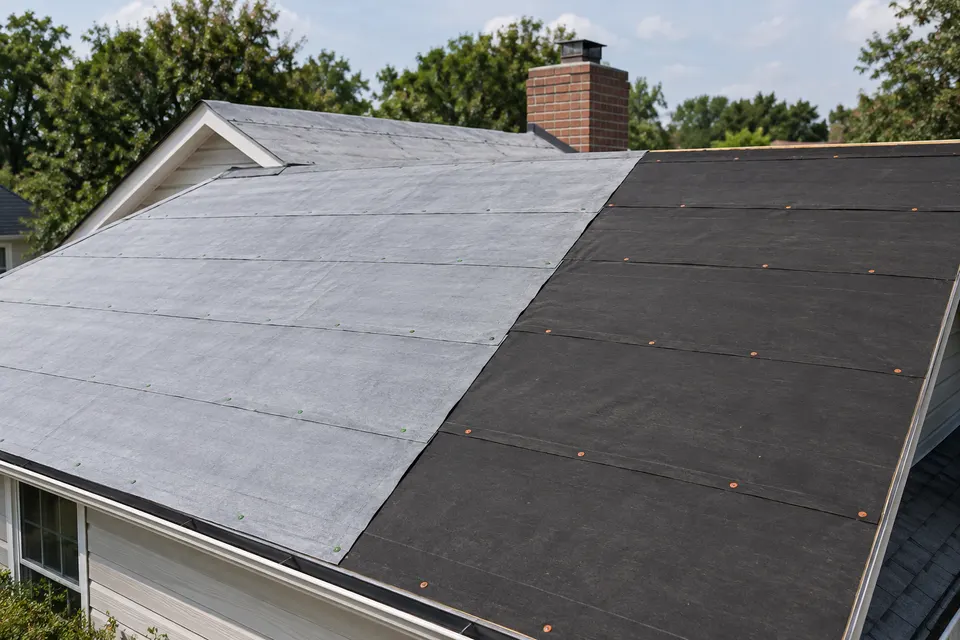
For most shingle roofs today, synthetic underlayment is usually the better choice, and some shingle makers now name it in their instructions. It costs more: Fixr puts synthetic at $0.17 to $0.55 per square foot for material, against $0.05 to $0.10 for No. 15 felt and $0.10 to $0.20 for No. 30 felt. On a whole roof that difference is usually a few hundred dollars. For that, synthetic is lighter, harder to tear, gives better footing, and can sit uncovered for weeks instead of hours. Felt still meets the building code. It can do the job when the roofer covers it quickly and lays it flat.
Our guide to roof decking and underlayment explains the layers under your shingles and what a new deck costs. This page compares the two common underlayments side by side.
What underlayment does
Underlayment is the sheet nailed over the wood deck before the shingles go on. The Asphalt Roofing Manufacturers Association (ARMA) lists four jobs for it:
- It is a second barrier, so water that gets past the shingles does not reach the wood.
- It keeps the deck dry while the roof is open during the job.
- It smooths the surface, so the outlines of the deck panels do not show through the shingles.
- It is part of the fire rating. A shingle's fire class is tested with underlayment under it.
The International Residential Code (IRC), the model code for houses published by the International Code Council, requires underlayment under asphalt shingles. Whichever type your roofer uses, it is not optional.
No. 15 felt, No. 30 felt and synthetic
Felt, often called tar paper, is a paper-like mat soaked in asphalt. Synthetic underlayment is a woven or laminated plastic sheet, which InterNACHI, the home inspectors' association, says is usually polypropylene or polyethylene.
| No. 15 felt | No. 30 felt | Synthetic | |
|---|---|---|---|
| Standard it is made to | ASTM D226 Type I, or ASTM D4869 | ASTM D226 Type II, or ASTM D4869 | ASTM D8257 |
| Minimum weight per 100 square feet under ASTM D226 | 11.5 pounds | 26 pounds | Not rated by weight |
| Material cost per square foot (Fixr) | $0.05 to $0.10 | $0.10 to $0.20 | $0.17 to $0.55 |
| Rolls for a 2,000-square-foot roof (Fixr) | about 14, for felt in general | about 14, for felt in general | 2 or 3 |
| Typical life (HomeGuide) | 20 to 30 years | 20 to 30 years | 25 to 30 years |
The number on felt is a weight class, not a guarantee. An article in IIBEC Interface, the journal of the building enclosure consultants' institute, shows why. ASTM D226 Type II ("No. 30") must weigh at least 26 pounds per 100 square feet. ASTM D4869, a lighter standard, has four types that start at 8 pounds per 100 square feet. The same article gives an example of one maker selling three products with "30" on the label that weighed 26, 13 and 8 pounds. InterNACHI adds that some felt sold as "15-lb" or "30-lb" meets no standard at all, and that such felt tends to soak up water and fail sooner. If an estimate says "30 lb felt", ask which ASTM standard and type it meets.
Heavier felt is sturdier. HomeGuide describes No. 15 as thinner and more flexible, and No. 30 as more water-resistant, less likely to tear and more expensive.
What the difference costs on your estimate
Roofers price by the square, which is 100 square feet of roof. Converting Fixr's per-square-foot material prices gives our own rough per-square figures:
| Underlayment | Material per square | Material for a 20-square roof |
|---|---|---|
| No. 15 felt | $5 to $10 | $100 to $200 |
| No. 30 felt | $10 to $20 | $200 to $400 |
| Synthetic | $17 to $55 | $340 to $1,100 |
That arithmetic is ours, not a price Fixr publishes. It leaves out the extra material used in overlaps and waste, and the labor. Fixr puts labor for underlayment on a full reroof at $0.15 to $0.50 per square foot.
HomeGuide's material prices differ: $0.05 to $0.15 per square foot for asphalt felt and $0.10 to $0.35 for synthetic, updated April 2024. Fixr's figures were updated January 2025. The two sources don't agree, so treat any single figure as a guide, not a price.
Both sources say the same thing about how it shows up: most roofers price the underlayment into the replacement rather than as its own charge. On a typical roof, switching from felt to synthetic changes the material bill by a few hundred dollars, a small share of a full replacement. If two estimates differ by much more than that, the underlayment is not the only thing that differs. Our guide to comparing roofing estimates covers the other lines, and the roof cost calculator gives a rough total for your roof.
Weight, tear strength and footing
Weight. A roll of synthetic covers far more roof than a roll of felt. Fixr's count is 2 or 3 rolls of synthetic for a 2,000-square-foot roof against about 14 of felt, so there is much less to carry up the ladder. ARMA also notes that synthetics are lighter and cover more area per roll.
Tear strength. Fixr reports tear strength of 34 to 77 pounds for synthetic underlayment against about 2 pounds for felt. Test methods differ from product to product, so read that as a sign of how large the gap is, not as an exact figure. Felt torn by wind or by boots during the job leaves bare deck. Heavier No. 30 felt tears less than No. 15.
Footing. ASTM D8257, the standard for synthetic underlayment, requires a surface that gives the roofer traction and slip resistance, according to an explainer in Professional Roofing, the National Roofing Contractors Association's magazine. InterNACHI describes synthetics as usually non-skid.
How long it can stay uncovered
This is the biggest practical difference between the two.
- Felt should be covered fast. HomeGuide says asphalt felt may tear or wrinkle if left exposed for more than a few hours.
- Synthetic is made to take sun for longer. HomeGuide says synthetic can stay exposed for several weeks. InterNACHI says synthetics resist UV well and can be left exposed for six months to a year, depending on the product.
The standard sets only a floor. ASTM D8257 tests a sheet after 500 hours of laboratory weathering, which Professional Roofing reports is roughly equal to 30 days outdoors. Each product's data sheet states its own exposure limit, and that limit is what counts.
Exposure time matters when the job stretches out: a crew that tears off in the morning and runs out of shingles, a delivery that is late, or a week of storms. If your roof may sit open for more than a day, ask your roofer what the underlayment's exposure limit is.
Wrinkling and moisture
Felt absorbs water. InterNACHI explains that wet felt swells and wrinkles, and that the wrinkles can show through thinner shingles. The water it takes up can also pass into the deck, which then swells and shrinks.
Wrinkles are not only cosmetic. The IRC's underlayment table says distortions in the underlayment must not keep the shingles from sealing. Shingle makers agree: CertainTeed's instructions tell roofers to apply underlayment flat and unwrinkled. That is one more reason to keep felt dry and cover it the same day.
Synthetic does not soak up water, so it lies flat. The tradeoff is vapor. InterNACHI gives No. 15 felt a perm rating of about 5, meaning some water vapor passes through it. Many synthetics let far less through. CertainTeed's instructions tell roofers to make sure the deck is well ventilated when synthetic underlayment is used, and InterNACHI notes that poor installation of a synthetic can let water wick under it. Neither problem is a reason to avoid synthetic. They are reasons to get the attic ventilation right; our guide to roof ventilation explains how.
What the building code and shingle makers require
The IRC. The 2024 IRC lists what may go under asphalt shingles: ASTM D226 Type I or II felt, ASTM D4869 Types I to IV, ASTM D6757, ASTM D1970 self-adhering membrane, and ASTM D8257 synthetic. ICC-ES's evaluation report ESR-3267 for one line of shingles lists the older standards for earlier code editions and notes that D1970 and D8257 underlayments are also permitted under the 2024 code. Professional Roofing reported in 2021 that D8257 would likely first appear in the 2024 codes. Felt and synthetic both meet the code; your local code is whichever edition your jurisdiction has adopted, with its own changes.
The code also says how to lay it. On slopes of 4 in 12 or steeper, where wind design is not required, the IRC calls for one layer laid shingle fashion from the eave, with 2-inch side laps and 4-inch end laps offset by 6 feet. From 2 in 12 up to 4 in 12, it calls for two layers, or one layer of self-adhering membrane. In areas where the code requires wind design, it calls for two layers and cap nails: ring-shank or deformed-shank nails with 1-inch caps. Your roofer or your local building department can tell you which rules apply to your house; check your state's rules and your local code.
The shingle makers. Your shingle warranty depends on installing to the maker's instructions, and those instructions say which underlayment they accept.
| Maker's document | What it says about underlayment |
|---|---|
| Owens Corning Duration shingle instructions, January 2026 | On slopes of 4 in 12 or steeper, use its synthetic underlayment or an equivalent meeting ASTM D8257. On lower slopes, two layers of synthetic or one of self-adhered membrane. |
| Owens Corning standard shingle warranty, January 2026 | Excludes damage from installation not done to its written instructions and local code. Its own synthetic underlayment is one of five component types; using three or more of them extends the components' coverage to match the shingles. |
| Owens Corning Platinum Protection warranty, August 2026 | Requires its own synthetic underlayment, or its self-adhered membrane over the whole deck, among other conditions. |
| CertainTeed Landmark shingle instructions | Accepts its own synthetic underlayments, or underlayment meeting ASTM D226, D4869 or D6757, which include felt. Asks for good deck ventilation when synthetic is used. |
| CertainTeed 2026 shingle warranty | Excludes damage from installation not done to its instructions published at the time of installation. |
In short: under one of these makers' current instructions, felt is still accepted. Under the other's current instructions for this shingle line, synthetic is what is named. An enhanced system warranty usually requires the maker's own underlayment. Ask your roofer which shingle line they are installing and which underlayment its instructions call for. Our guide to roof warranties explains how those warranties differ. This is not legal advice about any warranty; the warranty document decides.
Where ice barrier fits
Neither felt nor synthetic seals around nails. Where water backs up under shingles, at the eaves in cold climates and in valleys, a self-adhering membrane called ice barrier goes down on the bare deck first. The IRC requires it where ice dams have a history of backing up water, running from the eave to at least 24 inches inside the exterior wall line. Felt or synthetic then covers the rest of the roof. Our guide to roof decking and underlayment covers ice barrier in detail, and our guide to ice dams covers what causes them.
What to ask your roofer
- Which underlayment, by product name, and which ASTM standard does it meet? "30 lb felt" alone is not enough.
- Is it what the shingle maker's instructions call for on my roof's slope? Ask to see the page.
- Does my warranty require the maker's own underlayment? This matters most if you are buying an enhanced system warranty.
- How long can it be left uncovered, and what happens if the job is delayed?
- Where will ice barrier go, and how far up from the eaves?
- How will you fasten it? Cap nails are required in some areas and are common elsewhere.
- Is attic ventilation part of the job?
Get the answers in writing on the estimate. Our lists of questions to ask a roofer and what to check before you hire cover the rest of the contract.
Frequently asked questions
Is synthetic underlayment worth the extra cost?
For most homes, yes. On a typical roof it adds a few hundred dollars in material. In return you get a sheet that is lighter, harder to tear, safer to walk on, and able to sit uncovered through a delay. Some shingle makers' instructions now name it.
Is felt underlayment still allowed?
Yes. The 2024 IRC still lists ASTM D226 and D4869 felt for asphalt shingles, and CertainTeed's instructions still accept it. Check that it suits the instructions for the shingle line on your estimate and your local code.
Is No. 30 felt better than No. 15?
It is heavier, tougher and more water-resistant, and it costs more. But the labels are not reliable: some "30" products weigh far less than the 26 pounds per 100 square feet that ASTM D226 Type II requires. Ask for the standard and type.
Does underlayment make my roof waterproof?
No. Felt and synthetic are water-shedding layers laid in overlapping courses, held with nails. Only a self-adhering membrane seals around nails, which is why it is used at eaves, valleys and other places where water collects.
Can underlayment be replaced without new shingles?
Not in practice. It sits under the shingles, so replacing it means taking them off. HomeGuide notes that most contractors put down new underlayment when they replace the roof, so the choice is made then.
How we got these numbers
HomeAnvil does not yet publish price data of its own. Every figure and fact on this page comes from a published source, each read on September 27, 2026:
- Fixr, roof underlayment replacement cost, updated January 31, 2025: material cost per square foot for No. 15 felt, No. 30 felt and synthetic, labor per square foot, rolls per roof, and tear strength.
- HomeGuide, roof underlayment replacement cost, updated April 18, 2024: material costs by type, the difference between No. 15 and No. 30 felt, lifespans and exposure times.
- Asphalt Roofing Manufacturers Association, Steep Slope Roofing Underlayment, May 6, 2025: what underlayment does, the ASTM standards and the low-slope rule.
- Jeffrey Levine, When Is No. 30 Asphalt Felt Not No. 30 Asphalt Felt?, IIBEC Interface, November 2019: minimum weights under ASTM D226 and D4869 and the labeling example.
- InterNACHI, Roofing Underlayment Types: non-standard felt, perm rating, wrinkling and moisture, synthetic materials, exposure time, footing and wicking.
- Mark S. Graham, A new standard, Professional Roofing, July 2021: what ASTM D8257 tests, its slip-resistance requirement and the 500-hour weathering test.
- International Code Council, 2024 International Residential Code, sections R905.1.1, R905.1.2 and Tables R905.1.1(1) to (3), read from the edition hosted by UpCodes: accepted underlayments, laps by slope, wind-area fastening and ice barrier.
- ICC Evaluation Service, ESR-3267, reissued December 2025, revised February 2026: underlayment standards accepted under each code edition.
- Owens Corning, TruDefinition Duration shingles installation instructions, January 2026; standard shingle and components warranty, January 2026; and Platinum Protection warranty, August 2026.
- CertainTeed, Landmark shingle installation instructions and asphalt shingle 2026 limited warranty, read from the copies hosted by BuildSite.
- The per-square and 20-square figures are our own arithmetic from Fixr's per-square-foot prices.
Our roof decking and underlayment guide gives Fixr's single felt range of $0.05 to $0.50 per square foot. This page uses Fixr's separate prices for No. 15 and No. 30 felt, which sit inside that range; Fixr notes that felt also comes in a heavier 40-pound weight for tile roofs. We will update this page when newer national figures are published, and the date above will say when.
Related guides
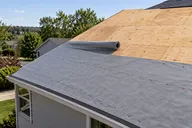 Roof decking and underlayment: what they are and costReplacing roof decking costs $2 to $5 a square foot; a sheet of plywood or OSB runs $9 to $64. How the deck, underlayment and ice barrier work.
 What does a roof warranty actually cover?A shingle warranty covers manufacturing defects, a contractor's warranty covers installation. How prorating, wind, algae, transfers and voiding work.
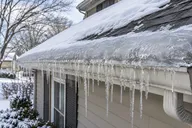 What causes ice dams, and how do you stop them?Ice dams form when attic heat melts roof snow that refreezes at the eaves. How to remove one safely, what not to do, and how to stop them coming back.
 What questions should you ask a roofer before you sign?The roofing questions to ask before you sign: tear-off, decking, ice barrier, ventilation, permit, crew, cleanup, payment and warranty papers, plus red flags.
 How do you compare roofing estimates?Compare roofing estimates line by line: squares, price per square, product lines, tear-off, decking, underlayment, flashing, permit, warranties and payment terms.
 What happens during a roof replacement, step by step?An asphalt shingle roof usually goes on in one to three days. What happens before, during and after, from tear-off and deck repair to flashing and cleanup.