
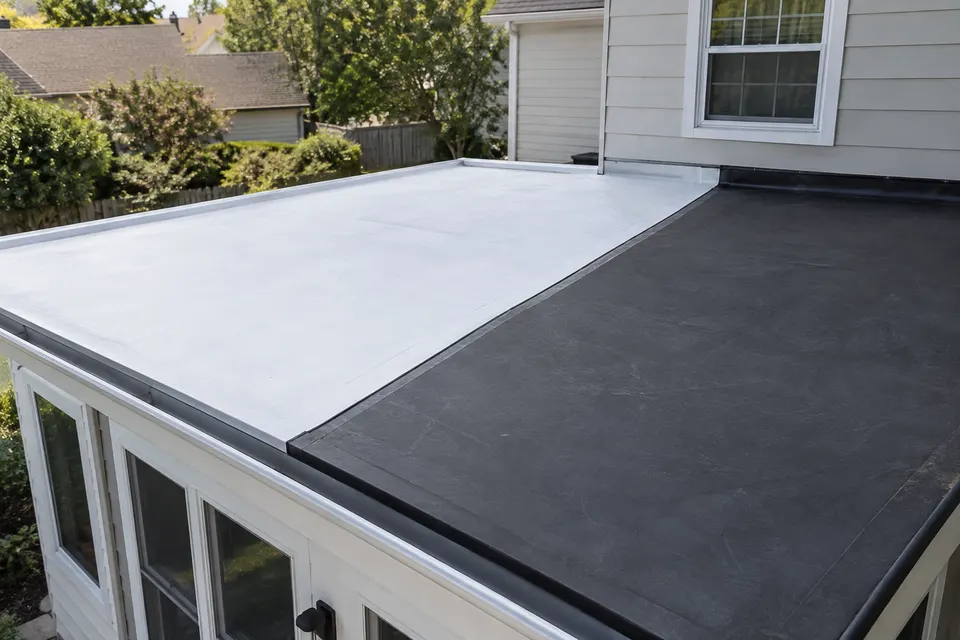
TPO, EPDM and PVC cost about the same to install: national cost sites put all three between roughly $4 and $16 a square foot, with PVC starting a little higher. The real differences are elsewhere. EPDM is a rubber sheet, usually black, with taped seams, and SPRI and the EPDM trade group describe it as easy to repair. TPO and PVC are white plastic sheets whose seams are melted together, so they reflect far more sun and have seams as strong as the sheet. PVC adds resistance to oils and grease. The sources below also show that drainage and what lies under the membrane can matter as much as which of the three you pick.
This guide compares the three head to head. For the full cost of a flat roof, including tear-off, labor, drainage and the other membrane types such as modified bitumen and built-up roofing, see our guide to flat roof replacement cost.
What each membrane is
All three are single-ply membranes: one waterproof sheet, rolled out in wide pieces and joined at the seams. The U.S. Department of Energy (DOE) notes that they are fastened down mechanically, glued down fully, or held in place with ballast such as stone or pavers.
| EPDM | TPO | PVC | |
|---|---|---|---|
| What it is | Synthetic rubber (a thermoset) | Thermoplastic polyolefin | Polyvinyl chloride, a thermoplastic |
| Usual color | Black; also white and gray | White; other colors exist | White; other colors exist |
| How seams are joined | Tape or liquid adhesive | Hot air melts the sheets together | Hot air melts the sheets together |
| Common thicknesses | 45, 60, 75 and 90 mils | 45, 60 and 80 mils in Fixr's pricing | 60 mils in the data sheet we read |
| Industry standard it is made to | ASTM D4637 | ASTM D6878 | ASTM D4434 |
A mil is a thousandth of an inch, so a 60-mil sheet is 0.06 inches thick. The thicknesses come from the EPDM Roofing Association, Fixr and one manufacturer's data sheets; the standards are the ones Johns Manville's data sheets say each of its membranes meets. SPRI, the single-ply roofing trade group, describes EPDM as traditionally black and TPO and PVC as mostly white.
What each costs installed
The national cost sites give overlapping ranges, per square foot of roof, materials and labor included.
| Source | EPDM | TPO | PVC |
|---|---|---|---|
| HomeAdvisor, rubber roof page, updated June 19, 2026 | $4.25 to $12 | $4.50 to $14 | $5.25 to $12.50 |
| This Old House, rubber roof page, updated June 11, 2026 | $4.25 to $12 | $4.50 to $14 | $5.25 to $13 |
| Fixr, rubber roof page, updated January 31, 2025 | $4.25 to $13 | $4.50 to $14 | $5.50 to $15 |
| HomeAdvisor, TPO page, updated June 19, 2026 | not given | $4.50 to $16 | not given |
These differ a little from the membrane table in our flat roof replacement cost guide, which comes from the same companies' flat roof pages. That is not a correction: each site publishes different ranges on different pages. The largest gap is This Old House, whose flat roof page prices a 2,000 square foot roof at $9 to $13 for EPDM and $8 to $11 for TPO, while its rubber roof page gives the wider ranges above. Across every page we read, the three membranes overlap, PVC starts highest, and EPDM and TPO start within 25 cents of each other.
On a 400 square foot garage or porch roof, HomeAdvisor's rubber roof ranges come to about $1,700 to $4,800 for EPDM, $1,800 to $5,600 for TPO and $2,100 to $5,000 for PVC. That is our arithmetic, for the membrane installed, before tear-off, new insulation or permit costs.
Two things move the price within a membrane:
- Thickness. Fixr prices TPO with standard installation at $3.00 to $4.50 a square foot for 45 mil, $4.00 to $6.50 for 60 mil and $5.50 to $8.50 for 80 mil.
- How it is attached. HomeAdvisor's TPO page gives $1.50 to $2.50 a square foot for a ballasted roof, $2 to $3 for a mechanically fastened one and $2.75 to $3.50 for a fully adhered one, as the attachment part of the cost.
HomeAdvisor puts labor at $2 to $6 a square foot on its rubber roof page and $3 to $7 on its TPO page, and removal of the old roof at $1 to $2. For a rough total on your own roof size, try the roof cost calculator, which has a flat roof setting.
How long each lasts
The published lifespans disagree more than the prices do, and the same company sometimes gives different figures on different pages.
| Source | EPDM | TPO | PVC |
|---|---|---|---|
| InterNACHI life expectancy chart | 15 to 25 years | 7 to 20 years | not listed |
| This Old House, rubber roof page | 20 years | 7 to 15 years | 20 years |
| Fixr, rubber roof page | can last over 60 years | 15 to 20 years | around 20 years |
| HomeAdvisor, TPO page | not given | 15 to 30 years | not given |
| EPDM Roofing Association (trade group) | 38 years expected | not given | not given |
The EPDM figure of 38 years comes from the EPDM industry's own trade group, which says its 2025 survey of 569 roofing professionals put expected service life at about 25 to more than 40 years, depending on thickness and attachment. Treat an industry's figure for its own product with that in mind. Our flat roof replacement cost guide gives Fixr's flat roof figures of about 30 years for EPDM and 20 to 30 for TPO and PVC, another example of one site's pages not agreeing.
The pattern that holds across sources: EPDM is given as long a life as the others or longer, and TPO's low end is the lowest. Our flat roof guide explains why drainage also has a large effect on how long any membrane lasts.
Seams and repairs
The three membranes are joined in different ways, which changes how they are repaired.
EPDM sheets are joined with pressure-sensitive tape, SPRI says. The EPDM Roofing Association says EPDM stays flexible with age rather than becoming brittle, and describes a repair as washing the membrane, preparing the surface and then applying the repair material. SPRI also credits EPDM with easy repairability.
TPO and PVC seams are made with hot-air welders that melt the two sheets together under pressure, SPRI explains. The roofing industry's weather-issues committee, in a guide published by the Insurance Institute for Business & Home Safety (IBHS), says these welded seams are as strong as or stronger than the membrane itself. Johns Manville's PVC data sheet lists its seam strength at 100% of the sheet's breaking strength, against a 75% minimum in the standard.
Welding an old thermoplastic roof takes more care. Carlisle, a membrane maker, tells installers always to clean aged or dirty membrane with a cleaner made for it before welding, to make test welds several times a day because air and roof temperatures change, and to probe every seam at the end of the day. When you get a repair on an older TPO or PVC roof, ask the roofer how they will prepare the old sheet and check the weld.
One detail matters for TPO and PVC. Both are reinforced with a fabric scrim in the middle, and the layer above the scrim is what weathers. The ASTM standards set a minimum of 0.015 inches above the scrim for TPO and 0.016 inches for PVC. Johns Manville's 60-mil sheets measure 0.028 and 0.027 inches above the scrim, which is less than half the sheet's full thickness (our arithmetic).
For what flat roof repairs cost, see our guide to flat roof repair.
Heat and reflectivity
This is the biggest practical difference. DOE says TPO and PVC are typically white and reflect sunlight well, while EPDM is typically black and has to be made in white or coated to be reflective. DOE adds that a dark roof can reach more than 150°F on a warm, sunny day, and a cool roof under the same conditions can stay more than 50°F cooler.
Johns Manville, which makes all three, publishes these solar reflectance figures (the share of sunlight a surface bounces away, from 0 to 1) and Solar Reflectance Index (SRI) figures for its 60-mil membranes:
| Membrane (60 mil) | Reflectance, new | Reflectance, after 3 years | SRI, new | SRI, after 3 years |
|---|---|---|---|---|
| Black EPDM | 0.06 | not given | not given | not given |
| White EPDM | 0.787 | 0.755 | 98 | 93 |
| White TPO | 0.77 | 0.70 | 95 | 85 |
| White PVC | 0.86 | 0.70 | 108 | 84 |
The three-year figures are for weathered, dirtier samples. White EPDM's are from an accelerated test the data sheet calls a rapid rating, while TPO's and PVC's are the Cool Roof Rating Council's three-year aged values, so compare them loosely. DOE says most of the loss from weathering and dirt happens in the first year or two, then levels off.
Black is not always a drawback. SPRI notes that black EPDM absorbs sun, which lowers heating costs in winter. Whether a white roof saves you money depends on your climate, your insulation and whether the flat roof sits over a heated or cooled room; a porch or garage roof may make little difference either way. Our guide to cool roofs covers the savings, the winter trade-off and how to read a Cool Roof Rating Council label. DOE also warns that membranes glued down with adhesive need a minimum temperature to bond, so a cool membrane may need warmer weather to install properly.
Punctures, hail and ponding
Punctures. Each of Johns Manville's 60-mil data sheets reports a pass on the standard ASTM puncture tests: dropped weight (D5635) and steady pressure (D5602). The tests were run at different levels for each membrane, so they show that each meets its standard, not which one is toughest. Thickness and what lies under the membrane matter as much as the material.
Hail. A 2016 hailstorm investigation by the Roofing Industry Committee on Weather Issues (RICOWI), as quoted in a 2022 Building Enclosure article, found that single-ply membranes generally performed well, with only a few roofs damaged by hail under 1.5 inches. The same report found damage on more than 43% of membranes laid over soft substrates, against 25% of those over high-strength boards. In other words, a hard cover board under the membrane made a bigger difference than the membrane type. The EPDM Roofing Association points out that the three EPDM roofs inspected in that storm, hit by hail of 1 to 3 inches, showed no punctures, while two thermoplastic roofs were badly damaged by hail under 2 inches. Three roofs is a small sample, and the claim comes from EPDM's trade group. For checking a roof after a storm, see how to tell if hail damaged your roof.
Cold. The same data sheets list EPDM as passing a brittleness test at -49°F and TPO at -40°F.
Ponding. The building code requires a design slope of at least 1/4 inch per foot for single-ply roofs, the IBHS guide notes. Standing water is a drainage problem for every membrane, but warranties treat it differently. The EPDM Roofing Association says ponded water will not void an EPDM manufacturer's warranty on its own. A sample TPO warranty from IB Roof Systems, by contrast, excludes "areas that pond water," defined as water standing longer than 48 hours. Warranties vary by manufacturer and product, so read the one you will actually get. Our flat roof replacement cost guide explains how a new roof can be sloped to drain, and our guide to roof warranties explains what they usually cover.
Grease and chemicals. SPRI says PVC resists rooftop chemicals, including acids, oils and greases, and Johns Manville's PVC data sheet lists oils, air conditioning coolants, fuels and grease. If a kitchen exhaust or other vent discharges onto the flat roof, ask the roofer whether that affects the choice.
Which one fits which roof
None of the three is the right answer for every home. Based on the sources above:
- EPDM suits a roof where you value easy future repairs and a long record in use, where the roof holds some water, or where a dark surface is fine, such as a garage or porch roof in a cold climate. Ask for white EPDM if you want it reflective.
- TPO suits a roof where you want a white, reflective surface and welded seams at a price close to EPDM. Ask about the thickness and the material above the scrim.
- PVC suits a roof where you want welded seams and a white surface and there is grease, oil or chemical exposure, and you accept a slightly higher starting price.
It is also worth asking a roofer which of the three they install most often.
What to ask a roofer
- Which membrane, by brand, product and thickness, and whether it is reinforced.
- How it will be attached: glued down, fastened or ballasted, and why.
- What goes under it: insulation, and whether there is a cover board.
- How the seams are made, and for TPO or PVC, how the welds are tested.
- How the roof will drain, and whether the warranty excludes ponding.
- Which warranty covers the membrane, which covers the labor, and for how long.
- For a cool roof, the product's solar reflectance and its Cool Roof Rating Council listing.
Our list of questions to ask a roofer covers the rest of the contract, and our guide to what to check before you hire a contractor covers licenses and insurance. Nothing here is legal or insurance advice; read your own contract and warranty.
Frequently asked questions
Is TPO or EPDM cheaper?
They are close. HomeAdvisor and This Old House both start EPDM at $4.25 a square foot and TPO at $4.50, and Fixr's ranges are almost the same.
Which lasts longer, TPO or EPDM?
Most sources we read give EPDM an equal or longer life. InterNACHI lists EPDM at 15 to 25 years and TPO at 7 to 20, and This Old House gives EPDM 20 years and TPO 7 to 15. HomeAdvisor gives TPO 15 to 30. Drainage and installation quality matter as much as the membrane.
Is PVC worth the extra cost over TPO?
It can be where oils, grease or chemicals reach the roof, which SPRI and manufacturers say PVC resists. Otherwise the two are similar: both are white, both are welded, and PVC starts about 75 cents to $1 a square foot higher in the ranges above.
Can EPDM be white?
Yes. The EPDM Roofing Association lists black, gray and white, and DOE says white or reflective-coated EPDM is available. Johns Manville's white 60-mil EPDM reflects about 0.79 of sunlight when new, similar to its white TPO.
Can you repair an old TPO roof?
Usually, but the old sheet has to be cleaned with a cleaner made for weathered membrane before a new piece is welded on, and the weld should be tested, as Carlisle's installation guidance describes. Ask the roofer how they will prepare and check it.
How we got these numbers
HomeAnvil does not yet publish price data of its own. Every figure on this page comes from a published source, read on September 27, 2026. Where we worked out a total or a share ourselves, the text says so.
- HomeAdvisor, rubber roof installation cost, updated June 19, 2026: price per square foot for EPDM, TPO and PVC, labor and removal.
- HomeAdvisor, TPO roofing cost, updated June 19, 2026: TPO price per square foot, the cost of each attachment method, labor and lifespan.
- This Old House, rubber roof cost, updated June 11, 2026: price per square foot and lifespan for EPDM, TPO and PVC.
- Fixr, rubber roof cost, updated January 31, 2025: price per square foot and lifespan for EPDM, TPO and PVC.
- Fixr, TPO roof cost, updated September 10, 2026: TPO price by thickness.
- InterNACHI, standard estimated life expectancy chart for homes: EPDM and TPO lifespans.
- EPDM Roofing Association, what is EPDM and physical properties: colors and thicknesses; longevity: the 38-year figure and its 2025 survey; repair and restoration: how EPDM is repaired; ponding and warranties, June 3, 2018; RICOWI hail study: the three EPDM roofs inspected.
- SPRI, single-ply roofing 101, January 2019: what each membrane is, colors, how seams are made, black EPDM and winter heat, and PVC's chemical resistance.
- Insurance Institute for Business & Home Safety, RICOWI roof guide: single-ply membrane: welded seam strength and the minimum design slope.
- U.S. Department of Energy, Guidelines for Selecting Cool Roofs, July 2010: membrane colors, roof temperatures, weathering of reflectance, and adhesive temperatures.
- Johns Manville data sheets for its 60-mil TPO (April 2022), black 60-mil EPDM (March 2023), white 60-mil EPDM (May 2025) and 60-mil PVC (October 2025): standards, reflectance, SRI, thickness over scrim, seam strength, puncture and brittleness tests, and PVC's chemical resistance. We use one manufacturer so the three are measured the same way; this is not a recommendation of its products.
- Carlisle, TPO and PVC welding guidelines, August 6, 2019: cleaning aged membrane, test welds and probing seams.
- IB Roof Systems, sample TPO commercial warranty: the ponding exclusion.
- Building Enclosure, designing for the impacts of very severe hail, by Jennifer Keegan, August 1, 2022: the RICOWI 2016 hailstorm findings on single-ply membranes and cover boards.
We will update this page when these sources publish new figures, and the date above will say when.
Related guides
 How much does a flat roof replacement cost?A flat roof replacement typically costs $3,331 to $11,558, or $4 to $35 a square foot. Membranes, lifespans, drainage, and why shingles can't go on it.
 How much does it cost to repair a flat roof?Most flat roof repairs cost $300 to $1,100, about $700 on average. Ponding, blisters, seams and flashing, costs by membrane, coatings, and when to replace.
 Is a cool roof worth it, and does it lower energy bills?A cool roof reflects sun and can cut cooling costs, most in hot climates. The ENERGY STAR roof label ended in 2022; the federal credit ended after 2025.
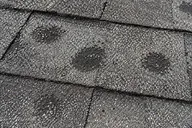 How do you know if hail damaged your roof?Quarter-size (1 inch) hail can start to damage older 3-tab shingles, laminated ones at 1.25 inches. How to spot real damage and when to call your insurer.
 What does a roof warranty actually cover?A shingle warranty covers manufacturing defects, a contractor's warranty covers installation. How prorating, wind, algae, transfers and voiding work.
 What questions should you ask a roofer before you sign?The roofing questions to ask before you sign: tear-off, decking, ice barrier, ventilation, permit, crew, cleanup, payment and warranty papers, plus red flags.