
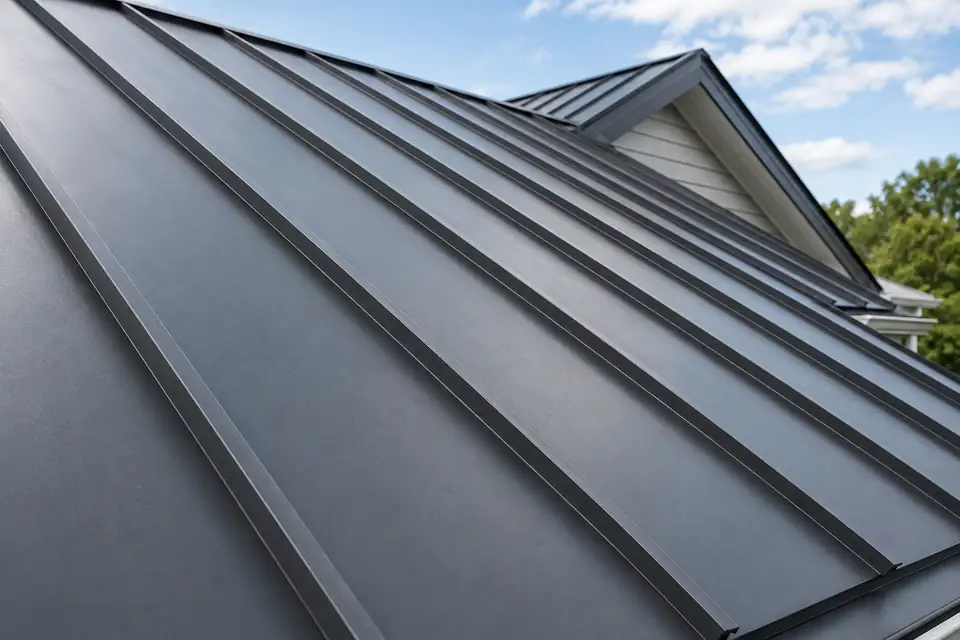
A standing seam roof costs more and asks less of you afterward. HomeGuide prices standing seam at $9 to $16 per square foot installed and exposed-fastener panels at $5 to $12. The difference is how each is held down: exposed-fastener panels are screwed through their face, so every screw is a hole that has to stay sealed, while standing seam panels lock together over hidden clips. Exposed-fastener panels suit a tight budget and a simple, steep roof; standing seam suits a low slope, a long stay in the house and an owner who would rather not check screws.
How each kind of panel is held down
The Department of Energy's Building America Solution Center describes the two kinds of metal panel this way:
- Exposed-fastener panels are made in a factory, typically about 3 feet wide and 8 to 16 feet long, with ribs pressed in for stiffness. Screws with rubber gaskets go straight through the face of the panel into the roof below. The panels are stiff enough to span open battens or purlins, which is why they are common on barns and sheds. Corrugated and ribbed panels are both of this kind; roofers also call them screw-down panels.
- Standing seam panels are fastened to clips, and the clips are screwed to a solid roof deck. The next panel covers the clip, so no screw passes through the metal you see. Panels are typically about 16 inches wide and run in one continuous piece from ridge to eave, and they are often formed to length on site.
Standing seam comes in two main kinds. Snap-lock panels press together by hand and cost less to install. Mechanically seamed panels are folded together with a seaming tool, which takes more skill and time. HomeAdvisor calls snap-lock less durable than a mechanical seam, and HomeGuide says it is less reliable in high wind and extreme weather.
The two side by side
| Exposed-fastener panels | Standing seam | |
|---|---|---|
| Installed cost per square foot (HomeGuide, November 2025) | $5 to $12 | $9 to $16 |
| Installed cost per square foot (HomeAdvisor, June 2026) | $3.50 to $15 (corrugated) | $7 to $30 |
| Installed cost per square, 100 square feet (HomeGuide) | $500 to $1,200 | $900 to $1,600 |
| Screws | Through the face of every panel, exposed to sun and rain | Hidden under the seams, on clips |
| Lowest slope allowed by the model residential code | 3 in 12 without lap sealant; ½ in 12 with it | ¼ in 12 |
| What it goes over | Solid deck, or open battens or purlins | Solid deck |
| Expected life (Angi, July 2026) | 30 to 45 years | 50 to 70 years |
The slopes are the International Residential Code's minimums for metal roof panels, as the Building America Solution Center summarizes them. Manufacturers often set higher ones for their own products. Sheffield Metals, a supplier of metal sheet and coil, says snap-lock standing seam should not go below 3 in 12, mechanically seamed panels below ½ in 12, or exposed-fastener panels below 3 in 12, which it calls the industry standard. Your roof's pitch can decide the choice for you: on a low slope, exposed-fastener panels are the wrong roof.
What the price difference buys
HomeAdvisor puts a typical standing seam roof at $9,400 to $32,600, with an average of about $19,000. For metal roofs of every kind it gives $6,045 to $18,341. Our guide to what a metal roof costs breaks those totals down by metal.
Standing seam costs more for three reasons the sources give:
- Labor. HomeGuide says standing seam takes more time and skill than corrugated panels, and puts its labor at $5 to $8 per square foot. HomeAdvisor gives $2 to $6.
- Parts. Exposed-fastener panels need no clips. S-5, which makes clamps and brackets for metal roofs, adds that exposed-fastener panels are usually thinner and wider, so less material covers the roof.
- The seam itself. A mechanical seam needs a seaming tool and a crew that has used it.
Within standing seam, the metal matters most. HomeGuide's standing seam figures, from a page dated April 2023, run from $7.50 to $12.50 per square foot installed for Galvalume steel to $18 to $32 for copper. Thicker metal costs more: most houses use 24- or 26-gauge, and a lower gauge number is thicker. HomeAdvisor says wider panels cost less but show more oil canning, the waviness that can appear in the flat of a panel. HomeGuide calls oil canning a cosmetic issue that does not need repair, and says ribbed or striated panels hide it.
Lifespan
| Source | Exposed-fastener | Standing seam |
|---|---|---|
| Angi, July 2026 | 30 to 45 years | 50 to 70 years |
| HomeAdvisor, June 2026 | not given | 50 to 80 years; copper and zinc can approach 100 |
| HomeGuide, November 2025 | 30 to 50 years for corrugated in humid climates | longer than corrugated |
HomeGuide's standing seam page gives a more cautious 30 to 50 years or more. For metal roofs in general, InterNACHI, the home inspectors' association, gives 40 to 80 years. HomeGuide also says most standing seam panels carry a PVDF paint finish (sold as Kynar 500 or Hylar 5000), typically warranted for at least 30 years. Our guide to how long a roof lasts compares metal with every other roofing material.
Fastener upkeep on an exposed-fastener roof
Metal grows longer as it heats and shorter as it cools. On a standing seam roof, the clips let each panel slide. On an exposed-fastener roof, the screws pin the panel to the roof, so the movement works on the screws instead. Sheffield Metals and S-5 both describe what follows:
- Screws back out. As the panel moves, screws can loosen and lift. Once the gasket no longer presses on the metal, water can get in at that hole.
- Gaskets age. The rubber washer under each screw head breaks down in sunlight faster than the screw does.
- Installation errors multiply. A screw driven too far crushes its washer; one not driven far enough leaves a gap; one driven at an angle does not seal. The Building America guidance says the washer should seal against the metal without being squashed flat, and that angled screws should be taken out and redone.
The upkeep that follows is a real cost. Sheffield Metals says an exposed-fastener roof may need its fasteners checked up to twice a year, with any that are loose, backing out or rusted replaced. HomeGuide prices replacing metal roof screws at $150 to $1,000, depending on how many. Standing seam needs routine inspection and cleaning too, but no screw checks across the field of the roof.
Sheffield Metals also says it knows of no manufacturer that offers a weathertight warranty on exposed-fastener panels. Some standing seam systems carry one. Ask which warranty comes with the exact panel you are being offered, and whether it covers leaks or only the paint.
Wind
The sources do not agree, so here is what each says:
- The Building America Solution Center calls standing seam "highly resistant to wind and wind-driven rain". It shows a standing seam roof that lifted in a storm because its clips were set too far from the eave, a reminder that the attachment matters as much as the panel.
- Angi says the many screws of an exposed-fastener roof resist uplift better than the fewer, hidden fasteners of standing seam.
- Sheffield Metals and S-5, which both sell for standing seam, say engineered standing seam systems are commonly tested for wind uplift, while many exposed-fastener profiles have not been.
What settles it for your roof is a tested rating, not the panel type. The Building America guidance says a metal roof should resist at least the uplift pressure your building code sets for your site's wind speed, and that the rating depends on the type, size and spacing of the clips or screws. The IBHS FORTIFIED Home standards also require stainless steel fasteners or clips within 3,000 feet of salt water. Ask for the wind uplift rating of the exact panel and attachment, and ask whether the crew will install it to that tested pattern. Metal roofs are also rated for hail under UL 2218; our guide to hail damage explains the classes.
Snow, ice and noise
Metal of either kind sheds snow quickly, which the Metal Roofing Alliance, the industry's trade group, says protects the roof structure. That sliding snow can be a hazard over a door, a walkway or a lower roof. The Building America guidance suggests snow guards there, and warns that snow held back by guards adds load to that part of the roof. On standing seam, snow guards can clamp to the seams without holes in the panel, as can solar mounts; on an exposed-fastener roof, they screw through it.
Angi favors standing seam where snow sits on the roof for long periods, because its fasteners are not exposed to snowmelt. Either roof still needs an ice barrier at the eaves where ice dams form; our guide to ice dams covers why.
The Metal Roofing Alliance says there is little difference in noise between metal and other roofing in rain or hail. HomeGuide says a metal roof is not noisy when it is installed and insulated correctly, whichever panel you choose, so if noise worries you, ask the roofer what goes under the metal. Sheffield Metals adds that panels pinned so they cannot move with heat and cold can make more noise, which is one more reason the attachment matters.
When each suits a home
Exposed-fastener panels tend to fit when:
- The budget is fixed and the roof is simple, with long, uninterrupted slopes.
- The pitch is at least 3 in 12.
- You are prepared to have the screws checked regularly and replaced as they age.
- The building is a garage, workshop or outbuilding where looks and a weathertight warranty matter less.
Standing seam tends to fit when:
- The roof has a low slope, below 3 in 12.
- You plan to stay for decades and want to avoid fastener upkeep.
- Heavy snow sits on the roof, or you plan to add solar panels or snow guards without drilling the panels.
- You want a leak warranty from the manufacturer, or the cleaner look of a roof with no visible screws.
If you are still deciding between metal and asphalt, start with our guide to whether a metal roof is worth it over shingles.
What to ask before you sign
- Which panel exactly: exposed-fastener, snap-lock standing seam or mechanically seamed, with the manufacturer and profile name.
- The metal, its gauge, the paint system and the paint warranty.
- The tested wind uplift rating for that panel and attachment, and the clip or screw spacing the crew will use.
- For exposed fasteners: the screw and washer type, and the maintenance the manufacturer expects.
- The underlayment, the ice barrier at the eaves, and whether snow guards are included.
- The manufacturer's warranty, whether it covers leaks or only the finish, and the contractor's own warranty on labor, in writing.
- How many roofs of this exact kind the crew has installed.
Frequently asked questions
Is standing seam worth the extra cost?
It depends on how long you will stay and how much upkeep you will accept. In HomeGuide's ranges, standing seam costs about $4 more per square foot installed at both the low and the high end (our subtraction), and every source we read expects it to last longer, with no screws to check. On a roof you will keep for decades, that usually favors standing seam; on a building where cost comes first, exposed-fastener panels can make sense.
Can an exposed-fastener metal roof go on a house?
Yes, where the pitch is at least 3 in 12. Plan for the fastener checks, and ask whether the manufacturer publishes a wind uplift rating for the panel.
How often do the screws on a metal roof need replacing?
There is no single interval. Sheffield Metals says exposed fasteners may need checking up to twice a year, replacing any that are loose, backed out or rusted. HomeGuide prices a screw replacement job at $150 to $1,000.
Is snap-lock standing seam as good as mechanically seamed?
It costs less to install, but HomeAdvisor calls it less durable and HomeGuide says it is less reliable in high wind and extreme weather. Snap-lock also needs a steeper roof: Sheffield Metals says 3 in 12 or more, against ½ in 12 for a mechanical seam.
Does standing seam work with solar panels?
Yes. Clamps fixed to the seams can hold solar racking and snow guards without holes in the panels. Our guide to a new roof with solar panels covers the timing of the two jobs.
How we got these numbers
HomeAnvil does not yet publish price data of its own. Every figure on this page comes from a published source, read on September 26, 2026:
- HomeGuide, metal roof cost, November 21, 2025: installed prices per square foot and per square for exposed-fastener and standing seam panels, labor, gauges, and lifespan in humid climates. HomeGuide says it tracks the estimates homeowners receive from contractors.
- HomeGuide, standing seam metal roof cost, April 5, 2023: prices by metal, labor, snap-lock and mechanical seams, oil canning, paint finishes and lifespan. This page is older than the others, so treat its prices as a guide to the spread between metals.
- HomeGuide, metal roof repair cost, February 4, 2026: the cost of replacing screws and the note on oil canning.
- HomeAdvisor, standing seam metal roof cost, updated June 19, 2026, and metal roof cost, updated June 19, 2026. HomeAdvisor says its figures come from surveying its customers, combined with other published research.
- Angi, standing seam vs. screw-down metal roofs, updated July 9, 2026: installed cost, lifespan, and its view on wind and snow.
- U.S. Department of Energy, Building America Solution Center, metal roofs: how each panel is attached, the model code's minimum slopes, fastener installation, wind uplift, IBHS FORTIFIED requirements and snow guards.
- Sheffield Metals, standing seam vs. exposed fastener metal roofing, March 10, 2022: thermal movement, fastener withdrawal, gasket wear, maintenance frequency, warranties and minimum slopes, from a supplier of metal sheet and coil.
- S-5, standing seam vs. exposed-fastener metal roofs, December 19, 2018: thermal movement, cost and wind testing, from a maker of clamps for metal roofs.
- Metal Roofing Alliance, frequently asked questions: snow shedding and noise.
- InterNACHI, life expectancy of home components: the 40 to 80 year range for metal roofs.
We will update this page when these sources publish new figures, and the date above will say when.
Related guides
 How much does a metal roof cost?A metal roof typically costs $6,045 to $18,341 installed, or $5 to $16 per square foot. Prices by metal and panel type, repair costs and lifespan.
 Is a metal roof worth it over asphalt shingles?A standing-seam metal roof costs about 1.6 times as much as asphalt shingles ($51,865 against $31,871) but is rated to last 40 to 80 years instead of 20 to 30.
 How long does a roof last?Architectural shingles last about 30 years, 3-tab about 20, metal 40 to 80, slate 60 to 150. What shortens a roof's life, and why a warranty isn't a lifespan.
 What causes ice dams, and how do you stop them?Ice dams form when attic heat melts roof snow that refreezes at the eaves. How to remove one safely, what not to do, and how to stop them coming back.
 How do you replace a roof that has solar panels?The panels come off, the roof is replaced, and the panels go back on. Removing and reinstalling them costs about $2,800 to $4,800 by one estimate, more by another.
 How do you know if hail damaged your roof?Quarter-size (1 inch) hail can start to damage older 3-tab shingles, laminated ones at 1.25 inches. How to spot real damage and when to call your insurer.