
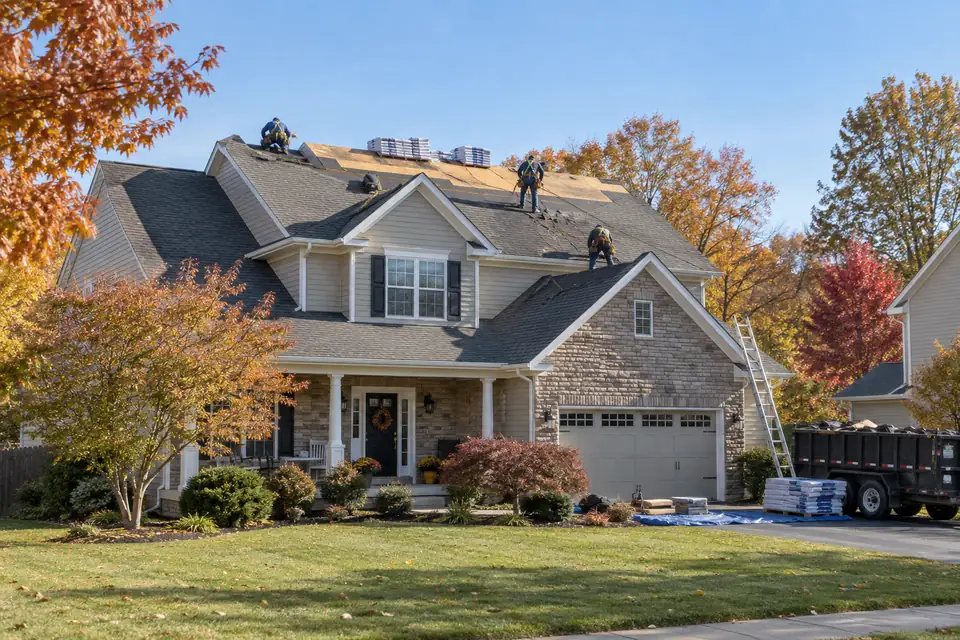
For an asphalt shingle roof, the best time is a stretch of dry days warm enough for the shingles to seal, booked early enough that you are not waiting in line behind everyone else. Shingle makers draw the line for cold weather at 40°F: Owens Corning's rules for cold-weather installation apply when the air and the roof surface are at or below that temperature, and they add steps such as hand-sealing the shingles around the edges of the roof. A mild season with steady sun is the easiest time to get a roof that seals well. But the calendar matters less than the forecast for the days the crew is on your roof, and a roof that is already failing should not wait for a better season.
What the weather has to do
A new shingle roof holds down against the wind mainly because each shingle bonds to the one below it. The bond comes from a strip of asphalt sealant put on at the factory, and heat from the sun activates it. IBHS, the insurance industry's research institute, calls the strength of that seal the most important factor in how self-sealing shingles perform in high winds.
That puts three demands on the weather:
- Warmth, to seal. Owens Corning's warranty says its sealant needs direct warm sunlight for several days to seal properly. IKO, another shingle maker, says the same in its warranty and adds that shingles installed in fall or winter may not seal until the following spring.
- Mild temperatures, to handle. Shingles stiffen as they get colder and soften as they get hotter. Both change how the crew has to work.
- Dry days, to work. The old roof comes off down to the wood deck, and the deck has to stay dry until it is covered again.
Weather conditions at a glance
| Condition | What happens to the shingles or the job | What the source calls for |
|---|---|---|
| At or below 40°F | Sealant may not activate until warmer weather; shingles are stiffer and may take longer to lie flat | Hand-seal the shingles around the roof's perimeter and leave small gaps at joints (Owens Corning) |
| Cool weather generally | Sealing may be delayed, and dust on the sealant can delay it further | Hand-seal any shingles that have not sealed after a reasonable time (CertainTeed) |
| Hot sun | The asphalt surface softens and scuffs under foot traffic | Soft-soled shoes, knee pads, work early in the day (ARMA) |
| Rain | A bare wood deck gets wet | Keep the deck dry before, during and after installation (Owens Corning) |
| No direct sun on a slope | Sealant may never reach the temperature it needs | Hand-seal shingles that have not sealed (IKO warns of it; CertainTeed calls for hand-sealing) |
Cold weather: what changes below 40°F
A winter roof is not a mistake in itself. It is a roof that needs extra steps. Owens Corning's technical bulletin on cold-weather installation, published April 2026, applies when the air and surface temperatures are at or below 40°F. It explains that shingles installed then may not seal until warmer weather arrives, and it recommends:
- Hand-sealing every shingle along the whole perimeter of the roof, with four 1-inch dabs of asphalt roof cement on each architectural shingle, or two dabs under each tab of a three-tab shingle.
- A gap of no more than 1/16 inch at every shingle's end joint, so the shingles have room to expand when the weather warms instead of buckling.
The Asphalt Roofing Manufacturers Association (ARMA) gives no single temperature. It tells installers to pick a temperature at which the shingles are flexible enough to work, to store bundles indoors to keep them warm before they go up, and to use open metal valleys in the cold, because woven and closed-cut valleys bend the shingles and can crack them. CertainTeed's instructions make the same point about bending: shingles must be warm enough to form over hips, ridges and valleys without cracking.
If your roof has to go on in the cold, ask each roofer in writing how they will handle it: whether they will hand-seal, which valley method they will use, and what the shingle maker's instructions say for that product. Our guide to what happens during a roof replacement covers the rest of the installation.
Hot weather: softer shingles and early starts
Summer is not off-limits, but heat changes the work. ARMA's bulletin on hot-weather installation notes that the asphalt surface softens in the sun, which makes shingles easy to scuff and mark under a roofer's boots, especially on steep slopes and in valleys where footsteps concentrate. It recommends soft-soled shoes and pads for kneeling, starting early in the day before the heat peaks, and working the south- and west-facing slopes in the morning and the east- and north-facing ones later. Owens Corning's installation instructions also set a storage limit of 110°F for its bundles, in a covered, ventilated place.
In practice, expect a summer crew to start at first light and perhaps stop early. That is a sign of care, not a lack of effort.
Wind and rain
Wind matters most in the weeks after the job, before the sealant has bonded. Both Owens Corning and IKO say that until their shingles have thermally sealed, they are more vulnerable to blow-offs, and that the warranty does not cover wind damage that happens before the shingles seal. That makes a new roof installed just before a stormy stretch, or late in the fall, more exposed than one that has had a few warm, sunny weeks to seal. ARMA says shingles can be hand-sealed with roofing cement for better protection against blow-off in very cold weather, and IBHS notes that hand-sealing is not common practice for winter installations, so it is worth asking about.
Rain matters on the day itself. Once the old roof is off, the wood deck is exposed, and Owens Corning's instructions require it to be kept dry before, during and after installation. Ask each roofer how much of the roof they will open at a time, whether the crew can cover it the same day, and how they protect the house if a storm comes in mid-job.
Contractor demand through the year
Roofers are busiest when the weather is best. JobNimbus, which sells software to roofing companies, describes summer and fall as the industry's busiest seasons and winter as the slow season in colder climates, while in places with mild winters the work continues all year. Erie Home, a roofing company, writes that fall's demand means booking months ahead, and that winter tends to bring more open schedules.
What that means for you:
- In peak season, the roofer you want may not have a start date for some time. Ask for the start date in writing when you compare estimates.
- In a slower season, crews may have more room in their schedule. Weigh that against the extra cold-weather steps above.
- After a big storm, many homes need roofers at once, and schedules fill. More on that below.
None of the sources we read publishes a reliable figure for how much prices change by season, so we do not quote one. Compare estimates on the same scope, as our guide to what a roof replacement costs explains, rather than counting on a seasonal discount.
Storm season
Severe weather has its own calendar. The National Hurricane Center's official Atlantic hurricane season runs from June 1 to November 30, with activity peaking around September 10 and most storms between mid-August and mid-October. The eastern Pacific season runs from May 15 to November 30. Hail and damaging thunderstorms follow a different calendar that depends on where you live.
Storm season affects your timing in two ways:
- A new roof needs time to seal before strong winds. If your roof is due for replacement and you can choose, finishing it well before your area's stormiest weeks gives the sealant a chance to bond.
- After a storm, demand spikes and so do scams. The Federal Trade Commission advises hiring only licensed and insured contractors after a weather disaster, confirming the license with your state or county government, asking for proof of insurance and getting a written contract. If a storm damaged your roof, call your insurer first; our guide to roof insurance claims after a storm walks through the process.
Planning ahead
The best time to replace a roof is usually before it forces the decision. A roof that is failing slowly gives you the choice of season; a roof that leaks during a storm does not.
- Know the roof's age and condition. Our guides to how long a roof lasts and the signs you need a new roof help you judge how much time you have.
- Get estimates a season ahead. If you want a fall roof, start collecting estimates in late spring or summer.
- Ask about weather in every estimate. How far ahead do they book? What do they do below 40°F or in rain? Do they hand-seal?
- Leave room in the schedule. A good roofer will move the start date for bad weather rather than tear off a roof in the rain.
- Don't wait out an active leak. If water is coming in, a repair or a temporary cover now is better than a perfect season later. Our guide to whether to repair or replace helps you choose.
Frequently asked questions
Can a roof be replaced in winter?
Yes, where the weather allows the crew to work safely. Below 40°F, shingle makers such as Owens Corning call for extra steps, including hand-sealing the shingles around the edges of the roof, because the factory sealant may not activate until the weather warms. IKO says shingles installed in fall or winter may not seal until spring.
How long does it take new shingles to seal?
It depends on sun and temperature. Owens Corning and IKO both say their sealant needs direct sunlight and warm temperatures for several days. In cool weather it can take much longer, and a slope that never gets direct sun may never seal without hand-sealing.
Is it too hot to install shingles in summer?
Heat does not stop installation, but it softens the shingles so they scuff more easily. ARMA recommends soft-soled shoes, kneeling pads and starting early in the day before the heat peaks.
What if it rains during my roof replacement?
The deck must stay dry once the old roof is off. Ask the roofer how much they will tear off at a time, and how they will cover the roof if weather turns before the new underlayment and shingles are on.
How far ahead should I book a roofer?
It depends on the season and on local demand. Roofing companies describe summer and fall as their busiest time, when you may wait weeks or longer for a start date, so start collecting estimates a season before you want the work done.
Where this information comes from
HomeAnvil does not yet publish data of its own on roofing jobs. Every temperature, date and instruction on this page comes from a published source, read on September 26, 2026:
- Owens Corning, cold weather shingle installation technical bulletin, publication 10022497-A, April 2026: the 40°F threshold, hand-sealing and joint gaps.
- Owens Corning, Duration series shingles installation instructions, January 2026: storage at no more than 110°F and keeping the deck dry.
- Owens Corning, Platinum Protection limited warranty, publication 10020608-F, January 2020, as posted by a contractor: several days of warm sun to seal, and no wind coverage before sealing.
- IKO, limited warranty for asphalt shingles, for shingles installed on or after February 1, 2025: fall and winter installations may not seal until spring, and no wind coverage before sealing.
- CertainTeed, Landmark PRO installation instructions, undated: delayed sealing in cool weather and warming shingles before forming hips, ridges and valleys.
- Asphalt Roofing Manufacturers Association, recommendations for installing asphalt shingles in cold weather, March 28, 2022, and storage and application of asphalt shingles in hot weather, February 22, 2024.
- IBHS, wind uplift of asphalt shingles: seal strength and how often hand-sealing is done. The page carries no date.
- National Hurricane Center, tropical cyclone climatology: the season dates and peak.
- JobNimbus, when is the slow season for roofing replacements?, April 27, 2026: busy and slow seasons.
- Erie Home, when is the best time of year to replace a roof?, April 24, 2025: booking ahead in fall and winter availability.
- Federal Trade Commission, four ways to avoid scams after a weather-related disaster, February 7, 2025.
Other shingle makers publish their own instructions, and your roofer should follow the ones for the shingle on your roof. We will update this page when these sources change, and the date above will say when.
Related guides
 What happens during a roof replacement, step by step?An asphalt shingle roof usually goes on in one to three days. What happens before, during and after, from tear-off and deck repair to flashing and cleanup.
 How much does a roof replacement cost?A roof replacement typically costs $5,900 to $13,400, or $400 to $1,100 per square installed. How to measure your roof, what moves the price and how to compare estimates.
 What are the signs you need a new roof?The signs a roof needs replacing, outside and in: age past 20 to 30 years for shingles, bald or curling shingles, repeat leaks, a sagging line. What each means.
 How does a roof insurance claim work after a storm?Insurance usually pays for sudden wind or hail damage, not wear. Wind/hail deductibles often run 1% to 5% of your home's insured value. How a claim works.
 How long does a roof last?Architectural shingles last about 30 years, 3-tab about 20, metal 40 to 80, slate 60 to 150. What shortens a roof's life, and why a warranty isn't a lifespan.
 Should you repair or replace your roof?Most roof repairs cost $395 to $1,967; a replacement typically costs $5,900 to $13,400. How age, damage, layers and repair history decide which one you need.