
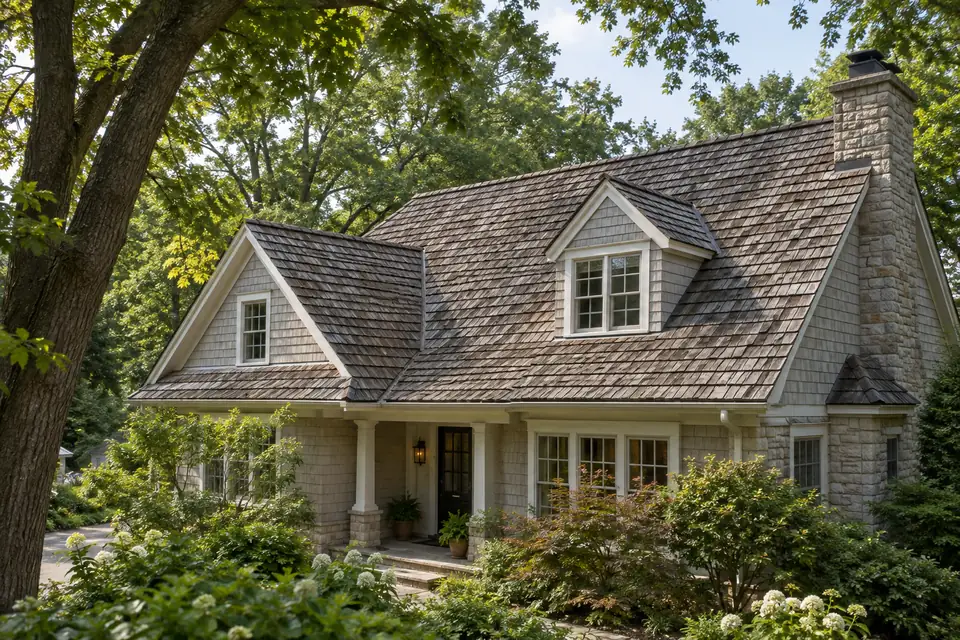
Most cedar shake roofs cost $15,800 to $30,000, with an average of about $21,000, according to HomeAdvisor's survey of its customers. Installed, shakes run $5.50 to $13.50 a square foot and sawn cedar shingles $4.50 to $9. A wood roof can last 30 years or more, but only with regular care, and it brings two questions an asphalt roof does not: how it is rated for fire, and how your insurer and your local code treat it.
Shakes and shingles are not the same product
Both are usually cut from western red cedar. The difference is how they are made:
| Wood shakes | Wood shingles | |
|---|---|---|
| How they are made | split from the block on at least one face, so the face is rough | sawn on both faces to an even taper |
| Thickness | thicker and heavier | thinner |
| Lengths (InterNACHI) | 18 and 24 inches | 16, 18 and 24 inches |
| Minimum roof slope (InterNACHI) | 4 in 12 | 3 in 12 |
| Felt between courses | used on many shake roofs | never |
| Wind certification InterNACHI cites | up to 245 mph | up to 173 mph |
| Installed cost per square foot (HomeAdvisor and Fixr) | $5.50 to $13.50 | $4.50 to $9 |
The felt detail matters when you compare estimates. InterNACHI, the home inspectors' association, explains that shakes are often laid with an 18-inch strip of 30-pound felt between courses, called interlayment, to stop wind-driven rain and snow. On a shingle roof the same felt is a defect: it slows drying and makes the shingles distort, decay and fail early. If an estimate for sawn shingles includes interlayment, ask why.
What a cedar roof costs
| Source | Typical total | Average | Per square foot |
|---|---|---|---|
| HomeAdvisor, updated June 17, 2026 | $15,800 to $30,000; from $9,001 to $52,500 at the extremes | about $21,000 | shakes $5.50 to $13.50 installed; shingles $4.50 to $9 |
| Fixr, updated January 31, 2025 | $11,000 to $17,500 for a 1,500-square-foot roof | $14,250 | cedar material $3.50 to $8.50, plus $2 to $5 labor |
HomeAdvisor's figures come from what its customers reported paying on jobs of every size; Fixr prices one roof size. The two sites give the same installed ranges for shakes and for shingles.
What moves the price:
- Labor. HomeAdvisor puts it at 50% to 60% of the total. Wood is laid piece by piece.
- Grade. HomeAdvisor says common-grade shakes cost up to 30% less than higher grades. Its three grades: common, lasting about 20 to 30 years; select, about 80% straight grain and 20% common, lasting 30 to 50 years; and all straight grain, lasting up to 60 years.
- How the shake is cut. Fixr gives $3.50 to $6.50 a square foot for hand-split shakes and $4.50 to $8.50 for tapersawn, material only.
- Treatment. Fire-retardant and preservative treatments add cost; see below.
To compare estimates, divide each total by the squares it covers (a square is 100 square feet). Our roof replacement cost guide shows how to measure your roof.
How long a wood roof lasts
The estimates vary with the wood, the grade and above all the climate:
- InterNACHI's life expectancy chart: 25 years for wood roofs.
- The Cedar Shake & Shingle Bureau, the cedar industry's trade group: about 30 to 40 years on average, and longer for preservative-treated products.
- HomeAdvisor: up to 60 years for a well-kept roof of the best grade.
- Fixr: 50 years or more with proper care, but only 20 to 30 years in very wet climates.
A wood roof's enemy is moisture. The roof lasts longest where it dries quickly after rain, in sun and moving air, and fails soonest under shade and debris.
Maintenance a wood roof needs
InterNACHI and the Insurance Institute for Business & Home Safety (IBHS) agree on the basics:
- Keep it clear. Leaves, needles and branches hold moisture against the wood and encourage rot. Clean the roof surface, gutters and downspouts regularly.
- Trim back trees. Shade slows drying and overhanging branches drop debris.
- Watch for moss, lichen and algae. They grow on damp wood roofs and make them slippery; stay off a mossy roof.
- Do not power-wash. IBHS warns it damages wood roofing.
- Be careful with chemicals. InterNACHI notes that the wrong cleaner can stain the roof and harm the plants below it.
- Replace rotted pieces. InterNACHI says shakes or shingles with visible decay should be replaced. The caps along the ridge and hips usually wear first.
- Reapply surface treatments. Fixr says treatments need reapplying every one to three years and puts fire-retardant application at $200 to $1,000.
Repairs. HomeAdvisor's average wood shake repair is $750. Our roof repair cost guide compares repairs across materials.
Fire ratings and treatments
Roof coverings are rated Class A (the most fire-resistant), B or C under the ASTM E108 or UL 790 fire tests. IBHS says untreated wood shakes and shingles are unrated: they do not reach even Class C.
Treated wood can be rated. The Cedar Shake & Shingle Bureau describes the process:
- Pressure-impregnated fire retardant. The retardant is forced into the wood at the factory and fixed by kiln drying. The Bureau says treated wood is fire-tested after weathering cycles of up to 10 years.
- Labels by class. Class B treated products carry a red label and Class C a blue one. A treated shake alone does not reach Class A; the Bureau says Class A takes a system, a Class B shake or shingle over specified underlayment or other layers beneath it.
- Fire retardant or preservative, not both. A piece is treated against fire or against rot. The Bureau notes its fire-treated products also resist moss and mildew.
- Surface coatings are different. A spray-on coating is not the same as a factory pressure treatment. Ask for the label and the tested class of the exact product and assembly in writing.
Local codes may set a minimum fire class for roofs, especially where wildfire is a risk. Check your state's and your city's rules, and ask the roofer to show that the product and assembly meet them.
Insurance and wildfire
Triple-I, the insurance industry's information group, says a roof's material is one of the things insurers weigh when they assess a home's risk. A wood roof's fire rating can therefore affect whether an insurer will write a policy and what it costs. How much depends on your insurer and where you live.
Wildfire programs are stricter than the fire tests. IBHS's Wildfire Prepared Home standard, which some insurers recognize, requires a Class A roof and does not accept wood shakes, wood shingles or any wood roof covering, whatever its test rating, because of uncertainty about how long fire treatments last. The program says any insurance discount for its designation is not guaranteed and varies by insurer and state.
Before you choose wood, ask your insurer:
- whether it will insure a wood roof at your address, and at what premium compared with a Class A roof;
- whether a treated, Class A-rated assembly changes that;
- what documents it wants, such as the treatment label and the fire classification.
This is general information, not insurance advice; your policy and your insurer decide. Our guide to roof age and home insurance covers how insurers treat older roofs.
Frequently asked questions
Are cedar shakes or cedar shingles cheaper?
Shingles usually are. HomeAdvisor and Fixr both put sawn cedar shingles at $4.50 to $9 a square foot installed and shakes at $5.50 to $13.50.
How long does a cedar shake roof last?
Estimates range from 25 years on InterNACHI's chart to 30 to 40 years from the Cedar Shake & Shingle Bureau and up to 60 years for top grades from HomeAdvisor. A wet, shaded roof lasts the least.
Are cedar shake roofs fire-resistant?
Not untreated: IBHS says untreated wood is unrated. Pressure-treated wood can be rated Class B or C, and Class A as part of a tested assembly.
Will a wood roof raise my insurance?
It may. Roof material is one factor insurers weigh, and wood's fire risk matters most where wildfire is a threat. Ask your insurer for a price on both a wood roof and a Class A roof before you decide.
What maintenance does a cedar roof need?
Keep it free of leaves and debris, trim overhanging trees, clean gutters, deal with moss without power-washing, and replace rotted pieces. Surface treatments need reapplying every one to three years, according to Fixr.
How we got these numbers
HomeAnvil does not yet publish price data of its own. Every figure on this page comes from a published source, read on September 26, 2026:
- HomeAdvisor, cedar shake roof cost, updated June 17, 2026: the typical, average and extreme totals, shake and shingle prices per square foot, labor share, grades and their lifespans. HomeAdvisor says its figures come from a survey of its customers and other published research.
- HomeAdvisor, roof repair cost, updated June 19, 2026: the average wood shake repair.
- Fixr, wood shake roof installation cost, updated January 31, 2025: its totals, material and labor prices, hand-split and tapersawn prices, fire-retardant treatment, reapplication and lifespan.
- InterNACHI, Mastering Roof Inspections: Wood Shakes and Shingles, part 1, part 3 and part 6: how shakes and shingles differ, lengths, wind certifications, slopes, interlayment, debris, moss and decay.
- InterNACHI, standard estimated life expectancy chart: wood roof life.
- IBHS, roof guide: cedar shingles and shakes: fire classes, untreated wood being unrated, and maintenance.
- IBHS, 2025 Wildfire Prepared Home technical standard and the program's frequently asked questions: the Class A roof requirement, the exclusion of wood roofs and the note on insurance discounts.
- Cedar Shake & Shingle Bureau, pressure-impregnated treated products and product FAQ: treatments, labels, how Class A is reached, and average life. This is the cedar industry's trade group.
- Triple-I, how your roof influences your home and business insurance: roof material as an underwriting factor.
We will update this page when these sources publish new figures, and the date above will say when.
Related guides
 Types of roofing materials, and how they compareRoofing materials compared: asphalt costs $3 to $7 a square foot installed and lasts 20 to 30 years; slate $15 to $30 and 60 to 150 years.
 How does your roof's age affect your homeowners insurance?Many insurers inspect or decline roofs over 20 years old, and older roofs are often paid at depreciated value. What to check in your policy and at renewal.
 How long does a roof last?Architectural shingles last about 30 years, 3-tab about 20, metal 40 to 80, slate 60 to 150. What shortens a roof's life, and why a warranty isn't a lifespan.
 How much does a roof repair cost?Most roof repairs cost $395 to $1,967, about $1,173 on average. Prices by problem: shingles, flashing, leaks, decking, vents, fascia and sagging.
 How much does a roof replacement cost?A roof replacement typically costs $5,900 to $13,400, or $400 to $1,100 per square installed. How to measure your roof, what moves the price and how to compare estimates.
 How much does a slate roof cost?A slate roof typically costs $4,389 to $22,377, and natural slate $20 to $30 a square foot installed. Lifespan by grade, weight, and repair vs replace.